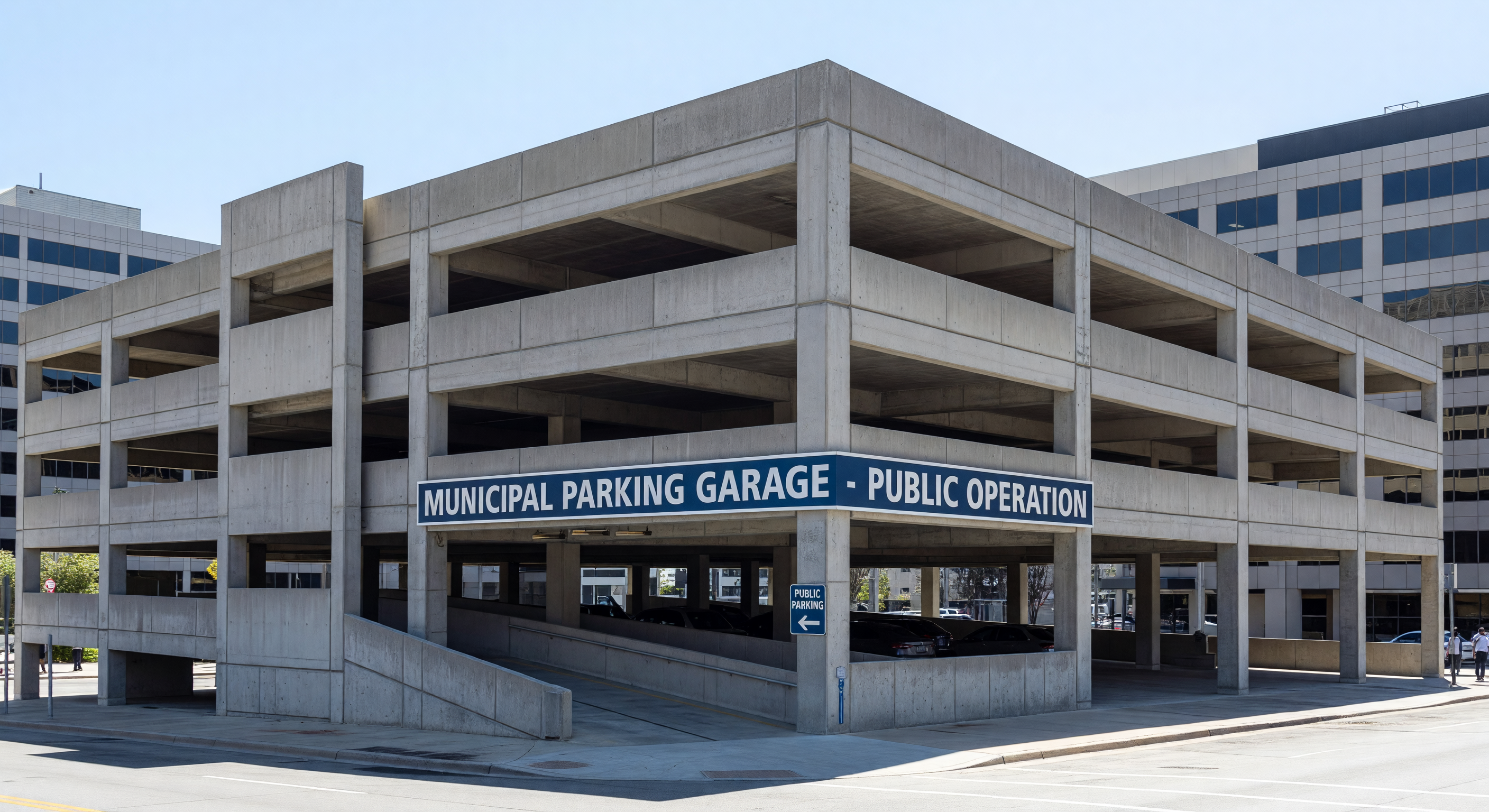
Chicago’s 2008 long-term lease of its parking meter system is the case that shaped the conversation for a generation. It is also not representative of what most public-private parking partnerships actually look like. The field has matured substantially since, and the accumulated experience now supports a clearer taxonomy of structures and their tradeoffs.
The Structural Menu
Parking asset partnerships fall into roughly four structural families, with meaningful variation within each.
Management contracts. The public entity retains ownership and economic risk. A private operator runs the facility for a fee, commonly with performance incentives. Short term (3 to 10 years), low complexity, limited upfront payment. This is by far the most common structure, used by a large majority of publicly owned garages.
Revenue-share concessions. The public entity retains ownership; the concessionaire pays a minimum annual fee plus a share of revenue above thresholds. Medium term (10 to 20 years). Produces modest upfront consideration and shifts some operational risk to the concessionaire. Common for downtown garage portfolios and university systems.
Long-term concessions / leases. The public entity retains ownership but transfers economic rights for an extended period (50 to 99 years) in exchange for a large upfront payment. The Chicago meter deal and several downtown garage leases (Indianapolis, Harrisburg, Pittsburgh attempts) fall into this category.
Design-build-finance-operate-maintain (DBFOM). Applied to new-build facilities rather than existing assets. The private partner designs, finances, builds, and operates the facility in exchange for availability payments or direct revenue rights. Common in airport and university contexts.
Each structure distributes operational risk, capital risk, and political risk differently, and the choice among them depends on which risks the public entity actually wants to transfer.
What the Long-Term Concessions Taught
The first wave of long-term parking concessions produced several lessons that are now reasonably well accepted.
Rate covenants are the central issue. Nearly every long-term parking concession has been politically strained by rate-escalation provisions. Rate schedules that seemed reasonable at signing produced politically untenable rates a decade later. Structures that allowed public entities to modify rates without concessionaire consent, or that tied rates to external indices with public override rights, have fared better than pure contractual rate schedules.
Demand risk allocation matters. Concessions that transferred most demand risk to the private partner priced that risk into lower upfront payments. Concessions that retained demand risk publicly produced larger upfront consideration but left the public entity exposed to ride-hail and remote-work erosion.
Termination provisions are essential. Early long-term deals had limited or extremely expensive termination options. The next generation has built in more flexibility, including buyback provisions triggered by specified conditions and more favorable default remedies.
Transparency reduces political risk. Concessions negotiated with detailed public disclosure have been more durable than those negotiated largely in closed session. The latter tend to attract sustained opposition that erodes political support for the operating arrangement, even when the underlying economics are reasonable.
The Government Finance Officers Association and the National Council for Public-Private Partnerships have published guidance reflecting these lessons.
Where Each Structure Fits
Practical experience supports a rough matching between structure and situation.
Management contracts suit public entities with stable assets and capacity to retain risk in exchange for full optionality. They are rarely wrong; they sometimes leave value on the table.
Revenue-share concessions fit portfolios where the public entity has identified specific operational inefficiencies a private partner could address, wants some risk transfer, but is not trying to monetize the asset in a single transaction.
Long-term concessions fit situations where the public entity has a specific, large, one-time capital need and accepts the tradeoff of reduced long-term flexibility. The list of situations meeting that test is shorter than the early wave of deals suggested.
DBFOM fits new capacity needs where the public entity wants to transfer construction risk and finance risk simultaneously, typically where user charges rather than tax revenue will service the facility.
The Decision Variables
Decision-makers evaluating a potential partnership can benefit from working through a consistent set of questions before engaging advisors or market participants.
- What risks does the public entity actually want to transfer, and at what price?
- What is the expected demand trajectory over the concession term, including mode-shift risk?
- What rate-setting flexibility does the public entity need to preserve?
- How will the monetization proceeds be used, and is that use worth the optionality sacrifice?
- What is the realistic termination and default path if the relationship goes wrong?
Partnerships that have answered these questions honestly before going to market have generally worked. Partnerships that have answered them during structuring have generally worked less well.
FAQ
Are long-term parking concessions still being signed?
Yes, though less frequently and with materially tighter rate-setting and termination provisions than the first wave. Lessons from the 2008 to 2015 deals have substantially reshaped market practice.
What distinguishes a concession from a management contract?
A concession transfers some or all economic rights — typically revenue — to the private partner in exchange for ongoing payments or upfront consideration. A management contract pays the private operator a fee and leaves economic risk with the public entity.
Who bears demand risk?
It varies by structure. Most management contracts retain demand risk publicly. Revenue-share concessions typically split it, with a floor protecting the public entity. Long-term concessions have varied widely; the Chicago meter deal transferred most demand risk to the concessionaire, which proved advantageous during the post-2008 period.
Where are these deals publicly documented?
EMMA (the MSRB’s filing system), GFOA case studies, and the NCPPP project database together cover most substantial North American parking partnerships.