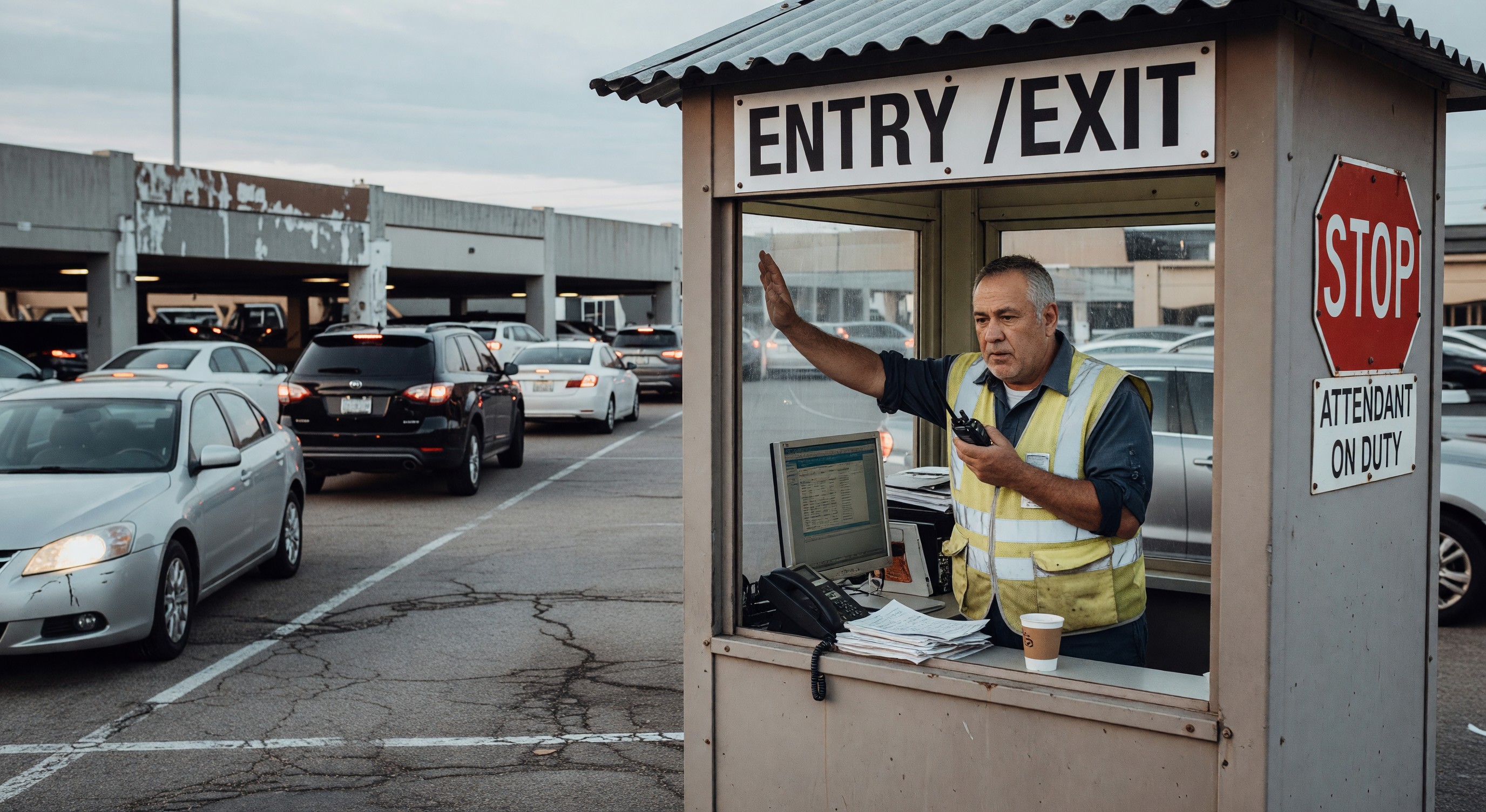
Staffing is the largest controllable cost in attended parking operations, typically representing 40 to 60 percent of total operating expense. Getting staffing ratios, scheduling, and training right directly determines both operational cost efficiency and customer service quality. Understaffing creates delays, customer complaints, and safety gaps; overstaffing wastes labor budget without corresponding quality improvement.
Attendant-to-Stall Ratios
There is no universal attendant-to-stall ratio — the appropriate ratio depends on the facility type, payment method, automation level, and peak demand pattern. That said, industry benchmarks provide planning starting points:
Fully attended cashier operations: One cashier per entry/exit lane for attended periods. A facility with 2 entry lanes and 2 exit lanes during peak periods requires minimum 4 cashier positions at any given moment. Roving attendants (who provide customer service, direct traffic, and handle payment exceptions) add additional positions: typically 1 roving per 250 to 300 active stalls is a planning standard.
Partially automated operations: Where pay stations or LPR handle most transactions, attendants shift from cashiers to customer service and exception-handling roles. One attendant per 500 to 750 stalls is typical for facilities with high automation rates.
Valet operations: More labor-intensive than self-park. One valet runner per 2 to 3 vehicles per hour is required at peak drop-off/retrieval periods. Valet manager plus runners plus cashiers means a peak valet operation for 200 vehicles can require 8 to 12 staff positions simultaneously.
The IPMI Parking Benchmarks report (published annually by the International Parking and Mobility Institute) provides peer comparison data for staffing ratios by facility type, which allows operators to benchmark against similar facilities.
Shift Scheduling
Parking demand is highly time-concentrated — morning ingress, lunchtime, and evening egress peaks are predictable in most facilities. Scheduling should match staff presence to demand rather than providing uniform coverage across the day.
Demand-based scheduling: Analyze hourly transaction volume for each day of the week using gate transaction reports from the PARCS system. Identify peak demand windows and staff accordingly. A facility with peak ingress 7:30 to 9:00 a.m. on weekdays needs more staffing during that window than during the 2:00 to 3:30 p.m. valley.
Shift structures: Common parking shift structures:
- Full-day split shift: 5:00 a.m. to 1:00 p.m. and 1:00 p.m. to 9:00 p.m.
- Peak-focused shifts: 6:00 to 10:00 a.m. (morning ingress); 3:00 to 7:00 p.m. (evening egress)
- Overnight shift: 10:00 p.m. to 6:00 a.m. for facilities requiring overnight presence
Part-time staffing for peak-only periods reduces labor cost while maintaining service quality during critical windows. Building a reliable part-time pool is operationally important — facilities that can’t reliably fill peak shifts compromise service quality on their busiest periods.
Event staffing: Event venues need event-specific staffing plans — additional attendants for ingress and egress around event times, with positions determined by expected vehicle volume and the duration of peak arrival/departure.
Onboarding and Training Program
Parking attendants interact with customers at the first and last moments of their experience. Training quality directly affects both customer satisfaction and incident management outcomes.
A structured onboarding program should cover:
Equipment operation: PARCS terminal operation, payment processing, ticket handling, gate malfunction response, intercoms, and emergency controls. Hands-on practice with actual equipment, not just observation.
Customer service standards: Greeting protocols, handling complaints and disputes, escalation procedures, and how to respond to common scenarios (lost tickets, validation questions, equipment malfunctions). Role-play exercises are more effective than lecture for service skills.
Safety procedures: Emergency evacuation, accident/incident reporting, severe weather response, and security observation. OSHA-required safety training for the specific work environment (traffic, exposure to vehicle exhaust, outdoor work in extreme weather).
ADA awareness: Staff should understand accessible parking requirements and be able to assist customers with disabilities appropriately.
Cash handling: For any staff handling cash transactions, training on proper cash handling procedures, counterfeit bill detection, and cash vault protocols.
Initial training for new attendants should run 2 to 4 days before solo shift assignment, with a designated experienced attendant as mentor for the first week of live shifts.
Retention and Career Development
Parking operations has historically high turnover rates — industry surveys suggest 40 to 70 percent annual turnover is common at the attendant level. High turnover is operationally expensive (recruiting, onboarding, training cost), and quality suffers during the time new hires are learning.
Retention strategies that have demonstrated effectiveness in the parking industry:
- Predictable scheduling that respects work-life balance
- Clear path from attendant to lead attendant to operations supervisor
- Training investment (IPMI CPP certification program for professional development)
- Competitive wages adjusted to local market (parking attendant wages must compete with retail, food service, and other service industry jobs)
- Recognition programs for safety, customer service, and attendance
Frequently Asked Questions
What is the standard attendant-to-stall ratio for an attended parking facility? For fully attended cashier operations, staffing is driven by lane count during attended periods. For mixed attended/automated facilities, 1 roving attendant per 250 to 300 active stalls is a planning benchmark. Valet operations require significantly more staff: approximately 1 runner per 2 to 3 vehicles per hour at peak.
How should parking shifts be scheduled? Use hourly transaction volume data from the PARCS system to identify peak demand periods and schedule accordingly. Demand-based scheduling reduces labor cost compared to uniform coverage. Part-time shift structures for peak-only periods (morning ingress, evening egress) are commonly used in commercial and office parking.
How long should new attendant training last? Minimum 2 to 4 days of structured onboarding covering equipment operation, customer service, safety, and cash handling before solo assignment. A mentor relationship with an experienced attendant for the first week of live shifts improves new hire performance and reduces error rates.
What causes high turnover in parking operations and how can it be reduced? Unpredictable scheduling, low wages relative to competing service industries, limited career development opportunities, and exposure to difficult outdoor working conditions drive turnover. Predictable scheduling, market-competitive wages, clear promotion paths, and investment in professional development (IPMI certification) address the primary turnover drivers.
Takeaway
Parking staffing is both a cost management challenge and a customer experience investment. Demand-based scheduling, appropriate automation to reduce cashier requirements, structured training programs, and retention-focused HR practices produce operations that are both efficient and high-quality. The facilities that consistently outperform peers on customer satisfaction scores are those that treat their attendant staff as professionals with career potential, not interchangeable labor.
Further Reading from Authoritative Sources
- IPMI Certified Parking Professional program and staffing development resources — IPMI is explicitly cited twice in this article as the source of staffing benchmark data and as the provider of the CPP certification program that is the industry’s primary professional development pathway for parking staff.
- ITE parking operations technical resources including workforce management — ITE’s parking operations resources provide the technical framework for demand-based staffing analysis and facility design decisions — such as lane configuration and automation level — that directly determine staffing requirements in the operational models described in this article.