Parking operations training is an investment with measurable returns: reduced incident rates, lower customer complaint volumes, shorter equipment failure response times, and lower staff turnover among employees who feel competent and valued in their role. Yet parking has historically underinvested in training relative to hospitality and retail — industries that face similar service quality challenges with large, distributed workforces.
New Hire Onboarding Framework
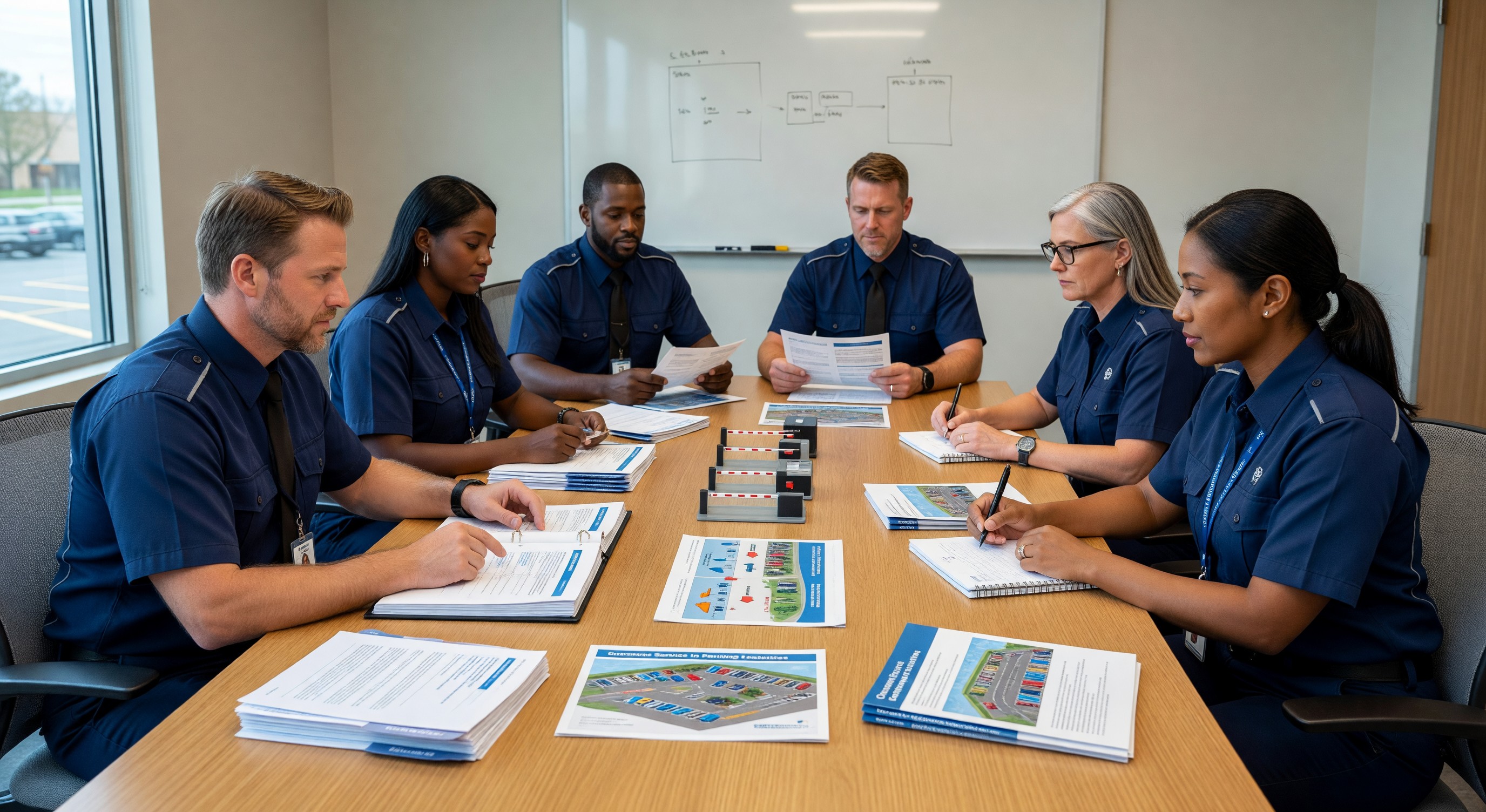
A structured onboarding program for new parking staff covers four core areas before the employee handles a shift independently:
Equipment operation training: PARCS terminal operation, payment processing for each accepted tender type (cash, credit, mobile payment, validation), ticket handling and verification, gate control, intercom use, and equipment malfunction response. Training should be hands-on with actual equipment, not just observation. Minimum: 4 hours of supervised equipment operation before solo assignment.
Customer service standards: The facility’s specific greeting and service standards, complaint handling procedures (including how to de-escalate difficult customer interactions), escalation protocols for issues beyond the staff member’s authority, and accessible parking service requirements for customers with disabilities. Role-play exercises are more effective than lecture for service skill development.
Safety and emergency procedures: OSHA-required safety training for the work environment (traffic management, vehicle exhaust exposure, outdoor work safety), emergency evacuation procedures, medical emergency response (including AED location and basic first aid if applicable), fire procedures, and how to call for assistance. Documentation: training log signed by the employee and trainer.
Revenue control and cash handling: Starting bank procedures, vault drop protocols, shift reconciliation, counterfeit detection, and the documentation chain of custody. Any staff handling cash must complete this module before first cash-handling shift.
Shadowing requirement: New hires should shadow an experienced employee for at least one full shift before solo assignment, after completing the structured training modules. The experienced employee serves as mentor and evaluator.
IPMI Certification Programs
The International Parking and Mobility Institute (IPMI) offers professional development certifications that provide a nationally recognized credential framework for parking staff:
Certified Parking Professional (CPP): The primary credential for parking professionals with management experience. Requires demonstrated work experience (minimum 2 years), education criteria, and passing an examination covering parking operations, finance, design, technology, and law. CPP is the industry standard for senior operator and management roles.
Certified Parking & Mobility Professional (CAPP): Successor credential to the CPP, reflecting the industry’s expanded scope into mobility. Same examination-based qualification with updated content.
Fundamentals of Parking and Mobility (FPM): An entry-level credential accessible to newer professionals. Completion of the self-paced online program and examination provides a foundation credential appropriate for attendants and entry-level operations roles.
IPMI training modules: IPMI offers topic-specific online training modules covering revenue management, customer service, ADA compliance, technology, and other operational topics. These modules are appropriate for ongoing professional development and can be completed by individuals or assigned to teams.
Employers who support employee IPMI certification see measurable retention benefits — certified employees have invested in their own professional development and are more likely to see parking as a career rather than a job.
Safety Training Requirements
OSHA requirements applicable to parking operations vary by state and jurisdiction but commonly include:
Hazard Communication (HazCom): Employees who handle cleaning chemicals, de-icing agents, or other hazardous materials must receive HazCom training covering the Globally Harmonized System of Classification and Labeling (GHS). Safety Data Sheets must be accessible to all employees.
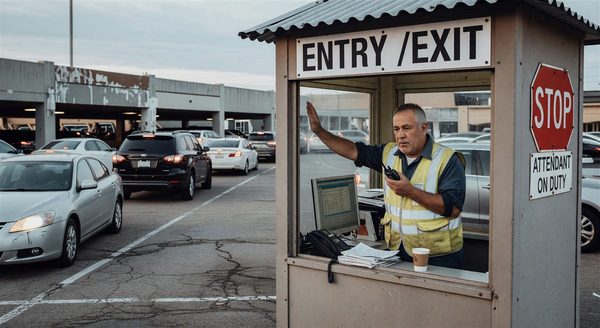
Personal Protective Equipment (PPE): High-visibility vests (ANSI/ISEA 107 Class 2 or 3) are required for employees working in or near active traffic lanes. Training on proper PPE use and maintenance is an OSHA requirement where PPE is required for the work.
Emergency action plan training: OSHA requires employers to train employees on their emergency action plan, including evacuation procedures and roles in emergency response.
Bloodborne pathogens: Staff who may have occupational exposure to blood or other potentially infectious materials require annual bloodborne pathogens training (29 CFR 1910.1030).
State and local requirements may add additional training obligations — OSHA state plan states often have requirements exceeding federal OSHA minimums.
Measuring Training Effectiveness
Training investment should be measured against outcomes:
Post-training assessment: Knowledge checks immediately following each training module confirm that content was absorbed. Practical skills assessments (timed transaction processing, equipment malfunction response drills) evaluate operational competency.
Performance during probationary period: Tracking the frequency of errors, customer complaints, and supervisor interventions during the first 90 days identifies training gaps that require remediation.
Incident rate correlation: Tracking safety incidents and customer complaints over time against the training program investment reveals whether training improvements correlate with reduced incident rates.
Turnover measurement: Training investment correlates with retention — employees who feel adequately trained are less likely to leave within the first 6 months (the highest-cost turnover window). Tracking 90-day turnover before and after training program improvements reveals whether the investment reduces early attrition.
Frequently Asked Questions
What training must new parking attendants complete before working solo? Equipment operation (minimum 4 hours hands-on), customer service standards and procedures, safety and emergency procedures, cash handling if applicable, and at least one supervised shadow shift with an experienced employee. Documentation of all completed training should be retained in the employee file.
What is the IPMI Certified Parking Professional (CPP) credential? The CPP is the primary professional certification for experienced parking professionals, issued by the International Parking and Mobility Institute. It requires a minimum of 2 years of experience, meeting education criteria, and passing a comprehensive examination covering parking operations, finance, design, technology, and law.
What OSHA training is required for parking attendants? Core requirements include Hazard Communication training for employees handling chemicals, PPE training for employees working near traffic, emergency action plan training, and bloodborne pathogens training where applicable. State OSHA plan requirements may exceed federal minimums.
How can training effectiveness be measured? Post-training knowledge assessments, practical skills evaluations, performance tracking during probationary periods, safety incident rate monitoring, customer complaint volume, and 90-day turnover rates all provide evidence of training program effectiveness.
Takeaway
Parking staff training is a strategic investment in operational quality, safety performance, and employee retention. A structured onboarding program that covers equipment, customer service, safety, and revenue control — combined with ongoing professional development through IPMI certification and topic-specific modules — produces staff who are both more competent and more committed to the operation. The facilities that consistently outperform on customer satisfaction and incident metrics are those that treat training as an ongoing operational priority rather than a one-time compliance exercise.
Further Reading from Authoritative Sources
- IPMI CPP and CAPP certification programs and parking training resources — IPMI is explicitly identified in the article as the certifying body for CPP, CAPP, and FPM credentials and the provider of topic-specific training modules.
- ADA accessible parking service training requirements for parking staff — ADA.gov is the authoritative federal source for the ADA service requirements that parking staff must understand when serving customers with disabilities, including accessible space policies, complaint handling, and accommodation obligations.