Revenue management — the practice of adjusting prices in real time or near-real time based on demand conditions — is well established in airlines and hotels. Its application to parking has accelerated since the early 2010s, driven by SFpark (San Francisco) and LA Express Park demonstrations that showed meaningful revenue and efficiency improvements from demand-responsive pricing. Understanding the principles, tools, and limitations of parking revenue management enables operators to move beyond fixed-rate pricing toward revenue optimization without the operational complexity that deters many operators.
The Revenue Management Principle
The core insight of revenue management is that a fixed price at all times leaves money on the table in two ways: when demand exceeds supply, fixed prices leave revenue uncaptured (consumers would have paid more); when supply exceeds demand, fixed prices leave stalls empty (consumers who would have parked at a lower price did not).
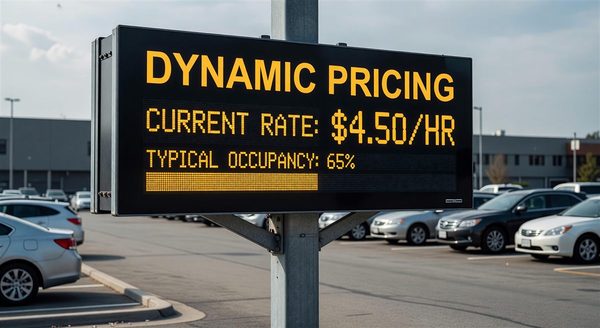
Applied to parking: a facility that charges $20 per day whether it’s 30 percent or 95 percent occupied is underpricing peak demand and overpricing low-demand periods. Dynamic pricing — lower rates when occupancy is low, higher rates when occupancy approaches capacity — theoretically achieves a closer match between price and demand, improving revenue realization and distributing demand more evenly across the day.
The SFpark demonstration (2011 to 2013), which implemented sensor-based occupancy monitoring and regular price adjustments on San Francisco’s metered street network, found that dynamic pricing reduced both cruising (driving in search of parking) and time spent searching, while increasing revenue on some corridors and reducing it on others — with an average reduction in cruising time of 50 percent in pilot areas.
Dynamic Pricing Models
Time-of-day pricing: The simplest implementation. Define peak periods (based on historical occupancy data) and apply higher rates during those periods. Off-peak periods receive lower rates. No real-time feedback loop — rates are set in advance and don’t respond to actual daily occupancy. Easy to implement with any PARCS system; appropriate for facilities with predictable, consistent demand patterns.
Day-of-week pricing: Rates vary by day based on demand patterns. A medical campus facility might charge higher Monday through Friday and offer weekend discounts. Event venue facilities charge event premiums. Again, rates are pre-set rather than real-time.
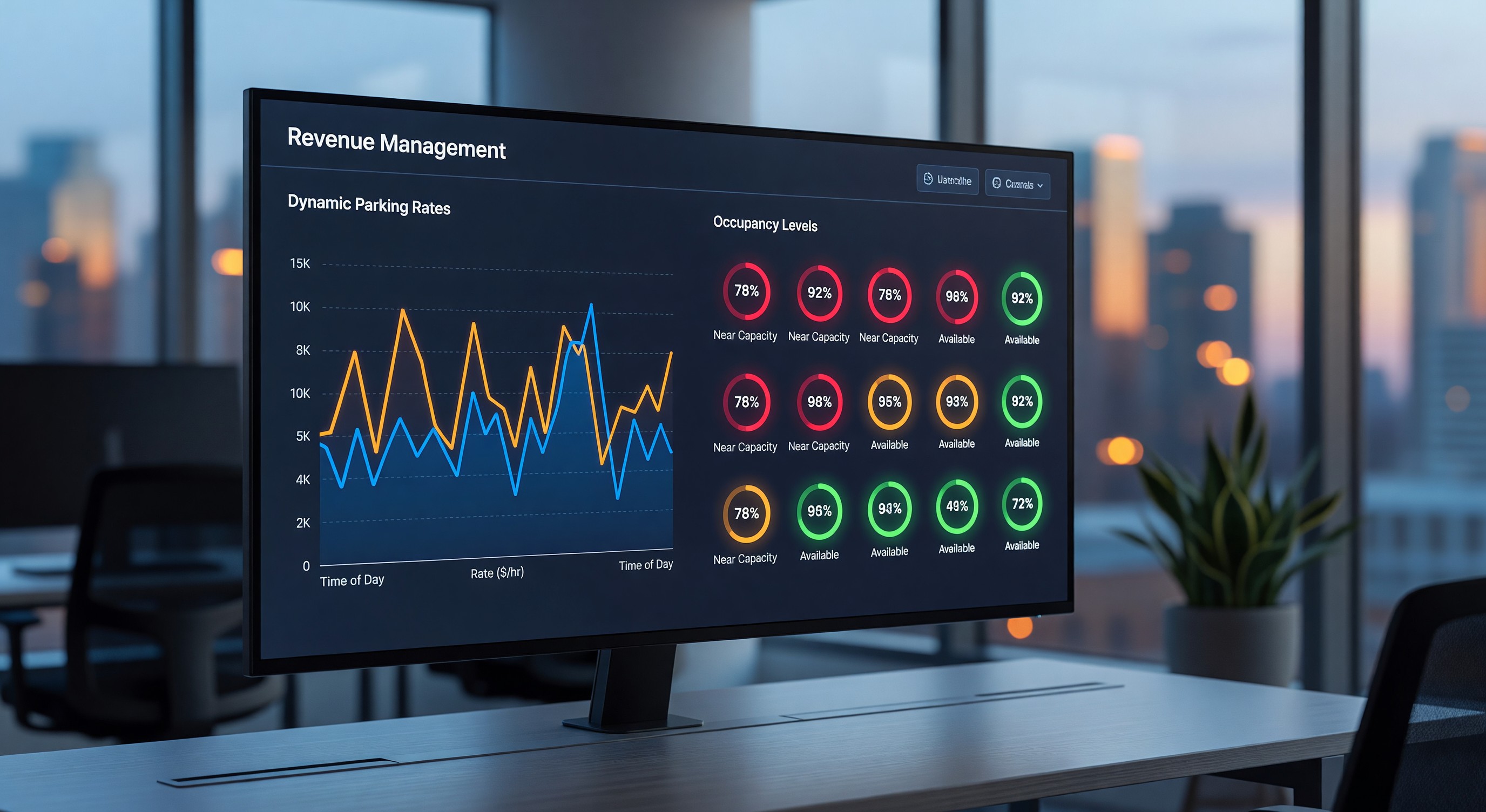
Demand-responsive (algorithmic) pricing: Rates adjust based on real-time or near-real-time occupancy feedback. The algorithm increases rates as occupancy approaches a threshold (commonly 85 to 90 percent) and decreases rates when occupancy is below target. Implementation requires occupancy sensing (entry/exit counts, in-stall sensors, or LPR-based occupancy estimates) and a PARCS system capable of receiving and displaying dynamic rates.
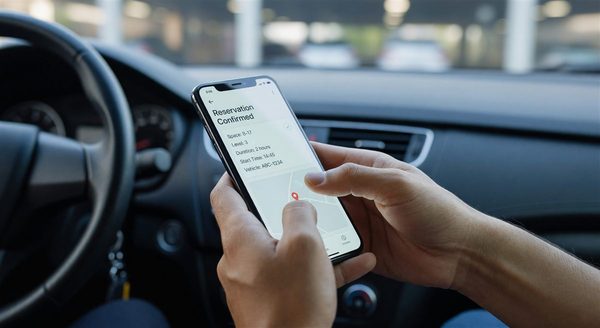
Advance reservation pricing: Different prices for the same stall depending on how far in advance the parking is reserved. Guaranteed advance reservations at a premium price give demand-sensitive customers price certainty; walk-up transient parkers accept rate variability. This is the model used by SpotHero, ParkWhiz, and similar parking marketplace platforms.
Yield Optimization Strategies
Yield optimization — maximizing total revenue from a fixed inventory — extends beyond rate-setting:
Stall type mix optimization: In facilities with multiple rate zones (premium close, standard, economy distant), the allocation of stall inventory between zones affects revenue. If premium stalls are consistently undersold while standard stalls overflow, rebalancing the inventory or adjusting the price differential improves revenue.
Monthly vs. transient mix: Allocating more stalls to transient parking during high-demand periods (event days, seasonal peaks) at the expense of monthly availability may increase revenue if transient rates are high enough. Dynamic monthly-transient allocation is complex operationally but used by some sophisticated operators.
Duration pricing: Charging progressively higher rates for longer stays incentivizes shorter dwell times, which increases turnover and allows the same stall to serve more customers per day. Progressive hourly pricing (first hour $3, second hour $5, third hour $8) works well in high-turnover retail and short-term commercial parking.
Advance purchase discounts: Pre-selling stalls through reservation platforms at a discount to the expected day-of rate fills capacity with demand-sensitive customers while premium-demand customers pay full walk-up rates.
Implementation Requirements
Dynamic pricing requires infrastructure that many facilities lack:
- Real-time occupancy data: Entry/exit count feeds or in-stall sensor data providing current occupancy
- PARCS integration for variable rate display: Digital pay stations and variable message signs that can display the current rate
- Consumer-facing rate communication: Posted rates must be accurate and visible before the customer commits to parking; real-time rates must be communicated at the facility entrance and on any pre-arrival digital channel
For simple time-of-day or day-of-week pricing, standard PARCS systems support rate schedules without additional infrastructure. For fully dynamic algorithm-based pricing, platform integration (CurbIQ, Passport, IPS parking systems, or operator-specific platforms) is required.
Pricing Communication and Consumer Acceptance
Effective revenue management requires transparent pricing communication. Consumers accept variable pricing more readily when:
- Rates are visible before commitment (at facility entrance, not at payment)
- The rate logic is understandable (peak hours clearly defined; event pricing disclosed in advance)
- The range of rates is within perceived reasonableness (8× price variation is less acceptable than 2× to 3× variation)
Opaque or surprise pricing at the exit — where the consumer learns the actual charge after parking — generates complaints regardless of whether the rate was communicated at entry. Ensure rate display is accurate and prominent at every decision point.
Frequently Asked Questions
What is dynamic parking pricing and how does it differ from fixed pricing? Dynamic pricing adjusts parking rates in response to demand conditions — higher prices when demand is high and space is limited; lower prices when demand is low and stalls are available. Fixed pricing sets a single rate regardless of demand levels, which underprices peak demand and overprices low-demand periods.
What occupancy rate should trigger a price increase in a dynamic pricing system? Most dynamic pricing systems set a trigger threshold of 85 to 90 percent occupancy. Above this level, prices increase incrementally. Below this level, prices decrease. The exact threshold and adjustment magnitude are calibrated based on the demand elasticity of the specific facility’s customer base.
What infrastructure is needed to implement dynamic parking pricing? Time-of-day and day-of-week pricing require only standard PARCS rate schedule configurations. Fully dynamic algorithm-based pricing requires real-time occupancy data (entry/exit counts or sensor feeds), PARCS integration for variable rate display at terminals, and consumer-facing rate communication on VMS signs or digital channels.
Does dynamic pricing always increase revenue? Not necessarily. If the demand response (customers who leave or don’t come because of higher prices) is large relative to the rate increase, revenue can decline. Pilot testing with careful measurement of volume and revenue changes is essential before full implementation. The SFpark demonstration found revenue improved on some corridors and declined on others.
Takeaway
Parking revenue management is a spectrum from simple time-of-day pricing to sophisticated real-time algorithmic systems. Even basic demand-based pricing — differentiated rates by peak/off-peak periods and day of week — typically improves revenue realization without requiring complex technology infrastructure. The facilities that achieve the highest revenue per stall are those that systematically match rates to demand conditions, communicate pricing transparently, and adjust rate strategies based on measured performance data. Revenue management is not a technology purchase — it is an operational discipline that technology enables.
Further Reading from Authoritative Sources
- FHWA value pricing and demand-responsive parking rate guidance — FHWA administers the federal Value Pricing Pilot Program and publishes technical guidance on demand-responsive pricing for parking and transportation that directly supports the dynamic pricing framework in this article.
- IPMI revenue management and dynamic pricing resources for parking operators — IPMI publishes revenue management guidance, dynamic pricing case studies, and yield optimization best practices specifically for parking operations.