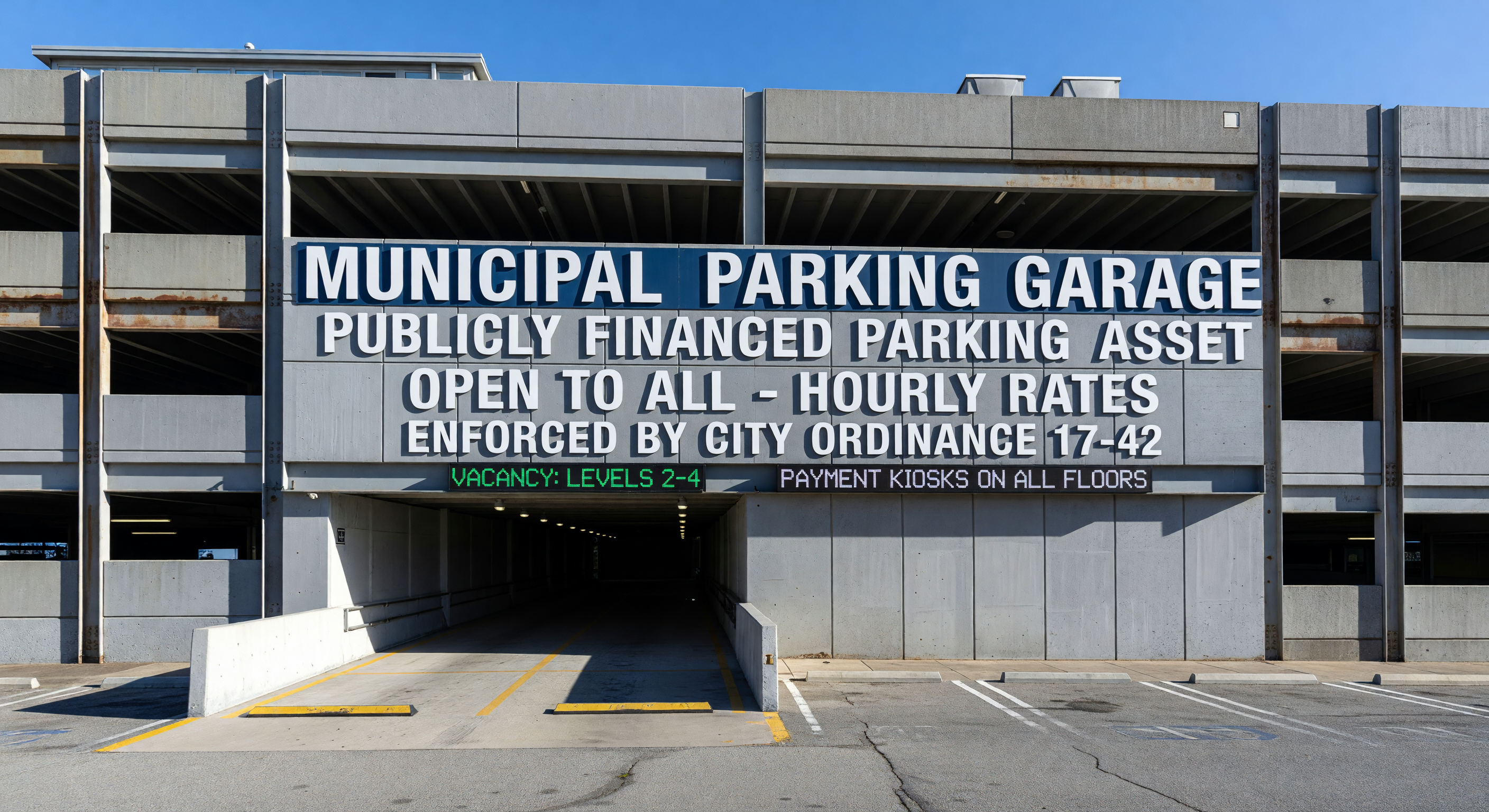
Most large parking garages on balance sheets that are not privately owned were built with revenue bonds. The structure matters to operators well beyond the capital stack: bond covenants shape rate-setting, maintenance reserves, reporting obligations, and sometimes even technology choices, years after the debt was issued.
The Basic Structure
A parking revenue bond is a tax-exempt (or occasionally taxable) municipal bond whose debt service is secured by the net revenues of a specific parking asset or parking system. Unlike a general obligation bond, it is not backed by the issuer’s full faith and credit. Bondholders are repaid from meter revenue, garage collections, permit fees, and ancillary income after operating expenses.
Typical features include:
- Tenor: 20 to 30 years, matched to expected useful life of the asset
- Debt service coverage ratio (DSCR) covenant: commonly 1.25x to 1.50x net revenues to annual debt service
- Debt service reserve fund: typically equal to maximum annual debt service
- Rate covenant: an obligation to set rates sufficient to meet DSCR, which has operational consequences we return to below
- Flow of funds: a waterfall directing revenue first to operations, then debt service, then reserves, then surplus
The Government Finance Officers Association and the Municipal Securities Rulemaking Board publish reference materials on enterprise revenue bond structure that describe these features in detail.
Where Risk Concentrates
Credit rating agencies evaluating parking revenue bonds focus on a predictable set of risk factors. The accumulated rating reports — Moody’s, S&P, and Fitch have all published methodology documents on parking enterprises — surface the factors that have driven downgrades and defaults.
Demand volatility. Parking demand is procyclical with retail, office, event, and travel demand. Facilities serving a single anchor use (a single stadium, a single hospital, a single office district) carry concentration risk. Systems with diversified demand across downtown retail, office, residential, and event uses are rated materially higher.
Technology and mode-shift risk. Long-dated parking bonds now carry explicit language on ride-hailing, autonomous vehicle, and remote-work risk in offering documents. Rating agencies have become more explicit about projecting demand erosion over 20- to 30-year horizons.
Political rate-setting risk. Rate covenants create a legal obligation to raise rates if DSCR is at risk. In practice, issuers have sometimes been reluctant to do so, and rating agencies now scrutinize the independence of rate-setting authority. Systems where rates are set by elected bodies carry a different risk profile than systems where rates are set by an appointed authority or by covenant-driven formula.
Capital reinvestment. Parking assets are concrete and steel. They have substantial periodic capital needs — waterproofing, structural repair, equipment replacement — that are frequently underfunded in early years. Bondholders increasingly demand funded capital repair reserves in addition to debt service reserves.
Operational Consequences
For operators working inside a bond-financed system, the covenants shape day-to-day decisions in ways that are easy to miss.
Rate-setting is not purely a market exercise. A facility approaching its DSCR floor may be covenant-obligated to raise rates, even if elasticity analysis would recommend holding them. Conversely, large rate reductions — sometimes desired for equity or economic development reasons — may require bondholder consent or defeasance.
Capital project timing is often driven by reserve fund balances and additional bonds tests rather than by pure engineering priority. A facility that needs a new payment system may wait for a refunding window rather than draw down operating cash.
Reporting obligations — continuing disclosure under SEC Rule 15c2-12, annual financials, event notices — require a level of financial hygiene that purely private operators rarely match. The Electronic Municipal Market Access (EMMA) system makes these filings publicly searchable and is a useful research tool for operators benchmarking peer systems.
The Refunding Calendar
Much of the visible activity in the parking revenue bond market is refunding — refinancing existing bonds at lower rates or to modify covenants. Operators who understand their issuer’s refunding calendar can align capital projects and rate-setting decisions with windows of covenant flexibility. Operators who do not often find themselves constrained by covenants they did not realize were binding.
FAQ
How does a parking revenue bond differ from a general obligation bond?
A revenue bond is repaid only from the net revenues of the parking asset or system; a GO bond is backed by the issuer’s full taxing authority. Revenue bonds typically carry higher yields because of the narrower security.
What is a rate covenant and why does it matter operationally?
A rate covenant is a legal promise to set parking rates at levels sufficient to maintain a specified debt service coverage ratio. It can force rate increases even when operators would prefer to hold rates for demand or equity reasons.
Are parking revenue bonds still getting issued given mode-shift concerns?
Yes, but underwriting has tightened. Rating agencies scrutinize ride-hail, AV, and remote-work exposure more explicitly, and more deals include robust capital reserves and demand-scenario stress tests than was typical a decade ago.
Where can operators research peer system financial performance?
The MSRB’s EMMA system publishes continuing disclosure filings for nearly all outstanding municipal revenue bonds, including detailed operating data on parking enterprises.