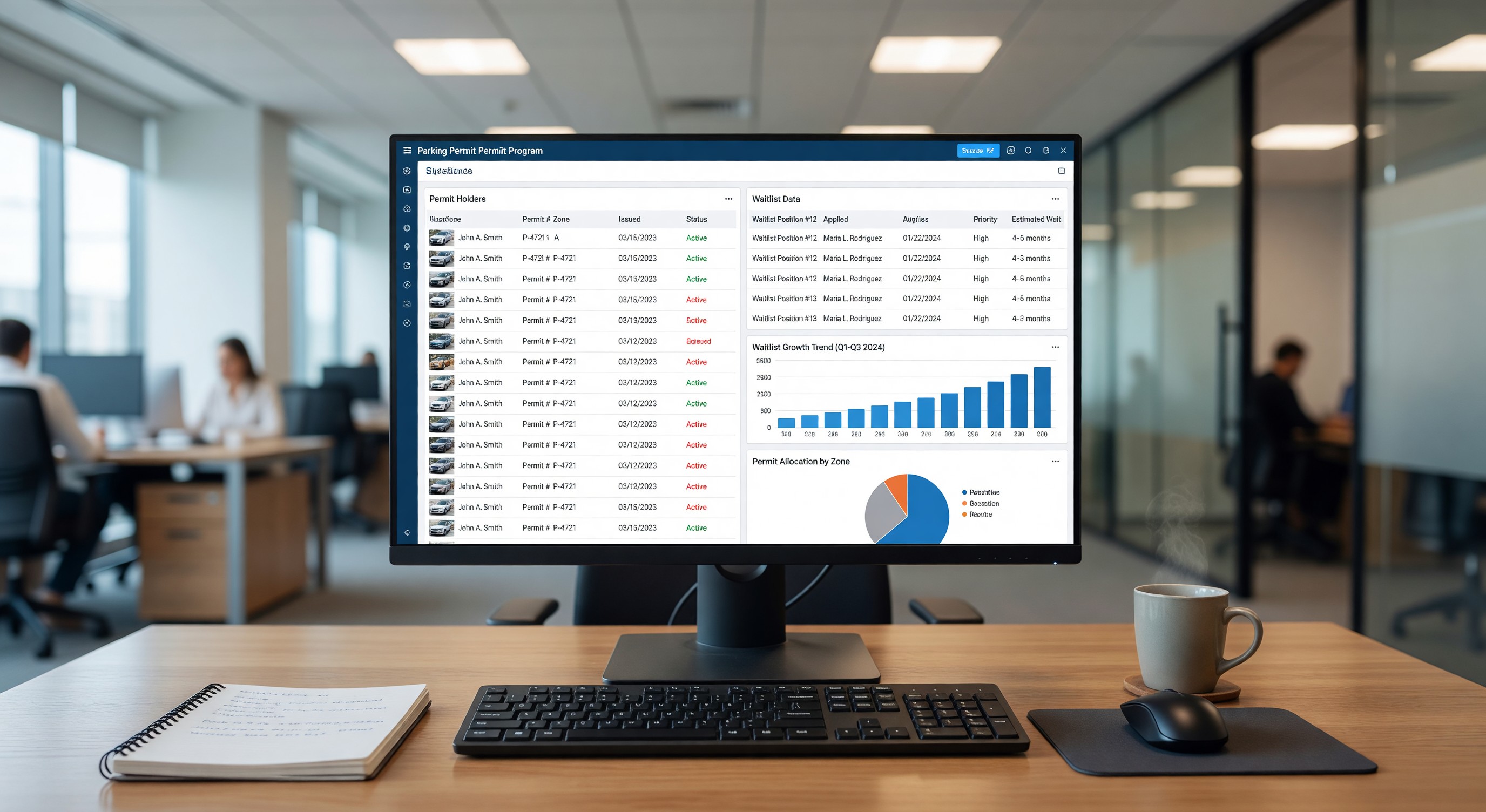
Parking permit programs — the monthly or annual contracts that provide guaranteed parking access for regular users — are the revenue foundation of most commercial and institutional parking facilities. Monthly parkers typically generate 40 to 60 percent of a facility’s gross revenue while consuming a smaller fraction of peak-hour capacity than their payment share would suggest. Managing permit programs well — from waitlist administration through renewal and enforcement — protects this revenue stream and maintains the reliability that monthly parkers pay for.
Permit Program Design
Before managing a permit program, its structure must be defined:
Rate structure: Monthly permit rates reflect the value of guaranteed access. Rates are typically set at 15 to 25 times the daily rate — the premium for guaranteed availability over pay-as-you-go. Premium locations (covered, closer to building, reserved vs. unreserved) command higher monthly rates. Tiered pricing (A, B, C locations within a facility) allows the operator to serve different budget points while maximizing revenue from the highest-demand spaces.
Inventory allocation: The percentage of facility inventory allocated to monthly permits versus transient daily parkers is a key revenue optimization decision. Too many monthly permits reduces transient parking availability and peak-hour revenue potential. Too few monthly permits forfeits the revenue certainty and occupancy floor that monthly accounts provide. Typical allocation ranges are 50 to 80 percent monthly, with the remainder available for transient use.
Permit types: Common permit types include:
- Unreserved monthly: Access to any available space in a defined area
- Reserved monthly: A specific designated space (usually premium-priced)
- 24-hour access vs. specific hour restrictions (daytime only, night only)
- Vehicle-specific (tied to one registered plate) vs. company accounts (multiple authorized vehicles)
- Motorcycle permits at reduced rates
Term and billing: Monthly permits are most commonly billed month-to-month with 30-day notice for cancellation. Some facilities use annual permits with a discount for annual payment. Billing should be automated through recurring ACH or credit card to reduce administrative overhead.
Waitlist Administration
When facility permit inventory is fully subscribed, a waitlist queue is the operational standard. Waitlist practices:
Waitlist enrollment: Applicants should be able to register for the waitlist with basic contact information and preferred permit type. Online registration is the standard; paper forms are increasingly obsolete. Communicate estimated wait time transparently — a waitlist of 150 names with 15 annual openings has a notional 10-year wait, which should be disclosed.
Waitlist queue management: Maintain strict FIFO (first-in, first-out) queue discipline unless specific priority categories apply (ADA, seniority for employer programs). Queue jumping for any reason — VIP exceptions, management discretion — undermines waitlist integrity and creates liability and perception issues.
Opening notification: When a space opens, notify the top waitlist enrollee first by email with a defined response window (typically 5 to 7 business days). If no response within the window, move to the next enrollee. Document all offers and responses.
Active waitlist maintenance: Contact all waitlist enrollees annually to confirm continued interest. Remove those who don’t respond. Maintaining a “ghost” waitlist of former applicants who are no longer interested inflates the queue and misrepresents actual demand.
Renewal Processes
Permit renewal is the lifecycle event that retains monthly parkers and recovers lapsed accounts. Best practice renewal processes:
Automated renewal invitations: Send renewal notices 45 to 60 days before the current term expires via email, with a direct link to the online renewal portal. Include current rate information; where rates are increasing, disclose the new rate with the renewal notice (not after renewal commitment).
Renewal window and deadline: Define a renewal window (commonly 30 days) during which existing holders have priority to renew before spaces are offered to the waitlist. Unused spaces at the end of the renewal window are offered to waitlist enrollees in queue order.
Non-renewal reasons tracking: Track why permit holders do not renew (job change, moved away, price sensitivity, dissatisfaction with service). This intelligence informs rate decisions and operational improvements.
Re-engagement for lapsed accounts: When a permit holder does not renew, a 30-day post-lapse re-engagement offer (sometimes with a waived reinstatement fee) captures parkers who may have allowed the permit to lapse through inattention rather than intent.
Permit Enforcement in Facilities
Permit-specific reserved spaces must be enforced — otherwise, monthly parkers who pay for guaranteed access find their reserved space occupied and the premium price unjustified.
Virtual permit enforcement via LPR: In LPR-equipped facilities, the permit database links registered plate numbers to authorized spaces or zones. The system automatically flags vehicles that park in permit zones without a registered plate. This eliminates physical hang tag requirements and provides continuous enforcement without manual patrol.
Physical hang tag enforcement: In facilities without LPR, hang tags (displayed on the rearview mirror or dashboard) allow patrol enforcement. Vehicles in permit zones without a displayed, valid hang tag receive a citation. Hang tag programs require administrative overhead for issuing, tracking, and replacing lost or damaged tags.
Temporary permit provisions: Provide a defined process for permit holders using substitute vehicles (rental cars, borrowed vehicles) — typically an online or phone notification system that registers the alternate plate for a defined period (24 to 72 hours) without requiring a physical tag.
Frequently Asked Questions
What percentage of facility inventory should be allocated to monthly permits? Typical allocation is 50 to 80 percent monthly, with the remainder available for transient parking. The optimal allocation depends on the relative revenue per stall from monthly vs. transient parkers and the facility’s peak occupancy pattern.
How should a parking waitlist be managed fairly? Strict FIFO (first-in, first-out) queue discipline with transparent communication of estimated wait time. Annual confirmation of continued interest removes inactive applicants. Offers to top-of-queue applicants with a defined response window before moving to the next applicant maintain integrity.
When should permit rates be increased? Annual rate review tied to the permit renewal cycle is best practice. Rate increases should be disclosed to existing holders at least 30 to 45 days before the effective date. Increases above CPI (consumer price index) inflation require market analysis to confirm demand supports the higher rate without excessive attrition.
How does LPR enforcement improve permit program management? LPR enables virtual permits (eliminating physical hang tags), continuous enforcement of permit zones without manual patrol, and real-time database management for alternate vehicle registrations. LPR-based permit enforcement reduces administrative overhead, eliminates lost/stolen hang tag issues, and provides more consistent enforcement than manual patrol.
Takeaway
Parking permit programs are the revenue foundation of most parking operations — but that foundation requires disciplined management of enrollment, waitlists, renewals, rates, and enforcement to perform as designed. Programs with transparent waitlist administration, automated renewal processes, rate structures that reflect market demand, and consistent enforcement of permit zones consistently outperform those managed informally. Monthly parkers who receive reliable, high-quality access have low attrition rates; those who experience frequent space availability problems or poor administrative responsiveness churn — and take their guaranteed revenue with them.
Further Reading from Authoritative Sources
- IPMI parking permit program management standards and best practices — IPMI is the primary industry association publishing permit program management standards, waitlist administration guidance, and monthly parker revenue benchmarks for parking professionals.
- ADA requirements for accessible parking permit programs — ADA.gov provides the federal requirements governing how accessible parking spaces must be treated in permit programs, including the prohibition on allocating them as general monthly permits and the required accessible space ratios.