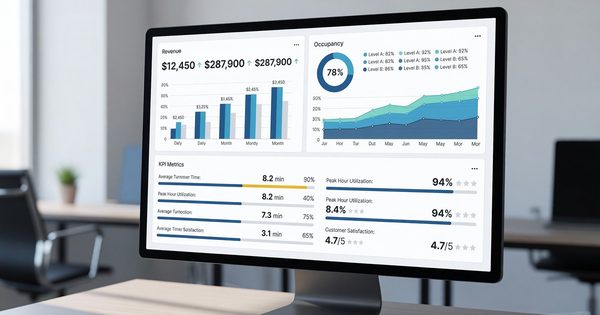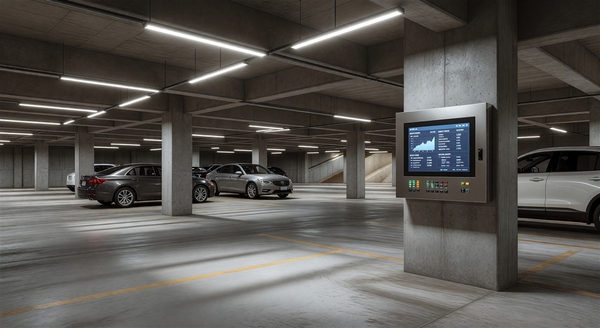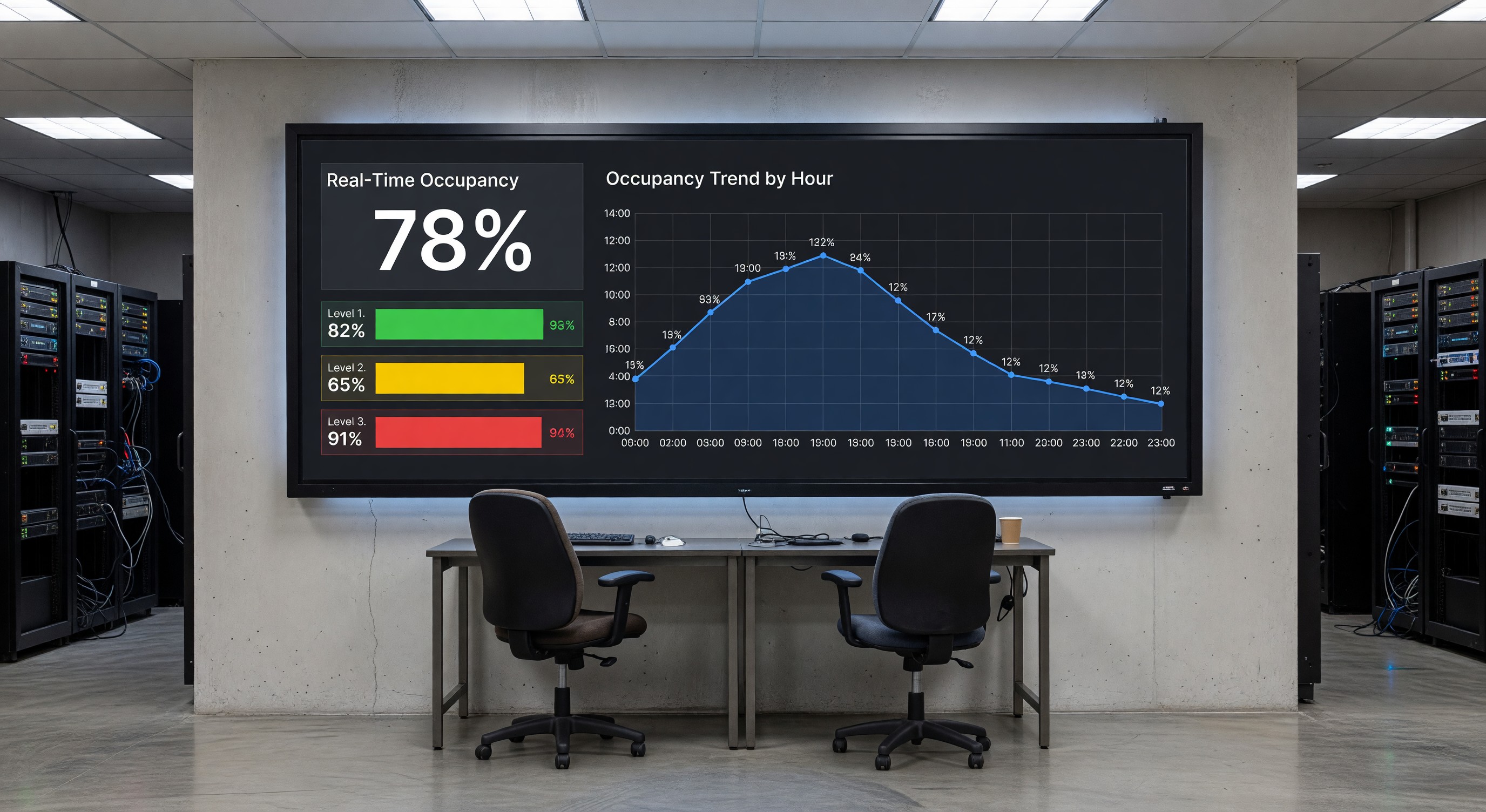
Occupancy data is the most operationally actionable metric in parking — it tells you when, where, and how much of your inventory is being used. Without reliable occupancy data, pricing decisions are guesses, capacity planning is based on anecdote, and the revenue optimization potential of your facility remains largely unrealized. With it, you can set rates intelligently, identify underperforming zones, and forecast future demand with enough confidence to make capital decisions.
Data Collection Methods
Parking occupancy can be measured at several levels of precision, with trade-offs between cost, accuracy, and granularity:
Entry/exit count method: Gate transaction data from the PARCS system provides net occupancy — vehicles entered minus vehicles exited. Accuracy depends on consistent transaction recording at every gate; bypasses, manual releases, and system errors degrade accuracy. This is the baseline method available from any PARCS-equipped facility at no additional equipment cost.
In-ground loop detectors: Embedded inductive loops in each stall detect vehicle presence. Accurate at the individual stall level; requires installation in pavement (significant retrofit cost) and maintenance of embedded sensors. Most common in new surface lots.
Overhead ultrasonic sensors: Sensors mounted above each stall (typically on a beam or canopy) detect vehicle presence using ultrasound. Accurate at the stall level; easier to retrofit than loop detectors. Common in covered parking structures. Provides data for parking guidance systems (green/red LED indicators).
Camera-based occupancy: Computer vision cameras mounted at the ends of drive aisles or overhead identify occupied and vacant stalls by visual analysis. Provides both occupancy count and zone-level data. More flexible than per-stall sensors; accuracy is generally 95 to 99 percent for well-deployed systems.
LPR-based occupancy tracking: LPR cameras at entry/exit lanes record plate at entry and exit, creating vehicle-level occupancy records (when each vehicle entered and exited). Provides the richest individual vehicle data but requires LPR at all entry/exit points.
Daily Reporting Structure
Daily occupancy reports should provide the information needed for next-day operational decisions:
Peak occupancy by day-part: The maximum stalls occupied during each operational period (morning: 7 a.m. to noon; afternoon: noon to 5 p.m.; evening: 5 p.m. to 9 p.m.; overnight). Day-part breakdown reveals whether the facility has consistent demand all day or concentrated peaks that require specific management.
Average occupancy by day-part: The average of occupancy readings throughout each period. Average is more representative of the typical utilization experience than the single-point peak.
Zone-level occupancy: For facilities with multiple sections (levels, zones, permit areas), occupancy by zone identifies underperforming areas that may benefit from signage, wayfinding, or pricing adjustments.
Transaction count: Number of individual parking transactions (entries) during the day. Compared against capacity to derive average dwell time.
Revenue per occupied stall-hour: Calculated from daily revenue divided by total stall-hours occupied. This normalizes revenue for comparability across days with different occupancy levels.
Trend Reporting for Management
Weekly and monthly trend reports reveal operational patterns that daily reports don’t resolve:
Weekday vs. weekend demand: Separately trending weekday and weekend occupancy reveals whether the facility’s demand is primarily weekday commuter (office, medical) or weekend destination (retail, entertainment). This drives rate strategy and staffing decisions.
Week-over-week and month-over-month changes: Tracking percentage change against the prior period and prior year identifies demand trajectory. A facility showing consistent 5 percent year-over-year occupancy growth is in a different strategic position than one showing flat or declining occupancy.
Seasonal occupancy patterns: Charting monthly average occupancy across the year reveals seasonal demand variation that operational planning should address. Most facilities show clear seasonal patterns; understanding them in advance allows proactive staffing and rate adjustments.
Correlation analysis: Cross-tabulating occupancy data with external drivers (weather, nearby events, announced employer headcount changes) identifies which factors most significantly influence demand. This improves forecast accuracy.
IPMI and Industry Benchmarks
The International Parking and Mobility Institute’s annual Parking Benchmarks report provides occupancy benchmarks by facility type:
- Downtown commercial structured parking: Average peak weekday occupancy of 75 to 90 percent is typical; below 70 percent suggests undersupply of demand or over-supply of inventory
- Airport long-term parking: Target peak utilization of 85 to 92 percent during high-travel periods
- Medical campus parking: High consistency; typically 80 to 95 percent weekday peak with lower weekend demand
- Retail: Highly variable by location and anchor tenant; peak occupancy of 75 to 95 percent during peak shopping periods
Benchmarks provide context for individual facility performance — a 70 percent peak occupancy is strong for a suburban strip mall but weak for a downtown garage in a tight market.
Occupancy Data for Pricing Decisions
Occupancy data is the direct input to evidence-based pricing:
Pricing trigger thresholds: Many dynamic pricing systems use occupancy triggers to adjust rates — increase price when occupancy exceeds 85 percent, decrease when below 60 percent. Setting these thresholds requires understanding the facility’s normal occupancy distribution, not just the peak.
Rate-occupancy elasticity: Historical data showing the relationship between rate changes and occupancy changes (demand elasticity) allows operators to model the revenue impact of rate adjustments before implementing them.
Segment mix analysis: If occupancy data is combined with customer segment data (monthly vs. transient, time of day by segment type), operators can identify which segments are under-served at current rates and where pricing adjustments would capture demand without displacing more price-sensitive customers.
Frequently Asked Questions
What is the most accurate method for measuring parking occupancy? Per-stall sensors (ultrasonic overhead or in-ground loop) provide the highest accuracy (95 to 99 percent) at the individual stall level. Camera-based occupancy systems provide comparable accuracy with more flexibility. Entry/exit count methods are less accurate due to bypass events and system errors but require no additional hardware beyond the PARCS system.
What peak occupancy level indicates a facility is pricing below market? Consistent peak occupancy above 95 percent, combined with unmet demand at entry (customers turned away or unable to find spaces), is a strong signal that current rates are below the market-clearing price. A healthy occupancy target is 85 to 92 percent at peak — high utilization with some available capacity.
How should occupancy data be benchmarked against industry standards? IPMI’s annual Parking Benchmarks report provides occupancy benchmarks by facility type and market context. Compare against the same facility type (surface vs. structured, urban vs. suburban) and similar market characteristics for meaningful peer comparison.
What interval should occupancy be measured at for daily reporting? 15-minute or 30-minute intervals provide the detail needed for day-part occupancy analysis. Hourly averages are acceptable for trend reporting. Raw transaction data from the PARCS system is the source; occupancy is calculated as a running count of entered-minus-exited vehicles per interval.
Takeaway
Occupancy data is the foundation of evidence-based parking management. Facilities that collect reliable occupancy data, report it systematically at both daily and trend levels, benchmark against IPMI standards, and use it to drive pricing and operational decisions consistently outperform those that rely on visual assessment and anecdote. The data collection infrastructure — whether PARCS transaction counts, in-stall sensors, or camera-based systems — is the prerequisite; the analytical practice of using the data for decisions is what converts the investment into revenue and efficiency results.
Further Reading from Authoritative Sources
- IPMI parking benchmarking and occupancy data standards — The International Parking and Mobility Institute publishes the primary benchmarking data for parking occupancy rates and data collection standards that are directly cited in the article.
- Transportation Research Board parking occupancy monitoring research — The Transportation Research Board publishes research on parking occupancy monitoring systems and data collection methodologies that provide an independent technical basis for the sensor comparison and accuracy claims in the article.