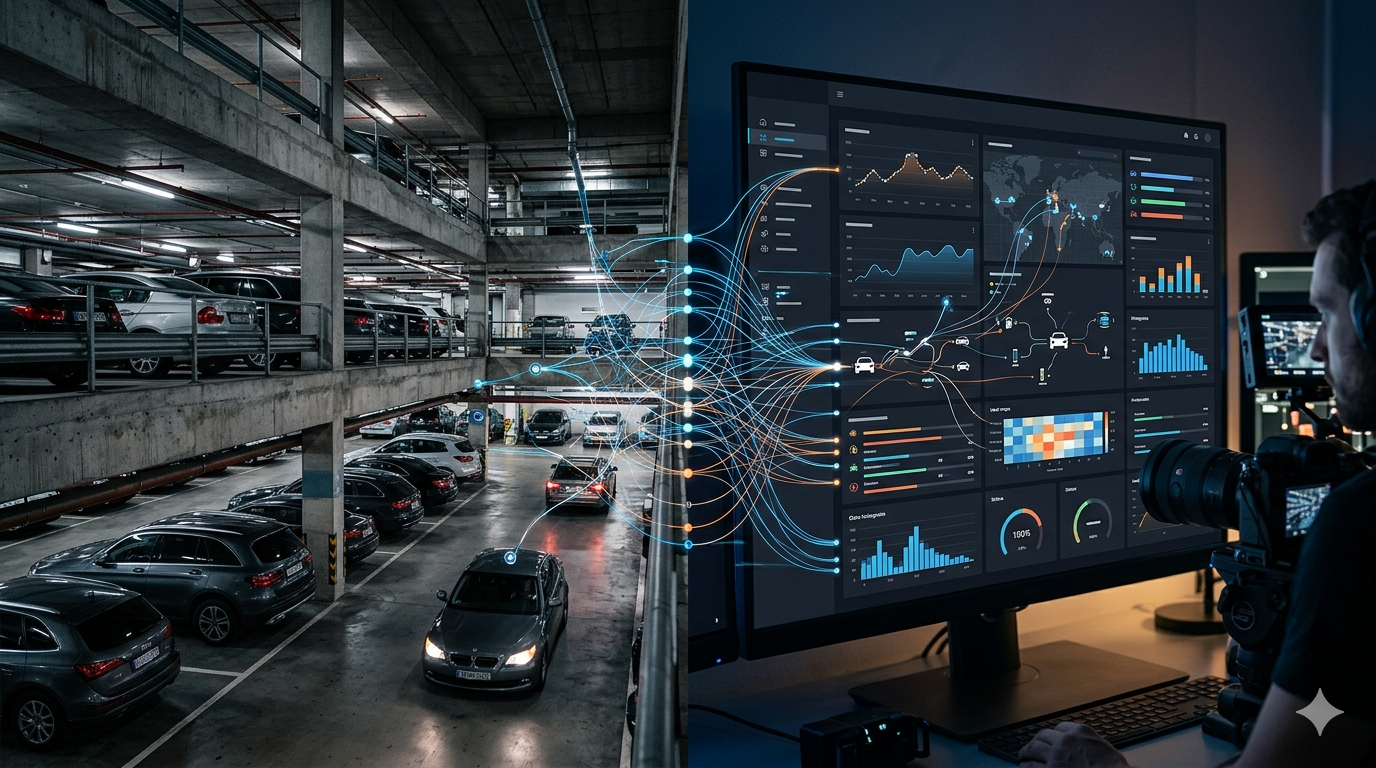
The parking management software market in 2024 looks nothing like it did five years ago. Research from Grand View Research projects continued strong growth in the smart parking technology sector. What was once a category dominated by on-premise systems — servers in closets, desktop applications, and manual data exports — has shifted decisively toward cloud-first platforms that promise real-time visibility, mobile management, and AI-powered analytics. Vendors who built their businesses on installed software are scrambling to develop cloud offerings. New entrants with no legacy baggage are gaining traction. And operators who delayed their software modernization are finding themselves at an increasing disadvantage.
This article maps the current landscape, examines the capabilities that matter most, and offers practical guidance for operators evaluating their software strategy.
The Cloud Transition: Where Things Stand
The parking industry’s shift to cloud-based management platforms has followed a trajectory familiar from other industries — initial skepticism, gradual adoption by early movers, and then a tipping point where cloud becomes the expected default rather than the innovative exception.
As of mid-2024, that tipping point appears to have arrived. The majority of new parking management software contracts specify cloud deployment. Operators who previously insisted on on-premise systems are migrating, driven by a combination of aging hardware, staff who expect modern interfaces, and the operational limitations of systems that require physical presence to manage.
The benefits that cloud advocates have been promising for years are now demonstrated rather than theoretical:
Remote management. Operators managing multiple facilities — whether across a city or across a country — can monitor and control all locations from a single dashboard. Rate changes, access credential management, and operational alerts flow through the cloud platform without the need for site visits or VPN connections to individual servers.
Automatic updates. Cloud platforms update continuously, delivering new features, security patches, and bug fixes without the operator scheduling downtime or hiring a technician. This alone eliminates a significant operational burden that on-premise systems impose.
Scalability. Adding a new facility to a cloud platform takes hours, not weeks. There is no server to procure, no software to install, no network to configure. The platform extends to the new location as soon as hardware is connected and configured.
Data aggregation. Cloud platforms inherently centralize data from all connected facilities, enabling cross-portfolio analytics, benchmarking, and reporting that on-premise systems struggle to provide without complex integration projects.
The remaining resistance to cloud adoption comes from two sources: operators in environments with strict data residency or security requirements (government facilities, certain healthcare campuses, defense installations) and operators with recent investments in on-premise infrastructure that they need to amortize before migrating. Both are legitimate constraints, but they represent a shrinking share of the market.
Mobile-First Management
If cloud is the platform shift, mobile is the interface shift. Parking management has historically been a desk-bound activity — checking reports on a desktop computer, adjusting rates through a management console, responding to alarms on a workstation. Mobile-first management platforms are changing this by putting full operational control on smartphones and tablets.
The implications extend beyond convenience:
Faster response times. Equipment failures, revenue anomalies, and customer service issues surface as push notifications on a manager’s phone. Response time drops from hours (the next time someone checks the desktop) to minutes.
Field operations integration. Maintenance staff, enforcement officers, and customer service representatives access the same platform in the field that managers use at their desks. Work orders, enforcement actions, and customer interactions are logged in real time rather than transcribed from paper notes at the end of a shift.
Reduced staffing requirements. Facilities that previously required on-site management staff around the clock can transition to remote monitoring with mobile response. A manager covering three facilities from home after hours, with mobile alerts and remote gate control, replaces three overnight attendants.
Owner and stakeholder access. Property owners, municipal administrators, and other stakeholders increasingly expect real-time access to parking performance data. Mobile dashboards that show occupancy, revenue, and operational status — without requiring access to the full management platform — satisfy this demand while maintaining appropriate access controls.
The mobile management revolution is not complete. Complex configuration tasks, detailed report building, and system administration still benefit from full desktop interfaces. But the trajectory is clear: routine operational management is moving to mobile, and platforms that do not support this are at a competitive disadvantage.
AI and Analytics: Substance Behind the Buzz
Every parking software vendor in 2024 claims AI capabilities. The term has been applied so broadly that it risks becoming meaningless — a marketing checkbox rather than a genuine feature description. But beneath the hype, several AI applications in parking management software deliver real operational value.
Demand Prediction
Machine learning models trained on historical occupancy data, event calendars, weather patterns, and seasonal trends can predict daily and hourly demand with impressive accuracy. The best implementations forecast peak occupancy within five to eight percent for routine days and flag anomalous demand events (concerts, sporting events, conferences) that would catch human planners off guard.
Demand prediction enables proactive rather than reactive management. Staffing schedules match anticipated demand rather than historical averages. Rate adjustments take effect before demand materializes rather than after the facility is full. And resource allocation — maintenance scheduling, cleaning crews, shuttle frequency — aligns with expected activity levels.
Anomaly Detection
AI-powered anomaly detection scans operational data for patterns that indicate problems: unexpected revenue drops, unusual access credential usage, equipment performance degradation, and transaction patterns that suggest fraud or system errors.
This capability is valuable precisely because parking operations generate enormous volumes of transactional data that humans cannot practically monitor. A facility processing 3,000 transactions per day produces data that no manager can review line by line. Anomaly detection algorithms surface the handful of transactions or patterns that warrant attention, dramatically improving the efficiency of operational oversight.
Dynamic Pricing Optimization
AI-driven dynamic pricing goes beyond simple time-of-day rate schedules. These systems continuously adjust pricing based on current occupancy, predicted demand, competitive rates (where data is available), and historical price elasticity. The goal is to maximize revenue per available space-hour while maintaining target occupancy levels.
The sophistication of these systems varies significantly across vendors. At the high end, pricing algorithms operate with the nuance of airline revenue management systems, adjusting prices in real time based on dozens of variables. At the low end, “AI pricing” amounts to a rule-based system that changes rates at preset occupancy thresholds — useful, but hardly artificial intelligence.
Customer Behavior Analysis
Platforms that track individual customer journeys — from initial search or reservation through entry, parking, payment, and exit — can build profiles that inform marketing, product design, and service improvement. Which customer segments are growing? Where do customers abandon the reservation process? What drives loyalty versus churn?
This analysis requires data integration across multiple touchpoints (reservation platforms, access control, payment systems, customer service interactions) and raises legitimate privacy considerations that operators must address through clear policies and opt-out mechanisms.
The Vendor Landscape
The parking management software market in 2024 features several distinct categories of vendors:
Legacy Platform Vendors
Companies that built the parking industry’s software infrastructure over the past two to three decades — names like TIBA, Amano, Scheidt & Bachmann, SKIDATA, and Sentry Control — are in various stages of cloud transition. Their strengths are deep domain expertise, large installed bases, and comprehensive feature sets refined over years of customer feedback. Their challenge is modernizing architectures and interfaces that were designed for a different era while maintaining backward compatibility with existing installations.
Cloud-Native Entrants
A newer generation of vendors built their platforms for the cloud from day one. Companies like Arrive, ParkHub, Metropolis, and FlashParking (now Flash) offer modern interfaces, API-first architectures, and mobile-native management. Their strengths are technology and user experience. Their challenge is building the depth of operational functionality and the integration ecosystem that legacy vendors have developed over decades.
Hardware-Integrated Platforms
Some equipment manufacturers offer management software platforms that integrate tightly with their hardware — gates, pay stations, LPR cameras, and sensors. This approach promises seamless hardware-software integration and single-vendor accountability. The trade-off is reduced flexibility in hardware selection, though the operational simplicity of an integrated platform appeals to many operators, particularly those managing smaller portfolios.
Specialized Solutions
Niche vendors focus on specific segments: municipal on-street parking, university campus parking, event venue parking, or enforcement-only solutions. These specialists often deliver deeper functionality in their target segment than general-purpose platforms, but they may lack the breadth to serve operators with diverse facility types.
What to Evaluate
Operators selecting a parking management platform in 2024 should focus on several critical dimensions:
Integration Capability
No parking management platform operates in isolation. It must integrate with access control hardware, payment processing systems, reservation platforms, accounting software, customer relationship management tools, and increasingly, smart city infrastructure as tracked by the Intelligent Transportation Systems Joint Program Office. API quality and breadth — not just the existence of APIs but their documentation, reliability, and the vendor’s commitment to maintaining them — should be a primary evaluation criterion.
Data Ownership and Portability
Cloud platforms host your operational data on their infrastructure. Operators should understand and contractually protect their data rights: Who owns the data? Can it be exported in standard formats? What happens to data if the contract ends? How is data backed up and protected?
These questions matter more than they might appear. Operators who discover years into a contract that their historical data is locked in a proprietary format face significant switching costs that give the vendor disproportionate leverage in renewal negotiations.
Total Cost of Ownership
Software pricing models in the parking industry range from perpetual licenses with annual maintenance fees to monthly subscription pricing based on facility size, transaction volume, or feature tier. Comparing these models requires careful analysis of total cost over a realistic contract period — including implementation, training, customization, integration, and ongoing support.
Subscription models that appear expensive on a monthly basis often prove more cost-effective over five years when the cost of hardware refreshes, software upgrades, and IT support for on-premise alternatives is factored in. But operators should model the numbers for their specific situation rather than accepting vendor comparisons at face value.
Vendor Viability
The parking software market is consolidating. Smaller vendors are being acquired, pivoting, or closing. Operators committing to a five to ten year platform relationship should evaluate vendor financial stability, market position, and strategic direction. A vendor with strong technology but uncertain funding may not be around to support the platform in three years.
User Experience
Software that operators find difficult to use will not be used effectively, regardless of its feature set. Evaluate the day-to-day user experience — not just the polished demo environment, but the actual interface that a parking manager or attendant will interact with hundreds of times per week. Ask for reference customers who can speak to real-world usability rather than relying on vendor demonstrations.
Implementation Realities
Selecting a platform is the beginning, not the end. Implementation of parking management software — particularly when migrating from a legacy system — involves challenges that vendors typically understate:
Data migration from legacy systems is consistently more difficult than anticipated. Historical transaction data, customer records, access credentials, and configuration settings must be mapped from old formats to new ones. Data quality issues that were invisible in the old system surface during migration.
Integration work with existing hardware and third-party systems consumes 30 to 50 percent of implementation budgets. Even vendors who demonstrate integrations in sales environments encounter compatibility issues, version mismatches, and configuration challenges in production deployments.
Training and change management determine whether the new platform delivers its potential value. Staff who revert to old habits or workarounds because they find the new system unfamiliar will not realize the efficiency gains the platform promises. Invest in comprehensive training and designate internal champions who can support colleagues through the transition.
Parallel operations during the transition period — running old and new systems simultaneously — add cost and complexity but reduce risk. The duration of parallel operations should be planned based on the criticality of the systems being replaced and the operator’s risk tolerance.
Looking Forward
The parking management software market will continue to evolve rapidly. Edge computing will push more processing to facility-level devices, reducing cloud dependency for time-critical operations. Computer vision integration will blur the line between parking management and broader facility management. And open standards — a topic the International Parking & Mobility Institute has been actively promoting — will reduce the integration friction that currently makes platform changes so painful.
For operators making decisions today, the practical advice is to choose platforms that are architecturally modern, financially viable, well-integrated with their existing hardware ecosystem, and backed by vendors who treat the relationship as a partnership rather than a transaction. The technology will continue to improve. The vendor relationship will determine whether those improvements benefit your operation.