Parking lot pavement represents one of the largest capital assets a property owner maintains. A commercial surface lot of 200 stalls at $3 to $5 per square foot installed cost represents a $500,000 to $800,000 investment. Without a structured preventive maintenance program, that investment deteriorates on an accelerated curve — minor surface defects become major structural failures within 5 to 10 years of neglect. With systematic maintenance, a quality asphalt surface can serve 20 to 25 years before major rehabilitation is required.
The Preventive Maintenance Philosophy
Parking lot pavement deteriorates through oxidation, water infiltration, freeze-thaw damage, and load-induced cracking. The maintenance strategy that produces the lowest lifecycle cost is aggressive early-stage treatment — crack sealing before cracks allow water infiltration, seal coating before surface oxidation advances to structural deterioration, and drainage maintenance before water ponding accelerates pavement failure.
The cost relationship is well-documented: $1 spent on preventive maintenance at year 3 to 5 prevents $3 to $5 in rehabilitation costs at year 10 to 15. Deferring maintenance to avoid near-term cost consistently produces higher long-term expenditure.
Annual Maintenance Calendar
Spring (April–May):
- Post-winter sweeping and cleaning to remove sand, grit, and debris from winter maintenance
- Drain inspection: clean stormwater inlet grates, test drainage flow, clear sediment accumulation from bioswales and surface drains
- Pavement inspection: walk or drive the full lot to catalog all cracks, depressions, potholes, and edge failures. Create a photographic condition record
- Immediate pothole repair: fill and compact any potholes that developed over winter before they enlarge. Cold mix temporary patch is acceptable as a temporary measure; hot mix permanent repair should follow within 30 to 60 days
- Marking inspection: assess retroreflectivity and marking condition following winter wear
Summer (June–August):
- Crack sealing: the optimal season for crack sealing in most North American climates. Cracks must be dry (typically following at least 3 days without rain) and open (not compressed by heat expansion). Rout and seal cracks 1/4 inch wide or wider with hot-applied rubberized asphalt sealant. Cracks narrower than 1/4 inch can be filled with crack fill emulsion without routing. Expected life of properly applied crack seal: 3 to 5 years.
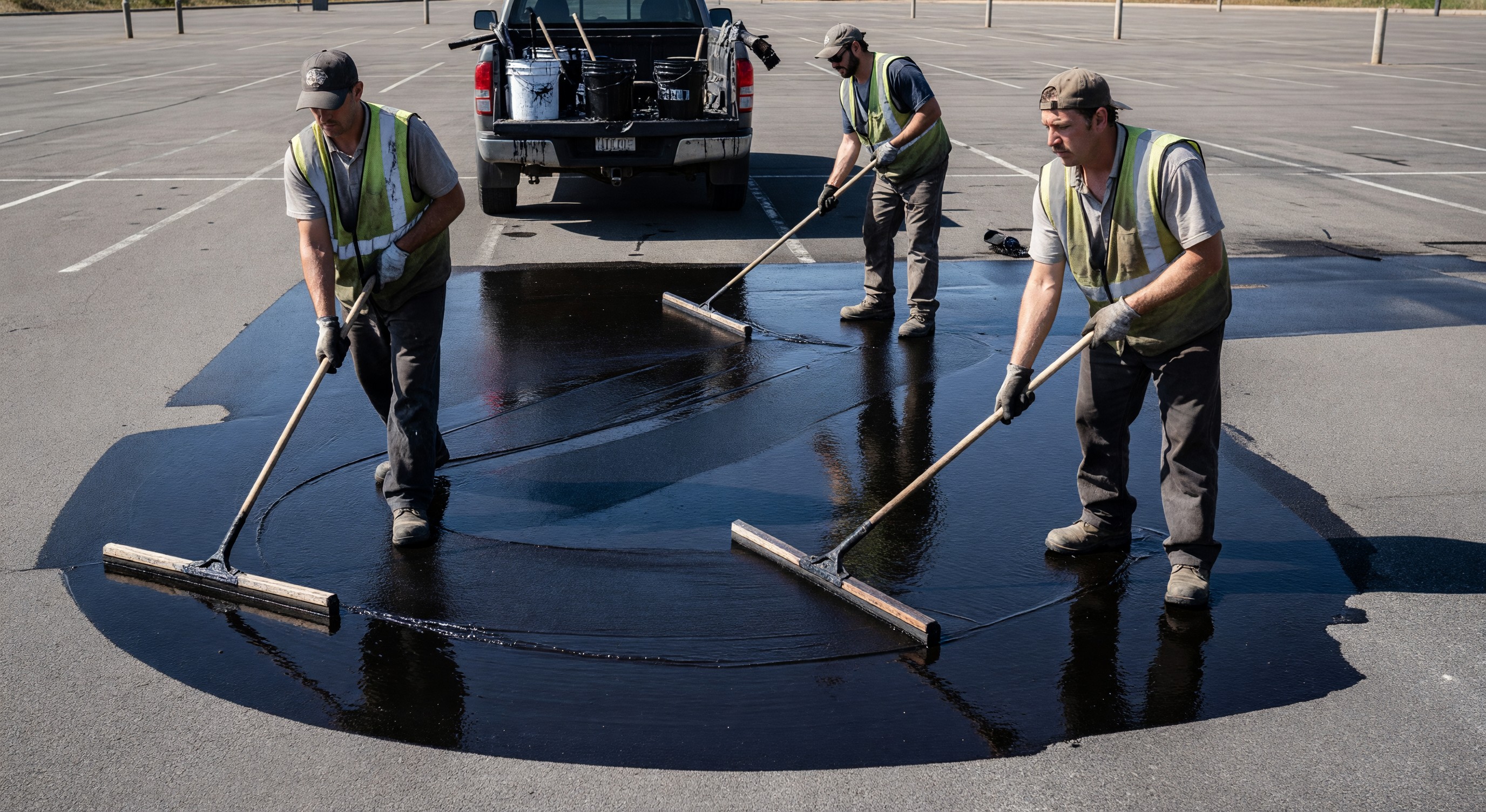
- Seal coat application: Apply emulsified coal tar pitch or asphalt emulsion seal coat to oxidized pavement surfaces. Seal coat fills small surface voids, slows oxidation, restores surface color and texture, and improves retroreflectivity of line markings. Application requires dry pavement (72+ hours without rain), ambient temperatures above 50°F and below 90°F, and a 24 to 48-hour cure period before restriping and traffic reopening. Seal coat cycle: every 3 to 5 years on high-use lots; every 4 to 7 years on lower-traffic lots.
- Restriping: Immediately following seal coat application (48 to 72 hours after cure). Update any changed layout, correct ADA deficiencies, and apply fresh retroreflective markings.
Fall (September–November):
- Pre-winter pavement inspection: identify any defects that developed during the summer that need repair before winter freeze-thaw cycling worsens them
- Drainage preparation: clean out drains and bioswales before fall leaf accumulation clogs them. Confirm all drain covers are secure and functional
- Lighting inspection: with shorter days, parking lot lighting operates longer. Replace any burned-out lamps before winter
- Sweep and clean: remove accumulated debris before it becomes embedded in winter snow and ice management operations
Winter (December–March):
- Snow and ice removal: plow and de-ice as needed per facility snow removal plan
- Minimize chloride de-icer use: excessive road salt accelerates concrete and asphalt deterioration. Use minimum effective application rates; consider alternatives (sand for traction; pre-treatment with liquid de-icers) where appropriate
- Ongoing incident response: document and repair any potholes that develop during winter for customer safety and to prevent enlargement
Major Rehabilitation Planning
Beyond the annual maintenance cycle, major rehabilitation events occur every 12 to 25 years:
Mill and overlay (10 to 15 years): Milling removes the top 2 to 3 inches of asphalt surface (including cracks, surface deformation, and oxidation). A new asphalt overlay is applied over the milled surface. Restores surface smoothness and performance without requiring full-depth reconstruction. Cost: $2 to $4 per square foot.
Full-depth reconstruction (20 to 30 years): When base course or subgrade failures have occurred, the full pavement section must be removed and reconstructed. Cost: $5 to $10 per square foot. Should be avoided through timely preventive maintenance, as the cost is several times that of a maintained pavement.
Budget Planning
Annual parking lot maintenance budget planning should include:
- Routine sweeping contract (monthly or weekly for high-traffic lots)
- Crack seal application (every 2 to 3 years; 5 to 8 cents per linear foot of crack)
- Seal coat (every 3 to 5 years; $0.20 to $0.35 per square foot)
- Restriping (concurrent with seal coat; $0.08 to $0.15 per linear foot of striping)
- Pothole repair and patching (contingency; $50 to $150 per patch for cold mix, $200 to $400 for hot mix)
- Drain and infrastructure maintenance
A 200-stall lot (approximately 60,000 square feet) can expect annual maintenance costs of $8,000 to $20,000, with seal coat and restrip years costing $15,000 to $25,000 in the seal application year.
Frequently Asked Questions
How often should a parking lot be seal coated? Every 3 to 5 years for high-traffic lots; every 4 to 7 years for lower-traffic commercial and residential applications. The optimal timing is before oxidation advances to the point where seal coat can no longer penetrate and bond to the surface — typically identifiable as gray or brown faded coloration and visible surface raveling.
When is the best time of year to apply parking lot seal coat? Summer (June through August in most North American markets) is optimal — dry weather, temperatures above 50°F and below 90°F, and sufficient dry cure time are the requirements. Spring and early fall can work in moderate climates; winter application is not feasible in cold climates.
How is crack sealing different from seal coating? Crack sealing fills individual cracks with flexible, rubberized sealant to prevent water infiltration. Seal coating is a surface treatment applied to the full pavement area to slow oxidation and restore surface condition. Crack sealing should precede seal coat application — seal coat alone does not effectively seal opened cracks.
What is the typical service life of a well-maintained asphalt parking lot? A quality asphalt parking lot with a systematic preventive maintenance program (crack sealing, seal coating on schedule, prompt pothole repair) can achieve 20 to 25 years before major rehabilitation. Without maintenance, the same lot may require full-depth reconstruction within 10 to 15 years.
Takeaway
Parking lot maintenance is an investment in asset preservation, not an unavoidable expense. The facilities that operate with the lowest lifecycle pavement cost are those that execute preventive maintenance on schedule — crack sealing before water infiltrates, seal coating before surface oxidation advances, drainage maintenance before water damage accumulates. The annual maintenance calendar provides the organizational framework; consistent execution within that framework produces pavement that serves its full design life at the lowest total cost of ownership.
Further Reading from Authoritative Sources
- EPA stormwater management and parking lot drainage maintenance requirements — The EPA publishes NPDES stormwater permit requirements and guidance for parking lot maintenance, including drain maintenance, oil-water separator servicing, and stormwater BMP upkeep that directly informs the drainage maintenance elements of the article’s maintenance calendar.
- FHWA pavement preservation and preventive maintenance technical resources — FHWA publishes the primary federal guidance on pavement preservation, preventive maintenance lifecycle cost analysis, and rehabilitation timing that underpins the cost-benefit framing throughout this article.