Incidents in parking facilities — vehicle accidents, theft, medical emergencies, fires — are inevitable over the life of any active parking operation. What is not inevitable is poor response. Facilities with documented incident response procedures, trained staff, and clear escalation paths handle incidents more efficiently, with less liability exposure, and with better outcomes for everyone involved than those that rely on improvisation when the situation is most stressful.
Vehicle Accident Response
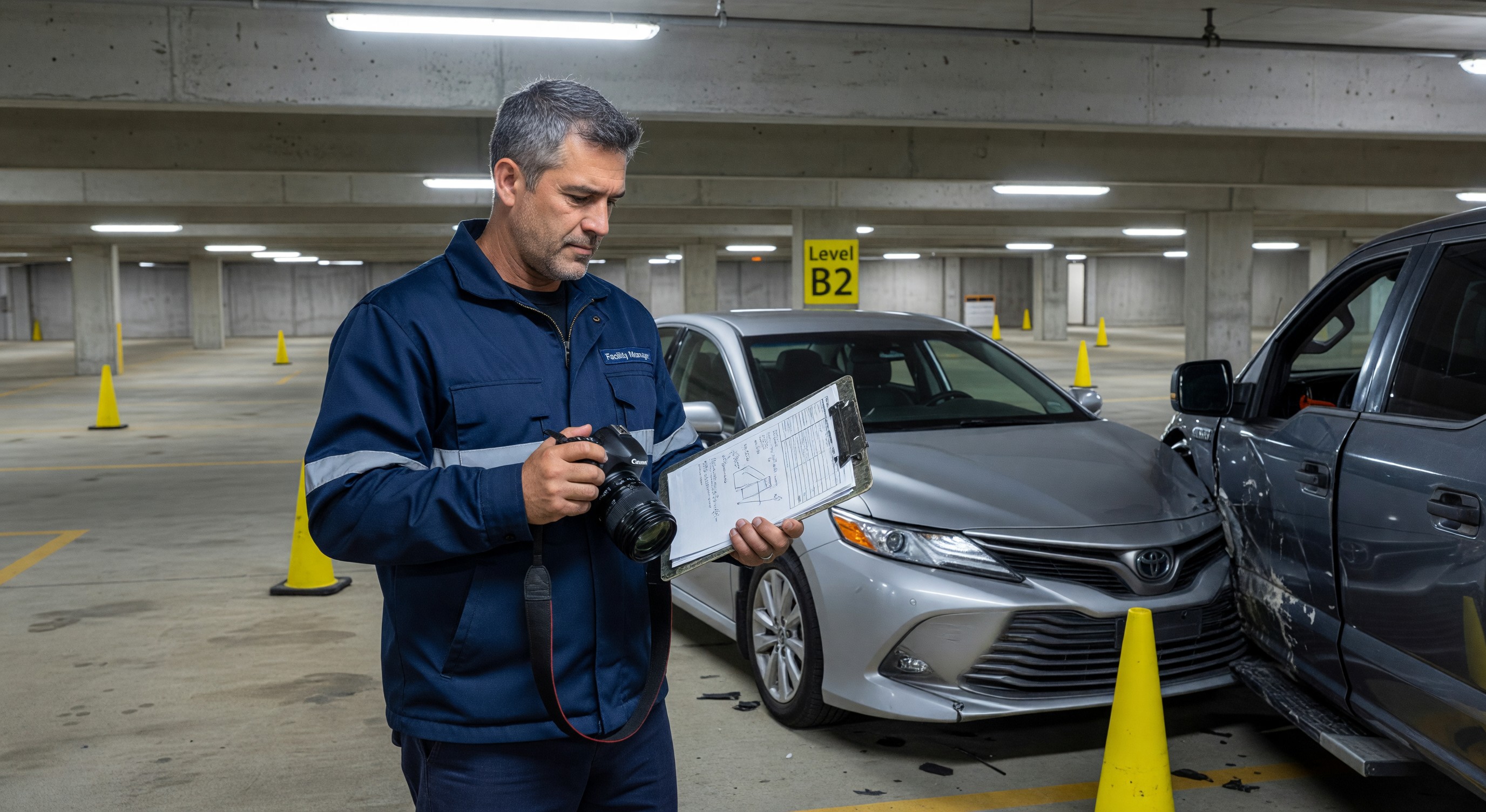
Vehicle accidents in parking facilities range from minor fender contacts (the most common type) to more serious collisions with pedestrians or structural elements. Response procedure:
Immediate response (0 to 5 minutes):
- Any staff witnessing or notified of an accident should proceed to the location immediately
- Assess for injuries — call 911 if anyone reports pain or visible injury
- Do not move vehicles unless they are blocking emergency vehicle access or creating immediate danger
- Separate the involved parties calmly; do not allow confrontation to escalate
Documentation (5 to 30 minutes):
- Photograph all vehicles involved, including damage, license plates, and position
- Photograph the accident scene including any CCTV camera locations
- Pull CCTV footage immediately for preservation — most systems overwrite footage within 30 to 90 days
- Collect identifying information from all parties: name, driver’s license number, insurance carrier and policy number, vehicle description
- Identify and collect contact information from any witnesses
- Complete the facility’s standard incident report form
Escalation:
- Accidents involving injuries: Call 911 immediately; notify facility management and property owner
- Accidents involving structural damage: Assess structural impact; call engineering or facilities management
- Accidents involving unattended vehicles: Document through photographs and attempt to identify the owner through the PARCS system or vehicle registration request
What not to do: Staff should not admit fault on the facility’s behalf, speculate about the cause of the accident, or direct customers to make damage claims directly against the facility without management review. Incidents involving injury should never have facility staff providing “unofficial” settlement offers.
Vehicle Theft and Break-In Response
Vehicle theft and break-ins (theft of items from vehicles) are the most common crimes in parking facilities. Response procedure:
- When a theft is reported, take the customer’s report seriously and document the details: vehicle description and plate, parking location within the facility, approximate time of last confirmed presence, items stolen or damage described
- Pull CCTV footage for the vehicle’s parking location and for entry/exit lanes covering the relevant time window
- Call 911 to report the theft — law enforcement will require the facility to preserve all relevant CCTV footage
- Provide the customer with the facility’s incident report number and a contact for law enforcement follow-up
- Review entry/exit transaction records for the vehicle’s plate if LPR is installed
- Notify facility management and the property owner
CCTV preservation: This is the most operationally critical step after calling 911. CCTV footage overwrites on continuous loops — if not preserved immediately, the forensic evidence of the theft may be lost. Export and store relevant footage to a separate location as soon as possible after the theft report.
Medical Emergency Response
Medical emergencies — customer falls, cardiac events, choking, diabetic events — require immediate response calibrated to the severity of the situation:
Life-threatening emergency (suspected cardiac arrest, unconsciousness, severe trauma):
- Call 911 immediately
- Direct someone to retrieve the facility’s AED (automated external defibrillator) if available — all parking facilities should have at least one AED, ideally one per level in multi-level structures
- Begin CPR if trained and the patient is not breathing
- Send a staff member to the facility entrance to meet and direct emergency responders
- Keep bystanders clear; maintain airway access
Non-life-threatening medical situations (fall with potential injury, reported illness):
- Offer to call 911 — some customers will decline; document the declination
- Provide a comfortable place to wait if the patient prefers not to be moved
- Document the incident regardless of whether the customer seeks treatment
- If the customer falls or is injured in a facility condition that contributed (poor lighting, damaged surface, unsafe conditions), notify facility management immediately for documentation and corrective action
AED availability: The American Heart Association recommends public access defibrillation programs for facilities with large numbers of people. OSHA and many state laws require certain employers to provide AED programs. Parking facility operators should consult applicable requirements and consider AED installation as a life safety investment independent of regulatory requirements.
Fire Response
Fire in a parking structure — vehicle fires being the most common initiating event — requires immediate escalation:
- Call 911
- Alert facility occupants via fire alarm pull stations if evacuation is warranted
- Activate any installed fire suppression system if not automatic
- Direct customers to evacuate via exit stairwells — not elevators
- Account for any known vehicles in the affected area
- Meet fire department at the facility entrance to provide structural access information (gate codes, elevator controls, sprinkler shut-offs)
EV battery fires present specific challenges: they cannot be extinguished by conventional means and must be allowed to burn out. If an EV battery is involved, communicate this to responding fire department immediately — it changes their tactical approach.
Documentation Standards
Consistent incident documentation protects the facility and its customers:
- Every incident, regardless of apparent severity, should be documented on a standard form within 24 hours
- Photographs should be taken at the scene and preserved with the report
- CCTV footage should be preserved for all incidents involving vehicles, injury, or criminal activity
- Incident reports should be retained for a minimum of 3 years (consult counsel for jurisdiction-specific requirements)
- Incident data should be reviewed monthly to identify patterns (recurring accident locations, lighting deficiencies, surface hazards) that operational or physical improvements can address
Frequently Asked Questions
What is the most important action after a vehicle theft is reported in a parking facility? Immediately preserve CCTV footage covering the vehicle’s parking location and all entry/exit lanes during the relevant time window. CCTV footage overwrites on continuous loops — delayed preservation may result in loss of the only forensic evidence of the crime.
Should parking facility staff call 911 for every accident in the lot? Call 911 for any accident involving reported injuries or significant property damage. Minor fender contacts where all parties are uninjured and agree to handle it privately are at the parties’ discretion — document the incident regardless. When in doubt, call 911.
Are parking facilities required to have AEDs? OSHA and many state laws have requirements for some employers. Beyond regulatory requirements, parking facilities serving large numbers of people benefit significantly from AED availability — cardiac arrest survival rates decline by 10 percent per minute without defibrillation. Facilities should consult applicable requirements and treat AED provision as a life safety investment.
How long should incident documentation be retained? A minimum of 3 years is a common standard; some insurance policies and jurisdictions require longer retention. Consult legal counsel for jurisdiction-specific requirements and ensure the retention policy is documented and consistently applied.
Takeaway
Incident response quality in parking operations is the difference between a bad situation and a catastrophic one — for customers, for staff, and for the operator’s liability exposure. Documented response procedures, trained staff, functioning emergency equipment (AEDs, clear 911 call protocols), and consistent documentation practices convert incidents from improvised crises into professionally managed events with defined outcomes. The investment in procedures and training is modest; the cost of unmanaged incident response — in customer harm, liability exposure, and reputational damage — is not.
Further Reading from Authoritative Sources
- ADA requirements for accessible space protection and enforcement in parking facilities — ADA.gov is the authoritative federal source for accessible parking enforcement obligations.
- NIST building safety and EV battery fire technical guidance — NIST conducts and publishes technical research on EV battery fire behavior, building safety, and fire suppression effectiveness that directly informs the EV fire response guidance in this article.