Event parking operations compress a facility’s peak demand into a fraction of its normal time window — generating revenue and operational challenges in equal measure. A 20,000-seat venue empties into its parking facilities within 30 to 45 minutes; a facility that manages 500 transactions per hour on a normal day must process 2,000 per hour during post-game egress. The operations plan that succeeds on a normal Tuesday fails spectacularly at an 8 p.m. event end if it hasn’t been redesigned for the concentrated demand.
Pre-Event Planning
Successful event parking operations start with planning, not improvisation:
Demand forecasting: Projected attendance from the venue determines expected vehicle volume. Assume 1.5 to 2 vehicle occupants per arriving vehicle (varies by event type — concerts skew toward higher carpooling; youth sports events skew toward 1.2 to 1.4). Apply a transit diversion factor for venues well-served by public transit (10 to 30 percent transit mode share is typical for major events at transit-accessible venues).
Space allocation: Assign specific parking areas to specific events or ticket tiers. VIP, accessible, and general admission zones should be identified and signed before event day. Pre-sold event parking should be mapped to designated areas with an entry verification mechanism.
Staffing plan: Calculate minimum staff positions for each phase — ingress (1 to 2 hours before event), event duration (minimal), and egress (30 to 60 minutes post-event). Ingress staffing focuses on entry lane processing; egress staffing focuses on traffic flow management, not payment processing (ideally, pre-payment or cashierless exit is used for event operations).
Coordination with venue and external agencies: Event parking requires coordination with the venue (event timing, expected attendance, VIP access requirements), local police or traffic control authorities (signal timing, pedestrian crossing management, road closures), and neighboring facilities if overflow is managed cooperatively.
Staffing Calculations for Events
Event staffing is driven by the peak arrival or departure rate, whichever is more demanding. For a 20,000-attendance event with 90 percent vehicle occupancy (18,000 vehicle spaces expected) and a 2-hour pre-event arrival window:
- Average arrival rate: 18,000 vehicles ÷ 120 minutes = 150 vehicles per minute = 9,000 vehicles per hour
- At 150 vehicles per hour per unattended pay lane: 9,000 ÷ 150 = 60 entry lanes needed at peak
- Practical implication: events at large venues use multiple facilities with coordinated entry — not a single entry plaza
For egress at event end:
- Exit rate is higher than ingress (concentrated within 20 to 30 minutes)
- Each unattended exit lane processes 200 to 400 vehicles per hour (pre-paid or pay-as-you-exit)
- Traffic management on the exit path — channelizing traffic from multiple structures to the street network — is as important as exit lane count
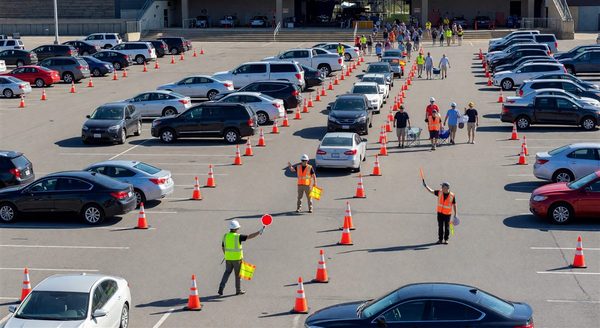
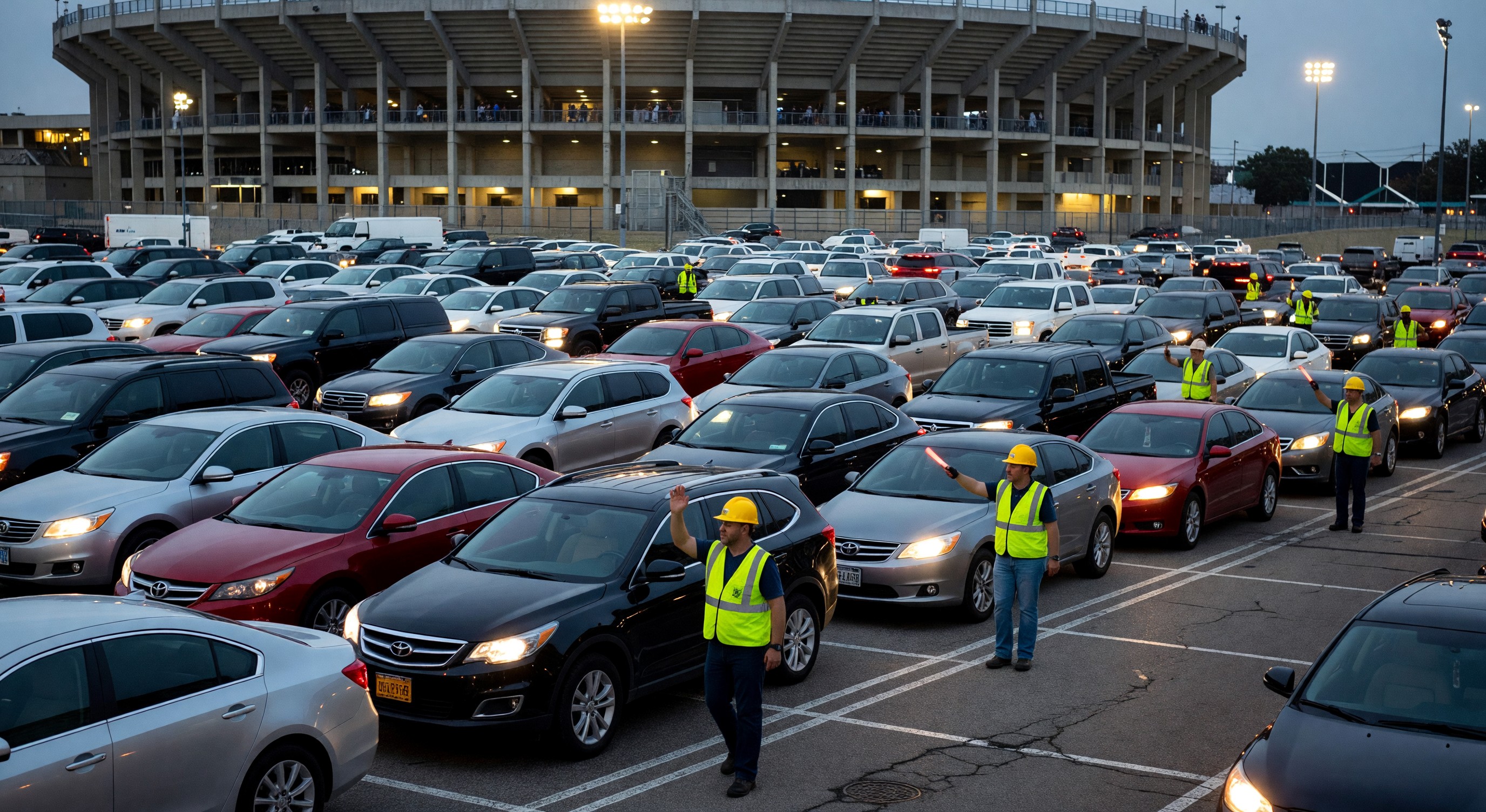
Traffic control personnel (law enforcement or trained lot attendants) are positioned at lot exits, street intersections, and pedestrian crossing points throughout the egress period. Minimum 1 traffic director per exit lane, plus 1 per major intersection in the lot.
Traffic Flow Management
Event egress is the most complex operational period. Traffic management priorities:
Staged release: Where multiple facilities serve a venue, releasing facilities sequentially rather than simultaneously prevents simultaneous street network saturation. Facilities further from the venue egress first; those closest hold until street capacity is available.
One-way circulation: Converting two-way drive aisles to one-way egress during the exit window maximizes throughput. Temporary signs and channelizing cones (not delineator posts — they impede rapid reconfiguration) redirect traffic for the event period.
Pedestrian/vehicle separation: Venues with high pedestrian volumes crossing parking facilities require traffic directors at every crossing. Pedestrian crossings should be closed to vehicles during high-pedestrian flow periods and reopened as pedestrian volumes diminish.
Communication with adjacent street operations: Radio coordination with traffic control staff at the street network allows the lot team to adjust release rates based on downstream street capacity — preventing lot exit queues that back up into the driving aisles.
Surge Pricing for Events
Event pricing — charging a premium above standard daily rates for event periods — is both a revenue maximization tool and a demand management mechanism. Higher prices during events reduce the cost-sensitive portion of demand (those who might have parked for the event but will use transit or rideshare at higher prices) and ensure that high-demand event stalls are available to those who value them most.
Event pricing ranges from 1.5× to 4× the standard daily rate, depending on the event, venue, distance from venue, and competitive price sensitivity of the market. Pre-sold event parking at fixed prices allows demand forecasting for operations planning; dynamic pricing (rates adjusted based on real-time occupancy) maximizes revenue but requires real-time pricing infrastructure and consumer price visibility.
Pre-event online parking reservations through facility platforms or aggregator apps (SpotHero, ParkWhiz, ParkMobile) shift cash transactions to pre-authorized card payments, dramatically simplifying event-day operations and accelerating egress.
Post-Event Reconciliation
Event reconciliation procedures:
- Pull the PARCS system transaction report for the event period by entry time, comparing actual vehicles to projected
- Reconcile pre-sold parking (digital reservations) against vehicles admitted under reservation credentials
- Count post-event cash and reconcile against system transaction totals
- Document any equipment failures, gate bypass events, or cashier exception transactions
- Compile staffing hours for payroll processing
- Complete an event after-action review (what worked, what didn’t, what to change next time)
After-action review is the most underutilized tool in event operations. Capturing lessons learned after every event — and actually incorporating them into the next event plan — is what separates operations that consistently improve from those that repeat the same problems.
Frequently Asked Questions
How is staffing calculated for large event parking operations? Calculate the peak arrival or departure rate (vehicles per hour), divide by the throughput per lane for the planned payment method, and add traffic control positions for exit routing and pedestrian management. Events at major venues require coordination across multiple facilities with staged egress.
Should event parking use pre-sold reservations or at-gate payment? Pre-sold parking through digital reservation platforms is strongly preferred for events. It pre-authorizes payment, shifts cash handling to card transactions, allows demand forecasting, and dramatically accelerates egress by eliminating on-exit payment. At-gate cash payment is the least efficient and most labor-intensive approach for event operations.
What is staged release and why is it used for event egress? Staged release sequences the opening of multiple parking facilities to avoid simultaneous saturation of the street network. Facilities furthest from the venue typically release first; those adjacent to the venue hold until street capacity is available. This reduces total egress time and prevents individual lot exits from queuing back through the driving aisles.
How much should event parking cost above standard daily rates? Event premium pricing ranges from 1.5× to 4× standard daily rates, depending on the event type, venue demand, and competitive market. Premium pricing serves both revenue and demand management functions — reducing cost-sensitive demand while generating higher per-stall revenue from demand-inelastic event attendees.
Takeaway
Event parking operations require purpose-built planning and execution that treats normal parking operations as a baseline, not a template. Demand forecasting, staffing calculations, traffic management plans, pre-sold parking, and post-event reconciliation are the elements of an event operations plan that converts the revenue opportunity of high-demand events into consistent, profitable execution. Facilities that plan events systematically — including after-action review and incorporation of lessons learned — consistently outperform those that improvise each event as its own one-time challenge.
Further Reading from Authoritative Sources
- IPMI event parking operations best practices and staffing guidance — IPMI is the primary professional association publishing event parking operations standards, staffing guidelines, and revenue management best practices for parking industry practitioners.
- ITE traffic management standards for special event venue operations — ITE publishes technical guidance on traffic control, pedestrian-vehicle separation, and traffic management for special event venues that directly informs the traffic flow management section of this article.