Parking facilities operate under a web of environmental and accessibility regulations that most operators know exist but few have fully documented and actively managed. Stormwater discharge permits, hazardous material handling requirements, and ADA operational standards are not set-once compliance items — they require ongoing operational practices, documentation, and periodic review. Operators who treat compliance as a one-time check expose themselves to regulatory enforcement and legal liability; those who build compliance into operational practice reduce risk systematically.
Stormwater Compliance
Parking lot and structure stormwater runoff is a significant source of nonpoint source pollution — petroleum hydrocarbons, heavy metals from brake and tire wear, and suspended solids that degrade receiving water quality. Environmental regulations govern how parking facility operators manage stormwater.
MS4 Permits: The EPA’s National Pollutant Discharge Elimination System (NPDES) Phase II rules require operators of Municipal Separate Storm Sewer Systems (MS4s) serving populations above 10,000 to implement stormwater management programs. For many large parking facilities, the relevant obligation is compliance with the local MS4 permit holder’s requirements — typically the municipality — which may include best management practices (BMPs) for parking lot operators.
General Construction Stormwater Permit: Any parking lot construction or major resurfacing project over 1 acre disturbed area requires a NPDES General Permit for Stormwater Discharges from Construction Activities, or the state equivalent. This requires a Stormwater Pollution Prevention Plan (SWPPP) and erosion control measures during construction.
Industrial Stormwater Permit: Some large parking operations (over 1 acre, with vehicle maintenance or fueling) may be classified as industrial operations subject to the NPDES Industrial Stormwater General Permit, which requires stormwater monitoring, annual reports, and specific BMP implementation.
Operational stormwater BMPs for parking facilities:
- Regular sweeping to remove pollutants before they are washed into storm drains
- Oil-water separator maintenance (inspect and pump at least annually)
- Spill response kit at all fueling or vehicle maintenance areas
- No washing of vehicles (which carries pollutants into storm drains) without proper containment
- De-icer application management (minimum effective rates; no excess application)
Hazardous Material Handling
Parking facilities use and generate hazardous materials that require proper handling, storage, and disposal:
De-icing chemicals: Sodium chloride (road salt), calcium chloride, and magnesium chloride are the most common de-icers. They are not classified as hazardous materials under OSHA HazCom standards but are environmental concerns for soil and water quality. Urea-based de-icers are classified under agriculture chemicals. Potassium acetate (used at some airports) requires SDS documentation under HazCom.
Petroleum products: Used motor oil (from vehicles), hydraulic fluid (from gate operators and PARCS equipment), and gasoline/diesel (from fuel spills or stored fuel) are regulated hazardous materials. Universal Waste requirements govern collection and disposal. Absorbent spill response materials must be available and properly disposed of after use.
Cleaning chemicals: Commercial cleaning chemicals used in parking garage cleaning may include solvents, degreasers, and alkaline cleaners that are classified hazardous under OSHA HazCom. Safety Data Sheets (SDS) must be accessible to employees who handle these materials.
Fluorescent lamp disposal: Parking facilities transitioning from fluorescent or HID to LED must dispose of old lamps as Universal Waste. Lamp recycling programs are available through many suppliers and municipalities.
Waste disposal documentation: Maintain disposal records for any regulated waste generated at the facility — used oil, fluorescent lamps, cleaning chemical containers, contaminated absorbents. Records should be retained for at least 3 years.
ADA Operational Compliance
ADA compliance is not only a design issue — it has ongoing operational requirements:
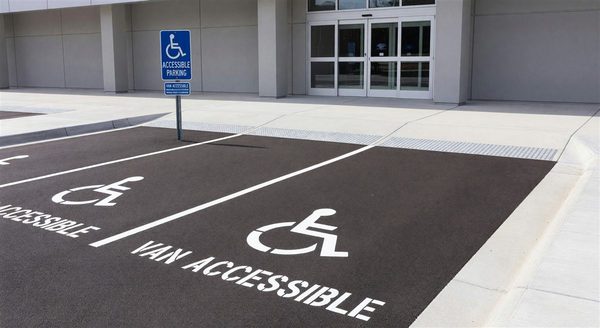
Snow and ice removal: ADA requires that accessible parking spaces, access aisles, and accessible routes to building entrances be cleared of snow and ice before or simultaneously with general parking areas. The access aisle must remain clear — snow plowed into an accessible access aisle creates ADA non-compliance for the duration of the snow event.
Barrier-free access maintenance: Any temporary barriers (construction, equipment maintenance, event management) that obstruct accessible routes must be replaced with alternative accessible access. Blocking an accessible route without providing an accessible alternative is an ADA violation.
Equipment accessibility: Pay stations and customer service kiosks must remain ADA-compliant in operation — not just at installation. Equipment that shifts in position, has height controls that move, or has accessibility features disabled must be corrected immediately.
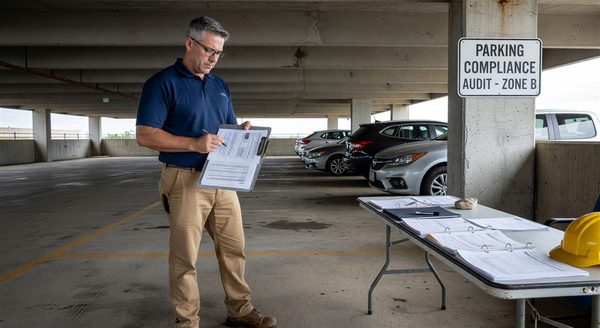
Annual accessible parking audit: The operation of accessible parking — proper signage, correct dimensions, clear access aisles, unobstructed accessible routes — must be inspected regularly. Annual inspection with corrective action tracking is the operational standard.
Building an Environmental Compliance Program
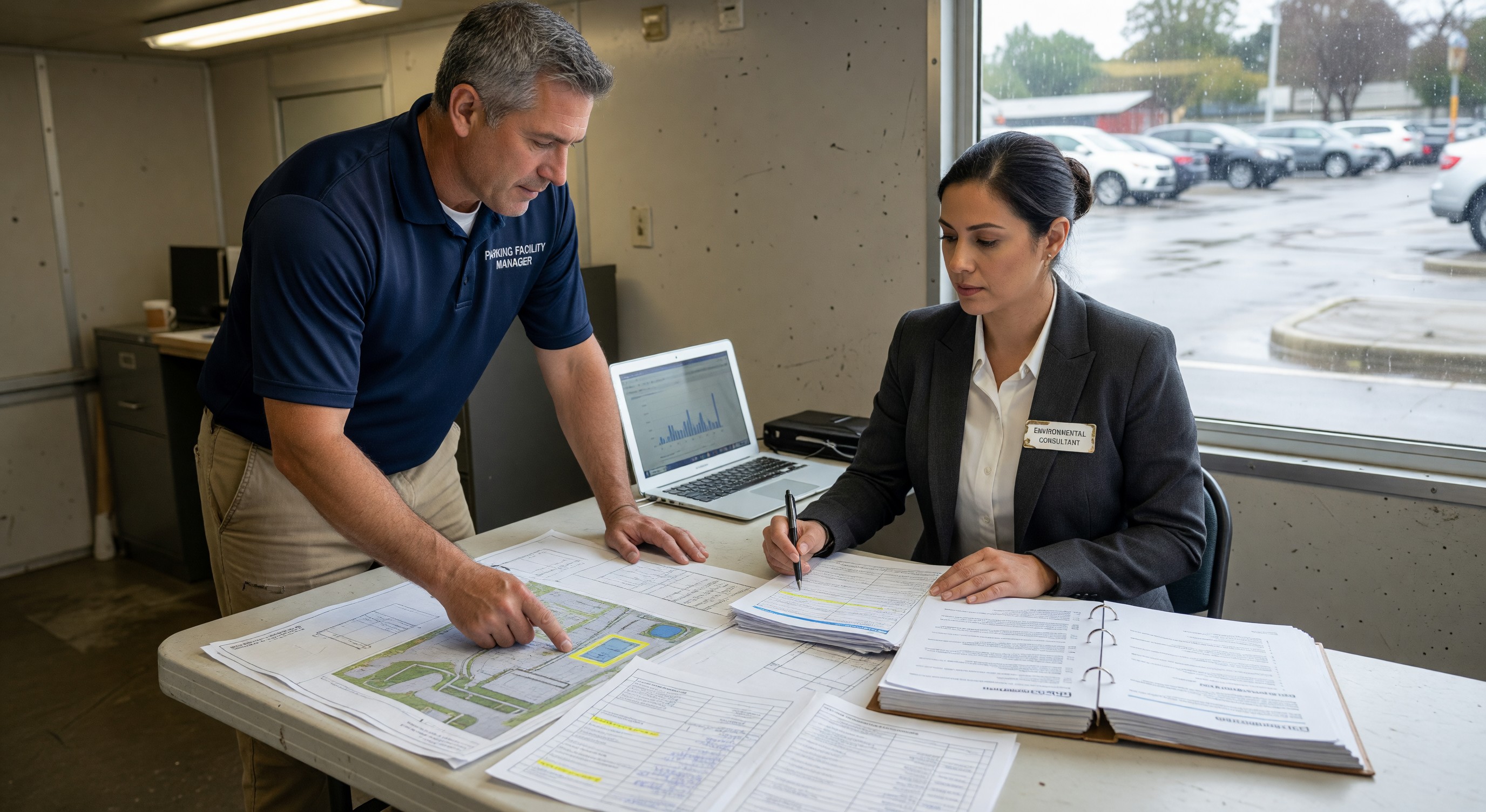
A documented environmental compliance program converts scattered compliance obligations into a managed operational framework:
- Regulatory inventory: Document all applicable regulations (NPDES, state stormwater, OSHA HazCom, ADA) and the specific requirements they impose
- BMP implementation plan: For each regulatory requirement, document the BMP or practice that addresses it
- Inspection schedule: Define frequency for compliance inspections (monthly stormwater BMP inspection, annual ADA audit, quarterly hazmat storage inspection)
- Training: Ensure all staff who handle hazardous materials or perform stormwater BMPs have received applicable training
- Documentation: Maintain records of BMP implementation, inspection findings, corrective actions, and regulatory correspondence
- Annual review: Review the compliance program annually against any regulatory changes
Frequently Asked Questions
What stormwater permits apply to a large commercial parking lot? Most large parking lots must comply with their local MS4 permit holder’s stormwater management requirements, which typically include BMPs such as regular sweeping, oil-water separator maintenance, and spill prevention. Lots over 1 acre undergoing construction require a NPDES Construction General Permit. Some facilities with vehicle maintenance operations may require an Industrial Stormwater permit.
How must accessible parking be maintained during snow events? ADA requires accessible spaces, access aisles, and accessible routes to building entrances to be cleared of snow simultaneously with general parking. Snow cannot be plowed into accessible access aisles. This is both an ADA compliance obligation and a practical necessity for customers with disabilities who park in accessible spaces.
What hazardous materials are typically generated by parking facilities? Used motor oil, hydraulic fluid from equipment, cleaning chemical residues, contaminated absorbents from spill cleanup, and fluorescent lamp waste are the most common. Each must be managed as Universal Waste or hazardous waste per applicable regulations. Maintain disposal records for at least 3 years.
Is formal documentation required for parking facility environmental compliance? Yes. NPDES permits require documentation of BMP implementation and inspections. OSHA HazCom requires SDS documentation accessible to employees. ADA requires ongoing compliance with operational accessibility standards. Maintaining organized documentation reduces regulatory risk and provides evidence of good-faith compliance in the event of an inspection or complaint.
Takeaway
Environmental compliance in parking operations is an ongoing management discipline, not a one-time design or construction certification. Stormwater management, hazardous material handling, and ADA operational requirements all impose continuing obligations that must be built into operational practice, staffing, and documentation. Facilities that build a structured environmental compliance program — with a regulatory inventory, BMP implementation plan, inspection schedule, and annual review — maintain compliance efficiently and reduce the enforcement and liability risks that arise when compliance is managed informally or reactively.
Further Reading from Authoritative Sources
- US EPA NPDES stormwater program requirements for parking facilities — The EPA is the federal authority for NPDES stormwater permits directly cited in this article as the primary regulatory framework governing parking facility stormwater discharge obligations.
- ADA operational requirements for accessible parking maintenance — ADA.gov is the official government source for ADA compliance requirements including the ongoing operational obligations for accessible parking that extend beyond initial design compliance — directly relevant to this article’s guidance on ADA operational compliance.