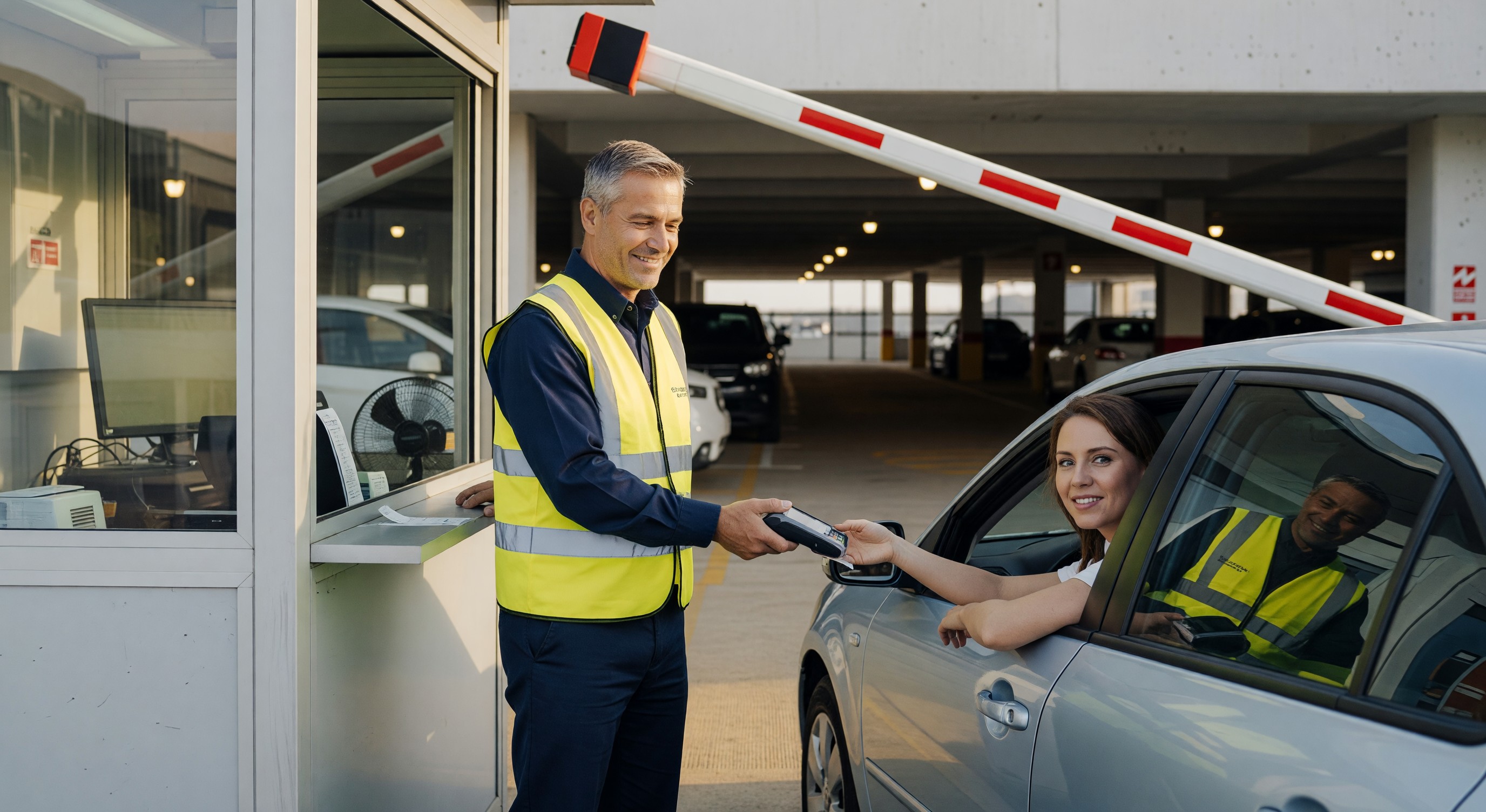
Parking is typically a transactional relationship — customers pay to store their vehicle and expect the vehicle to be there, undamaged, when they return. The experience is rarely memorable in a positive sense. But when something goes wrong — equipment failure, a confusing layout, a billing dispute, or damage to a vehicle — the way the operation handles it determines whether the customer returns or takes their business and their social media reviews elsewhere. Customer service standards in parking operations exist precisely for these moments.
Setting Service Standards
Customer service standards define expected behavior for every customer interaction. Effective standards are specific enough to guide real behavior without being so prescriptive that they prevent employees from using judgment. The IPMI (International Parking and Mobility Institute) and consulting firms specializing in parking operations management have developed benchmarks across four interaction categories:
Greeting: Every customer entering an attended lane should receive an acknowledgment within 10 seconds of stopping — a spoken greeting, eye contact, or a visible head nod. “Hello/good morning/afternoon” followed by a clear transaction prompt (“How long will you be parking?” or “Monthly or transient?”) is the standard template. Scripted greetings that sound robotic undermine the service quality they intend to convey.
Transaction processing: Transactions should be completed accurately and without unnecessary delay. Cashier performance benchmarks typically specify maximum 30 to 45 seconds average transaction time for cash and credit combined. Common service failure points: providing incorrect change, failing to verify validation eligibility, not confirming the amount charged before processing.
Assistance: Staff should be prepared to assist customers who are confused about layout, wayfinding, payment, or facility services. Effective assistance means understanding the customer’s actual need and helping them resolve it, not merely directing them to another person or a sign.
Exit interaction: The exit transaction is the last impression of the facility. “Thank you — have a great day” or equivalent closes the interaction positively regardless of any frustrations during the parking experience.
Complaint Handling Procedures
Complaints in parking operations fall into predictable categories: billing disputes (overcharges, incorrect time calculation), vehicle damage (dings, scratches, theft of vehicle contents), equipment failures (inability to process payment, gate malfunction), and general dissatisfaction (layout confusion, long waits, unhelpful staff). Each requires a defined response procedure.
The service recovery framework (LEARN): A widely taught approach in hospitality and service operations:
- Listen: Give the customer full attention without interrupting
- Empathize: Acknowledge the frustration without immediately accepting or denying fault
- Apologize: A genuine apology for the inconvenience, independent of fault determination
- Resolve: Offer a specific, prompt resolution — not a vague promise to “look into it”
- Notify: Follow up to confirm the resolution was implemented
Frontline staff should be authorized to resolve complaints within defined limits without management escalation — typically refund authority up to a set amount (commonly $20 to $50), complimentary parking validation for the visit, and access to a complaint form for issues beyond their authority. Requiring every complaint to escalate to a manager creates delays and signals to customers that staff are not trusted or empowered.
Vehicle Damage Claims
Vehicle damage claims — the highest-stakes complaint type — require a specific protocol:
- Staff should never deny or dismiss a damage claim before investigation
- Document the customer’s report: name, contact information, vehicle description, damage described, date/time
- Pull CCTV footage of the vehicle from entry to the reported time of damage discovery
- Contact the supervisor or manager immediately
- Provide the customer with a written acknowledgment of the report and a contact for follow-up
- Do not admit fault before investigation is complete
Facilities with clear protocols for vehicle damage claims handle them more efficiently, with less legal exposure, than those that rely on staff improvisation. The protocol should be posted in the operations manual and reviewed in training.
Proactive Service Standards
Service recovery is important, but proactive service — preventing complaints before they occur — is more valuable. Proactive service standards include:
Facility cleanliness: A dirty, poorly lit, or debris-strewn facility is a service failure before the customer ever interacts with staff. Regular cleaning inspections with documented checklists establish cleanliness as a standard rather than an aspiration.
Equipment functionality: Equipment failures (broken pay stations, gates stuck in the down position, ticket dispensers jammed) are among the most common sources of customer frustration. Preventive maintenance schedules and response time standards for equipment failure (IPMI and NPA recommend maximum 30-minute response for equipment failures at primary entry/exit lanes) prevent avoidable frustrations.
Proactive communication: When a problem is anticipated — construction disruption to normal routes, reduced stall availability during an event, equipment maintenance — communicating in advance by signage, email to permit holders, or social media reduces complaint volume significantly.
Measuring Customer Service Performance
What gets measured gets managed. Customer service measurement tools for parking:
- Customer satisfaction surveys: Short (3 to 5 question) digital surveys accessible via QR code at exit lanes or on receipts. Overall satisfaction, cleanliness, staff friendliness, and ease of payment are the most actionable questions.
- Mystery shopping: Third-party or internally conducted mystery shopping visits evaluate actual staff behavior against the service standards. Monthly mystery shops with scored results create accountability.
- Online review monitoring: Google Business Profile, Yelp, and TripAdvisor (for hospitality-adjacent facilities) review monitoring identifies systemic issues and provides marketing intelligence. Responding to reviews — both positive and negative — signals service investment to prospective customers.
- Complaint log analysis: Tracking complaint volume by category (billing, damage, equipment, staff) over time reveals operational patterns that training or process changes can address.
Frequently Asked Questions
What should a parking attendant do when a customer disputes a charge? Listen to the dispute without arguing, verify the transaction details in the PARCS system, and apply refund authority within the staff member’s defined limit. Issues exceeding authority should be escalated to the manager with the customer’s contact information documented. Never argue about the amount owed; resolve the issue with documented verification.
How should a vehicle damage claim be handled? Document the report (customer information, vehicle details, damage described, time), pull CCTV footage, contact the supervisor immediately, provide the customer with written acknowledgment, and defer fault determination to the investigation. Staff should acknowledge the report and express concern without admitting liability.
What customer service metrics should parking operations track? Customer satisfaction scores (from surveys), online review ratings and trends, complaint volume by category, mystery shop scores, and equipment uptime rates. Monthly tracking with trends across quarters reveals operational improvements and regressions.
How much authority should frontline staff have to resolve complaints? Frontline staff should be authorized to resolve most transactional complaints independently — typically refund authority up to $20 to $50 and the ability to provide complimentary parking for the visit. Requiring every resolution to escalate to management creates delays and signals distrust that undermines service culture.
Takeaway
Customer service in parking is defined primarily in the moments when things go wrong — the billing dispute at the exit, the report of a vehicle scratch, the gate that won’t open. Facilities with defined service standards, trained and empowered staff, and clear complaint handling protocols convert these difficult moments into evidence of operational competence. Those without standards rely on individual improvisation, which produces inconsistent outcomes and chronic negative reviews. Service standards are not bureaucratic constraints on staff judgment — they are the framework within which good judgment operates effectively.
Further Reading from Authoritative Sources
- IPMI parking operations certifications and professional service standards — IPMI is explicitly cited as the source of customer service benchmarks and equipment response time standards in this article.
- ITE parking operations professional development and service resources — ITE provides parking operations technical and professional resources that complement IPMI’s certification standards, giving readers an additional authoritative body for operational benchmarks applicable to customer service performance in parking facilities.