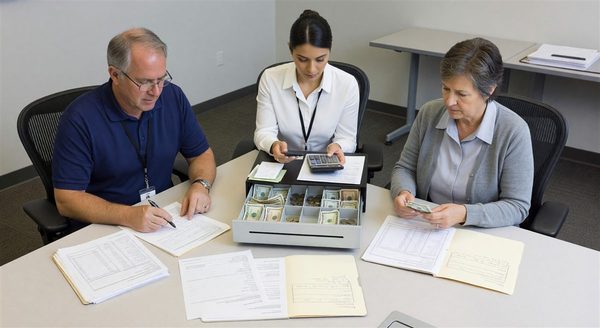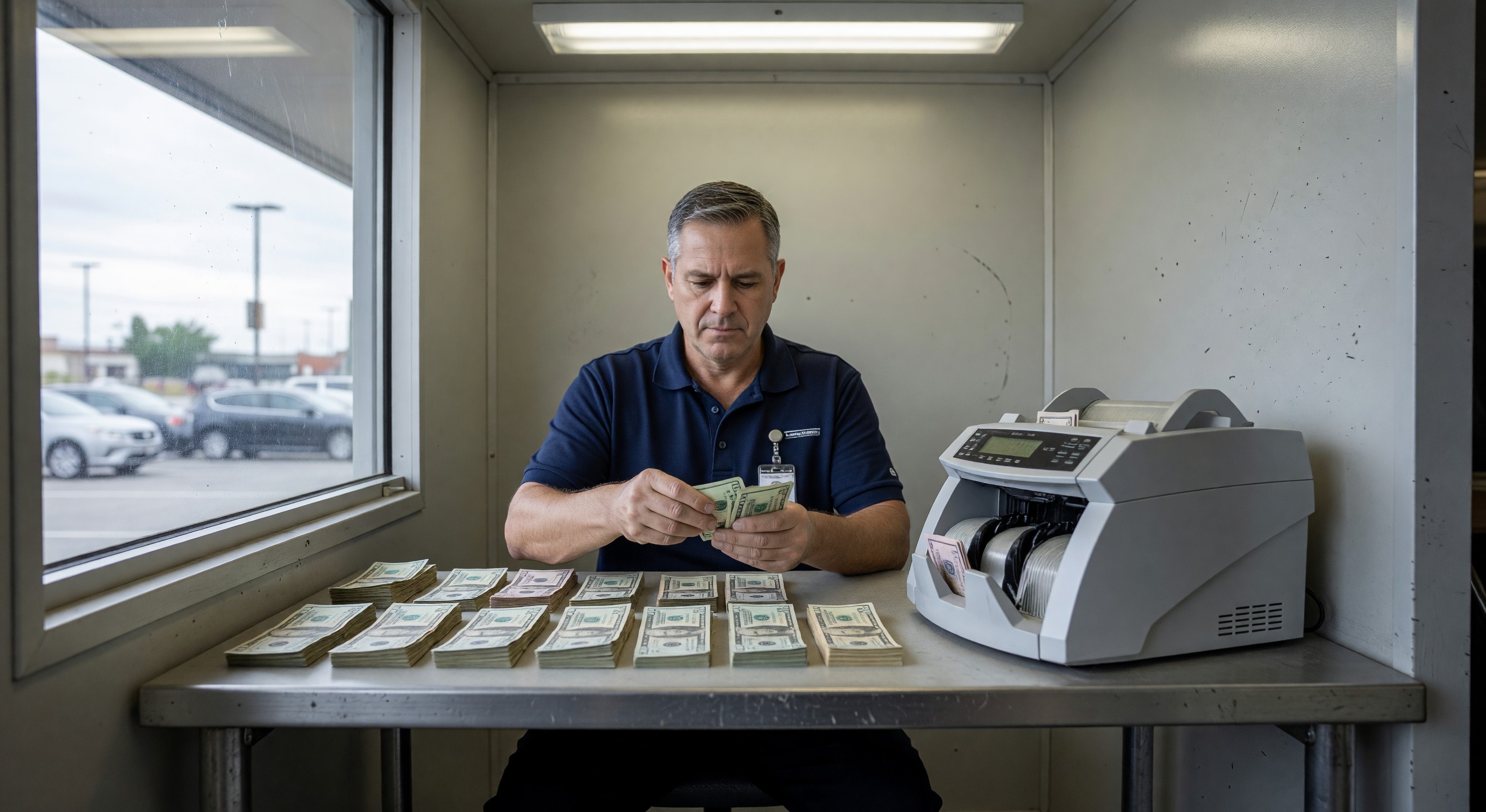
Cash remains a significant payment method in parking operations despite the growth of card and mobile payments. Even at facilities where credit card and contactless payments dominate, cash transactions of 20 to 40 percent of volume represent hundreds of thousands of dollars annually at mid-size facilities. Professional cash handling procedures protect revenue integrity, reduce employee theft risk, and create the documentation trail necessary for accurate revenue reconciliation and audit.
Starting Bank Management
Every cashier shift begins with a starting bank — pre-counted petty cash provided by the facility for making change. Starting bank management:
Standard bank amount: Most parking operations use a standardized starting bank amount by cashier position type (attended cashier, event cashier, etc.). Common starting bank amounts range from $50 to $300 depending on expected transaction volume and denomination mix. Higher-volume or higher-denomination environments require larger banks.
Bank issuance documentation: Banks are issued from a secure facility cash fund. Issuance is documented with a bank log: cashier name, shift date and time, amount issued, and signatures of the issuing supervisor and receiving cashier. Dual signature is the control standard; single-person bank issuance eliminates a control checkpoint.
Bank verification: Before accepting the bank, the cashier counts it and confirms the total. Any discrepancy from the standard amount is documented immediately before the shift begins. A cashier who accepts a short bank without documenting it at issuance is responsible for the deficit at end of shift.
Bank security during shift: The starting bank and transaction cash are maintained in the cashier booth cash drawer. Accumulated cash above a defined threshold is dropped to the locked drop vault — typically after every $500 to $1,000 in accumulation, or at defined intervals (every 30 to 60 minutes at high-volume periods).
Vault Drop Procedures
Drop vaults in cashier booths are secured containers accessible only to authorized supervisors, not to the cashier. The drop vault procedure:
- The cashier counts the accumulated cash from the drawer and records the amount on a drop ticket
- The cashier places the counted cash in an envelope or bag with the drop ticket
- The deposit is inserted through the vault slot; the cashier cannot retrieve it
- The drop ticket is retained by the cashier as a record of the drop amount
- The PARCS system transaction count since the last drop is noted on the drop ticket as a system check
Vault drops create a documented chain of custody for each cash movement from the cashier’s drawer to the secured vault. At shift end, the vault is opened by an authorized supervisor (using dual custody — two authorized individuals), and the total of all drops is reconciled against cashier drop tickets and the PARCS transaction total.
Cash Counting and Reconciliation
Shift-end cash counting should use a currency counting machine rather than hand counting. Currency counters produce an audit tape documenting the count — this tape becomes the official count record for the shift. Procedure:
- Supervisor opens the vault with second authorized person present (dual custody)
- All envelopes/bags are removed and listed by drop ticket number
- Currency counter processes all currency; audit tape produced
- Total counted amount minus the starting bank amount equals the gross cash collected
- Gross cash collected is compared to the PARCS system’s reported cash transaction total for the shift
- Variance (difference between counted cash and system total) is documented on the shift report
- The cashier signs the reconciliation; the supervisor countersigns
Variances within the defined tolerance (commonly ±$5.00) are recorded and closed. Variances outside tolerance require documented investigation before the shift is finalized.
Bank Deposits
Cash should be deposited to the bank daily, without accumulation over multiple days. Daily deposits:
- Accumulate all shift cash counts from the day into a single deposit amount
- Prepare the deposit slip with breakdown by denomination
- Double-count by a second authorized individual
- Both individuals sign the deposit documentation
- Cash is transported to the bank or placed in a night deposit under dual control
Where cash transport requires vehicle movement, the timing and route should be varied to reduce robbery risk. High-value deposits warrant armored carrier service rather than staff-transported deposits. A loss threshold for switching to armored transport — commonly $5,000 to $10,000 per deposit — should be defined in the cash handling policy.
Bank deposit receipts are retained and matched against the facility’s cash count records daily. Any discrepancy between the counted cash amount and the deposited amount is investigated immediately.
Counterfeit Currency Detection
Parking cashiers handle cash quickly and under pressure, creating conditions where counterfeit detection is challenging. Counterfeit losses are unrecoverable — once deposited at the bank, a counterfeit bill becomes the parking facility’s loss, not the bank’s.
Counterfeit detection tools:
- UV detection pens: Iodine-based markers that react differently on cotton-fiber currency paper (genuine) versus wood-pulp paper (most counterfeits). Fast and inexpensive; effective against basic counterfeits. Not reliable against high-quality counterfeits printed on bleached genuine paper.
- UV light illumination: Genuine US currency has embedded UV-reactive security strips and other fluorescent features that are absent from most counterfeits. UV light detection requires a mounted UV lamp in the cashier booth.
- Counterfeit detection machines: Currency counters with integrated counterfeit detection use UV, magnetic ink detection, and infrared sensors simultaneously. Higher reliability than single-method tools. Appropriate for high-cash-volume positions.
Policy: Any detected counterfeit bill should be retained (without returning it to the customer), the cashier should note the transaction details, and the bill should be submitted to law enforcement. Cashiers should never put themselves at physical risk to detain a suspected counterfeiter.
Frequently Asked Questions
Why is dual custody required for parking vault access? Dual custody — requiring two authorized individuals to access the vault together — prevents any single person from removing vault contents without a witness. It protects honest employees from false accusations and creates an additional barrier against intentional theft.
How often should cash be dropped from the cashier drawer to the vault? Drop frequency should be defined by policy and based on transaction volume. Common practice: after every $500 to $1,000 in drawer accumulation, or at defined time intervals (every 30 to 60 minutes during high-volume periods). Frequent drops limit the exposure of large cash accumulations in the cashier drawer.
What is the most reliable counterfeit detection method for parking cashiers? Currency counting machines with integrated UV, magnetic, and infrared detection provide the most reliable protection. For facilities using simpler tools, UV light detection of the embedded security strip and detection pen combined provide better protection than either alone. Train cashiers on the specific features of genuine currency they are checking for.
What should a cashier do if they discover a counterfeit bill in a transaction? Retain the bill (do not return it to the customer), document the transaction details (vehicle description, time), and notify the supervisor. Submit the bill to law enforcement. Cashiers should not confront or physically detain suspects.
Takeaway
Cash handling procedures are the operational infrastructure of revenue integrity in parking operations. Starting bank controls, vault drop procedures, dual custody for vault access, shift reconciliation protocols, and daily deposit practices form a control framework that protects revenue against both honest error and intentional misappropriation. The documentation created at each step — bank logs, drop tickets, count sheets, deposit records — provides the audit trail necessary for management oversight, external audit, and any subsequent investigation. Facilities that implement these procedures consistently experience materially lower unrecoverable cash variances than those that rely on informal practices.
Further Reading from Authoritative Sources
- IPMI parking operations standards and cash management guidance — The International Parking and Mobility Institute is the primary authority for parking operations best practices, including cash handling procedures that are the subject of the article.
- NIST guidance on physical security controls and cash handling systems — NIST publishes security control frameworks (including NIST SP 800-53) that provide authoritative context for the internal controls and physical security requirements in parking cash handling operations.