A parking control system is the operational backbone of any managed parking facility. It governs who enters, how they pay, when they leave, and what the operator knows about all of it. The acronym PARCS — Parking Access and Revenue Control Systems — has been the industry standard label for decades, as defined by the International Parking & Mobility Institute, though the systems it describes have evolved well beyond the ticket-spitting machines and cash registers it originally encompassed.
This guide covers the full scope of modern parking control: entry management, payment collection, exit processing, enforcement, and reporting. Whether you are planning a new facility, upgrading aging equipment, or simply trying to understand how all the pieces fit together, this article provides the framework you need.
Entry Systems: The First Point of Contact
The entry system determines who gets in, how they are identified, and what information the facility captures about the transaction from the outset.
Ticket-Based Entry
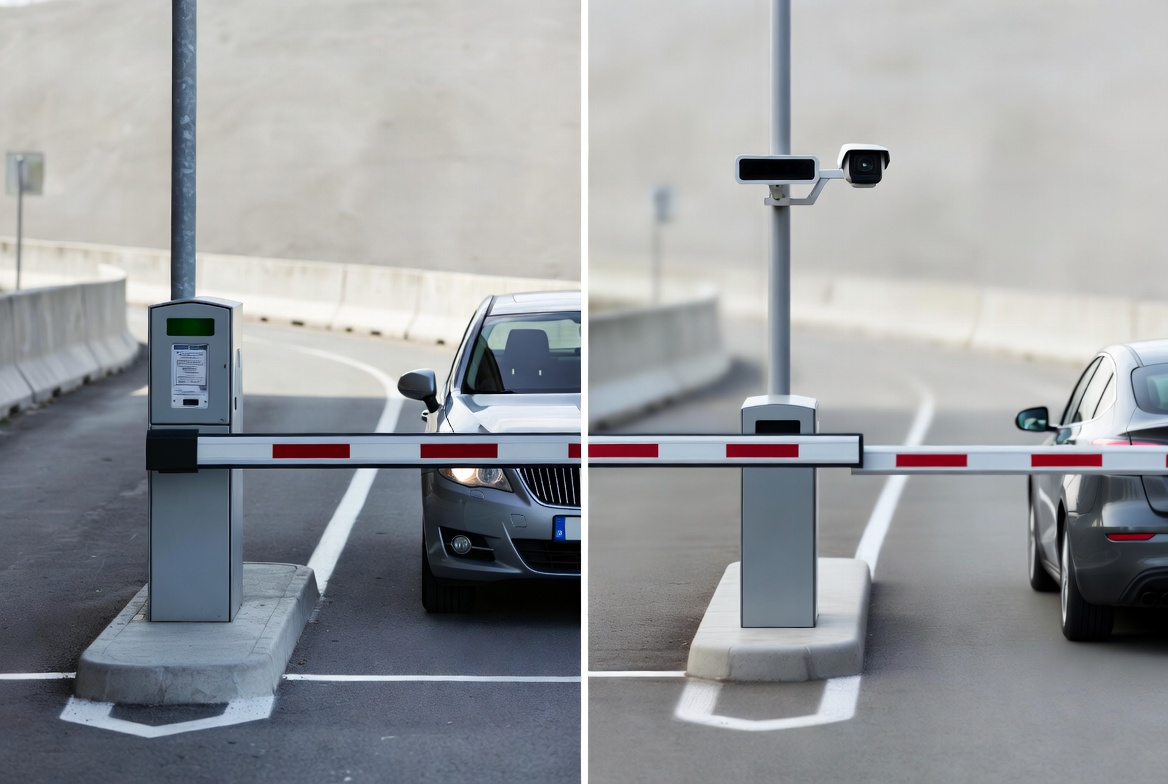
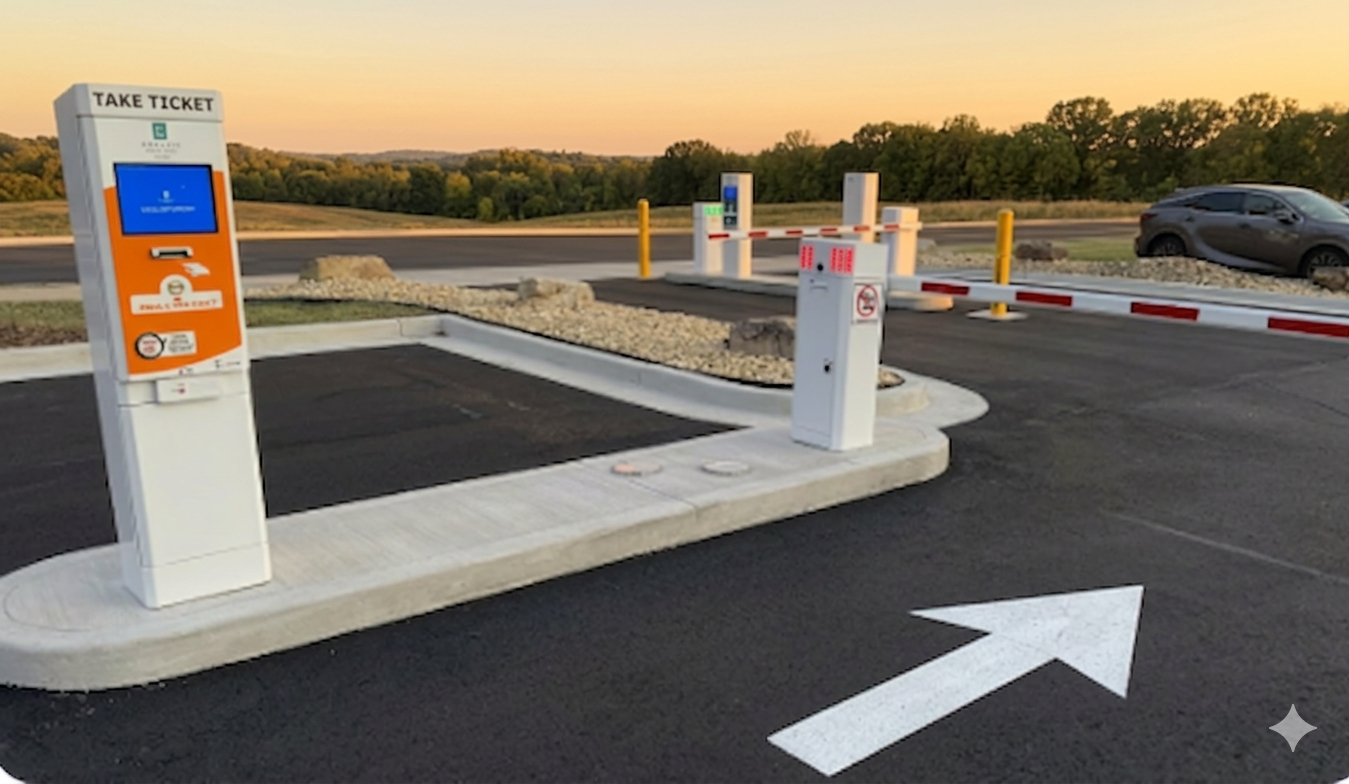
The traditional approach: a driver pulls up to a lane, takes a ticket from a dispenser, and a barrier gate rises. (For a technical look at what happens inside the gate mechanism during that cycle, see how automatic car park barriers work.) The ticket — either a paper ticket with a magnetic stripe or barcode, or a reusable RFID-embedded token — records the entry time and serves as the transaction identifier throughout the parking visit.
Ticket-based entry remains common but is declining. The hardware is proven and relatively inexpensive. But tickets create operational overhead: dispensers jam, tickets are lost, paper stock must be replenished, and the entire process adds seconds to each entry transaction that compound into meaningful congestion during peak periods.
Credential-Based Entry
Monthly parkers, tenants, and employees typically use credentials rather than tickets. The credential identifies the driver to the system and triggers gate opening without a ticket transaction.
Proximity cards and fobs remain the most common credential type in structured parking. They are inexpensive, reliable, and familiar to users. Their limitation is that they authenticate the device rather than the person — a shared card provides access to anyone who holds it.
Mobile credentials using Bluetooth Low Energy (BLE) or Near Field Communication (NFC) are gaining adoption. Smartphones replace physical cards, eliminating the cost of card issuance and the risk of lost or shared credentials. The user experience varies — some systems require an app to be open, while others work passively in the background.
License plate recognition is increasingly serving as the primary credential for both transient and permitted access. A camera reads the plate on approach, the system matches it against a database of authorized plates, and the gate opens without the driver doing anything. For transient parkers, LPR captures the plate at entry and associates it with the parking session, enabling ticketless operation.
Gateless Entry
Some facilities have eliminated entry gates entirely, relying on LPR cameras to record every entering vehicle. This approach maximizes throughput — there is no gate cycle time, no stopped vehicle, no potential for a mechanical failure to block a lane. It works well in environments where enforcement can be handled through other means (license plate-based citations, for example) and where the revenue risk of unrecorded entries is acceptable.
Gateless systems are most common in surface lots and campuses where the physical environment makes gates impractical. In structured garages where controlling access is both a revenue and security function, gated entry remains the norm.
Payment Systems: Collecting Revenue
Payment is where the economic purpose of a parking control system is realized. Modern facilities offer multiple payment channels, each serving different customer preferences and operational needs.
Pay-on-Foot Stations
Pay-on-foot (POF) stations — sometimes called pay stations or auto-pay machines — allow drivers to pay before returning to their vehicle. Located in elevator lobbies, stairwell landings, or near facility exits, POF stations accept the driver’s ticket or read their license plate, calculate the fee, accept payment, and encode the ticket or update the system to allow exit.
Modern POF stations accept credit cards, debit cards, contactless payments (Apple Pay, Google Pay), and in some cases mobile payments via QR code. All payment-accepting devices must comply with PCI Security Standards to protect cardholder data. Cash acceptance is declining but remains necessary in facilities serving diverse demographics. Stations that accept cash require bill validators, coin mechanisms, and bill recycling or change-making capability — all of which add maintenance burden and cost.
The trend in POF design is toward larger screens, simpler interfaces, and multilingual support. Operators serving international travelers, hospital visitors under stress, or elderly populations need payment stations that are intuitive for users with varying levels of technology comfort.
In-Lane Payment
In-lane payment integrates the payment transaction with the exit lane. The driver inserts a ticket or is identified by LPR, the fee is displayed, and payment is accepted at the exit lane itself. This consolidates the pay-on-foot and exit functions into a single interaction.
The trade-off is speed. In-lane payment is slower than pre-paid exit because the driver must complete the payment transaction while sitting in the exit lane, blocking the lane for following vehicles. During peak exit periods, this creates congestion. Facilities that rely heavily on in-lane payment need more exit lanes than those where most customers pay on foot before reaching the exit.
Mobile and Digital Payment
Mobile payment — through operator apps, third-party platforms like ParkMobile or PayByPhone, or reservation systems — enables drivers to pay without interacting with any physical device. The session is started and ended through the app, payment is processed digitally, and the exit gate opens based on plate recognition or a digital credential.
Mobile payment is the fastest-growing payment channel in parking. It reduces hardware maintenance, speeds throughput, eliminates cash handling, and generates complete digital transaction records. The limitation is adoption — not all customers have smartphones, are willing to download an app, or are comfortable with digital payment. Facilities that go fully mobile-only risk alienating customer segments that other payment channels serve.
Validation
Validation programs allow third parties — retailers, restaurants, employers, hospitals — to subsidize or fully cover parking costs for their customers, employees, or visitors. Validation systems have evolved from paper stamps and stickers to electronic systems where the validating business applies a credit to the parking transaction through a point-of-sale integration, a web portal, or a mobile app.
Electronic validation provides operators with detailed data about validation usage — who validates, how often, and at what cost. This data enables auditing of validation programs and identification of overuse or fraud, which paper-based validation systems cannot support.
Exit Systems: The Final Transaction
The exit system closes the parking transaction. Its design directly affects customer experience — the exit is the last interaction a driver has with the facility, and a frustrating exit experience colors the memory of the entire visit.
Barrier Gate Exit
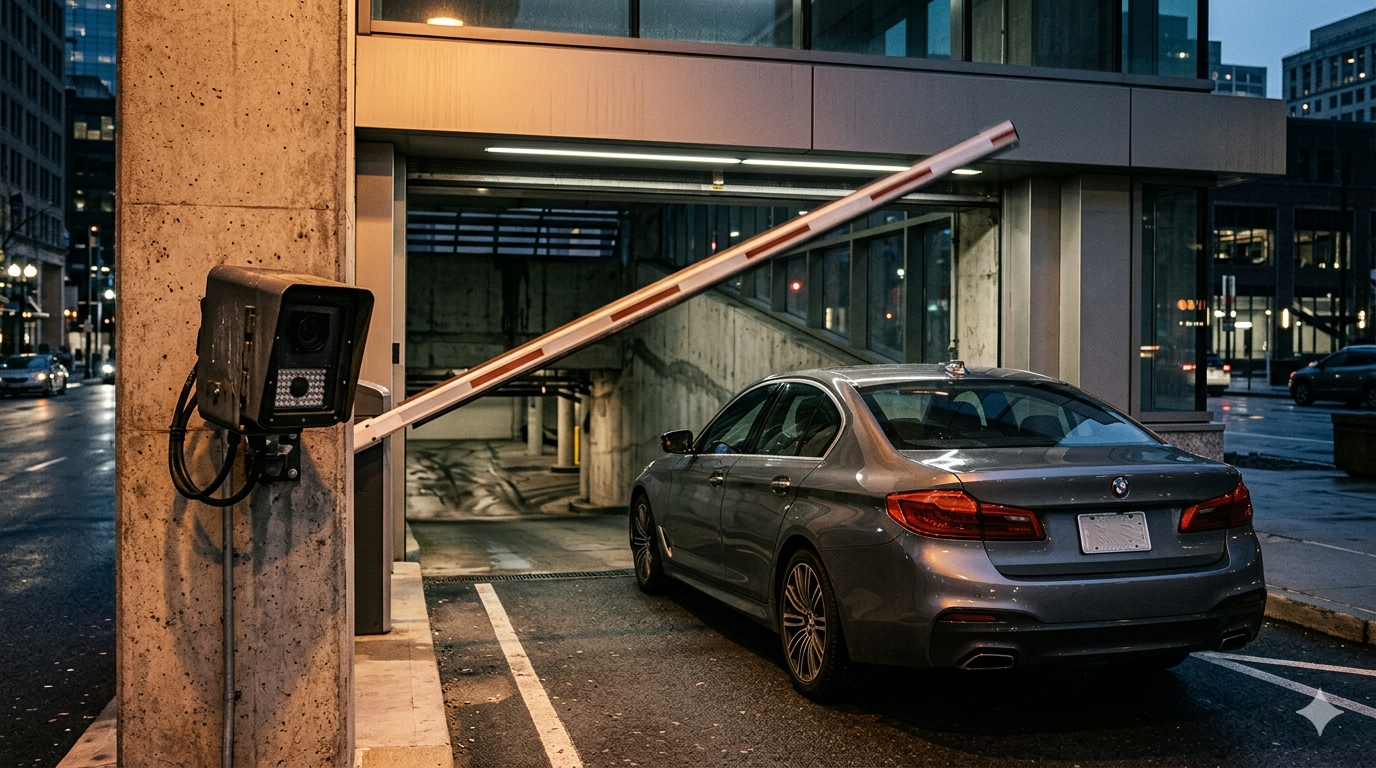
In gated facilities, the exit lane verifies that payment has been made (by reading a paid ticket, checking a plate against the payment database, or validating a credential) and opens the barrier gate. The gate must then close before the next vehicle approaches to prevent tailgating — a source of revenue leakage that operators take seriously.
Anti-tailgating measures include:
Safety loops embedded in the pavement detect when a vehicle is present in the gate zone, preventing the gate from closing on a vehicle. These are standard safety features required by code.
Anti-passback logic in the access control system prevents a credential from being used for a second entry without a corresponding exit event. This does not prevent physical tailgating but prevents credential sharing.
Tailgate detection sensors using infrared, laser, or camera-based technology detect when multiple vehicles pass through on a single gate cycle and trigger alerts or record the event for follow-up.
High-Speed Exit
Facilities with high exit volumes — event venues, airports, large retail centers — need exit lanes that process vehicles quickly. High-speed barrier gates that cycle in one to two seconds (compared to four to six seconds for standard gates) significantly increase exit throughput. Combined with pre-payment and LPR identification, high-speed exit lanes can process 400 to 600 vehicles per hour, compared to 150 to 200 for traditional in-lane payment exits.
Gateless Exit
Matching gateless entry, gateless exit uses LPR to record departing vehicles. The system matches the exit record with the entry record, verifies payment, and flags any vehicles that exit without paying for enforcement follow-up. This approach maximizes exit throughput and eliminates gate maintenance but requires robust enforcement capability and a tolerance for some level of revenue leakage.
Enforcement: Ensuring Compliance
Enforcement in modern parking systems has moved from chalk marks on tires and paper tickets under windshield wipers to technology-driven approaches that are more consistent, more efficient, and more documentable.
LPR-Based Enforcement
License plate recognition enables mobile enforcement where a vehicle equipped with LPR cameras drives through a facility or district, reading plates and comparing them against databases of paid sessions, valid permits, and violation histories. Vehicles without valid payment or permits are flagged automatically, and citations are either issued on the spot or mailed based on registered owner information.
LPR enforcement covers more territory in less time than foot-patrol officers, and its systematic coverage reduces the perception that enforcement is random or inconsistent. The data it generates — violation rates by time, location, and type — enables targeted enforcement strategies that maximize compliance with minimal staffing.
Digital Citations
Paper citations are being replaced by digital citation management systems that track the entire lifecycle of a violation: issuance, notification, appeal, payment, and collections. Digital systems reduce administrative overhead, improve collection rates, and provide the audit trails that contested citations require.
Permit Management
For facilities with permit programs — monthly parkers, tenant employees, validated users — enforcement includes verifying that permits are valid, used within their authorized parameters, and not shared or abused. Modern control systems automate much of this verification through credential authentication and anti-passback logic, but edge cases (expired permits, changed vehicles, special event exceptions) still require human judgment supported by system data.
Reporting and Analytics
The reporting layer of a parking control system transforms raw transaction data into operational intelligence. Every entry, exit, payment, and enforcement action generates data. The quality of reporting determines whether that data becomes actionable information or digital clutter.
Operational Reports
Standard operational reports include:
- Occupancy by hour, day, and facility zone
- Revenue by payment type, rate category, and time period
- Transaction volume at entry, exit, and payment points
- Equipment status including uptime, error rates, and maintenance needs
- Credential usage including permit activity, validation redemption, and access patterns
These reports serve daily management needs — understanding what happened yesterday, identifying today’s issues, and planning for tomorrow’s operations.
Financial Reporting
Revenue reconciliation — ensuring that every dollar the system recorded was actually collected and deposited — is a critical function that parking control systems must support. Reports that compare system-recorded revenue against payment processor settlements, cash counts, and bank deposits identify discrepancies that require investigation.
Tax reporting, audit support, and financial compliance requirements vary by jurisdiction and ownership structure but universally demand accurate, exportable transaction records. The National Parking Association publishes guidance on financial reporting best practices for parking operators.
Analytics and Insights
Beyond standard reporting, modern parking control platforms offer analytics that reveal patterns, trends, and opportunities:
Customer behavior analysis identifies how different customer segments use the facility — peak arrival times, average duration, payment preferences, and response to rate changes.
Revenue optimization analysis models the impact of potential rate changes, validation program adjustments, and product modifications before implementation.
Predictive maintenance uses equipment performance data to anticipate failures before they cause downtime, enabling proactive maintenance that reduces service disruptions.
System Architecture: How It Fits Together
A modern parking control system is not a single piece of equipment but an ecosystem of hardware, software, and network infrastructure. Understanding how the components interconnect helps operators make better procurement and maintenance decisions.
Field Hardware
The physical devices in the facility: barrier gates, ticket dispensers, card readers, LPR cameras, pay stations, lane controllers, signage, and sensors. These devices connect to local lane controllers that manage real-time operations — gate cycling, credential validation, payment processing — even if the network connection to the central server is temporarily interrupted.
Providers like Parking BOXX (system shown in main image) design integrated control systems where the hardware components are engineered to work together, reducing the integration complexity that often plagues multi-vendor installations.
Network Infrastructure
Ethernet cabling, fiber optic connections, and increasingly wireless networks link field hardware to the management platform. Network reliability is critical — a network outage that prevents gates from operating or payments from processing is an operational emergency. Redundant network paths and local processing capability at the lane level provide resilience against network failures.
Management Platform
The central software platform — whether on-premise or cloud-hosted — aggregates data from all field devices, provides the management interface, generates reports, and connects to external systems (payment processors, reservation platforms, building management systems, municipal databases).
Integration Layer
APIs, middleware, and data connectors that link the parking control system to the broader technology ecosystem: property management systems, ERP platforms, CRM tools, smart city infrastructure, and third-party service providers.
Selecting a Parking Control System
Operators evaluating parking control systems should consider:
Facility requirements. Transaction volume, customer mix, payment preferences, security needs, and growth projections determine the functional requirements.
Technology direction. Is the vendor investing in LPR, mobile payment, cloud management, and AI analytics? Or are they maintaining legacy technology that will become increasingly difficult to support?
Integration ecosystem. Does the system integrate with your existing infrastructure — building management, accounting, reservation platforms, and municipal systems?
Total cost of ownership. Hardware, software, installation, training, maintenance, and support over a realistic ownership period — not just the purchase price.
Vendor partnership. The relationship with a parking control system vendor spans years or decades. Evaluate the vendor’s support infrastructure, responsiveness, financial stability, and willingness to invest in the partnership.
Parking control systems have evolved from simple gate-and-ticket mechanisms to sophisticated platforms that integrate access management, payment processing, enforcement, and analytics into a cohesive operation. The technology continues to advance. The operators who approach system selection and management with both strategic vision and operational pragmatism will get the most from their investment.