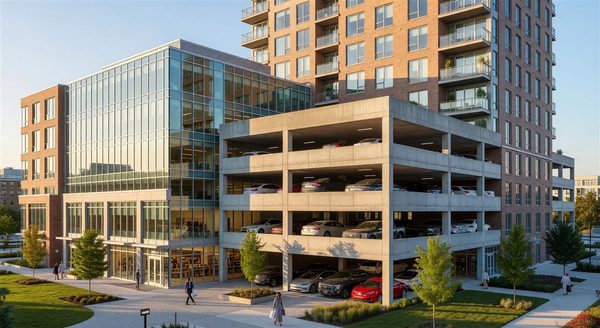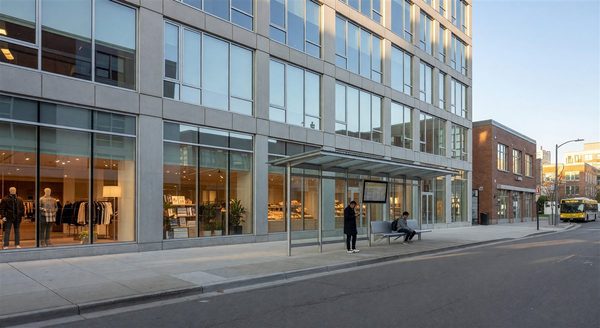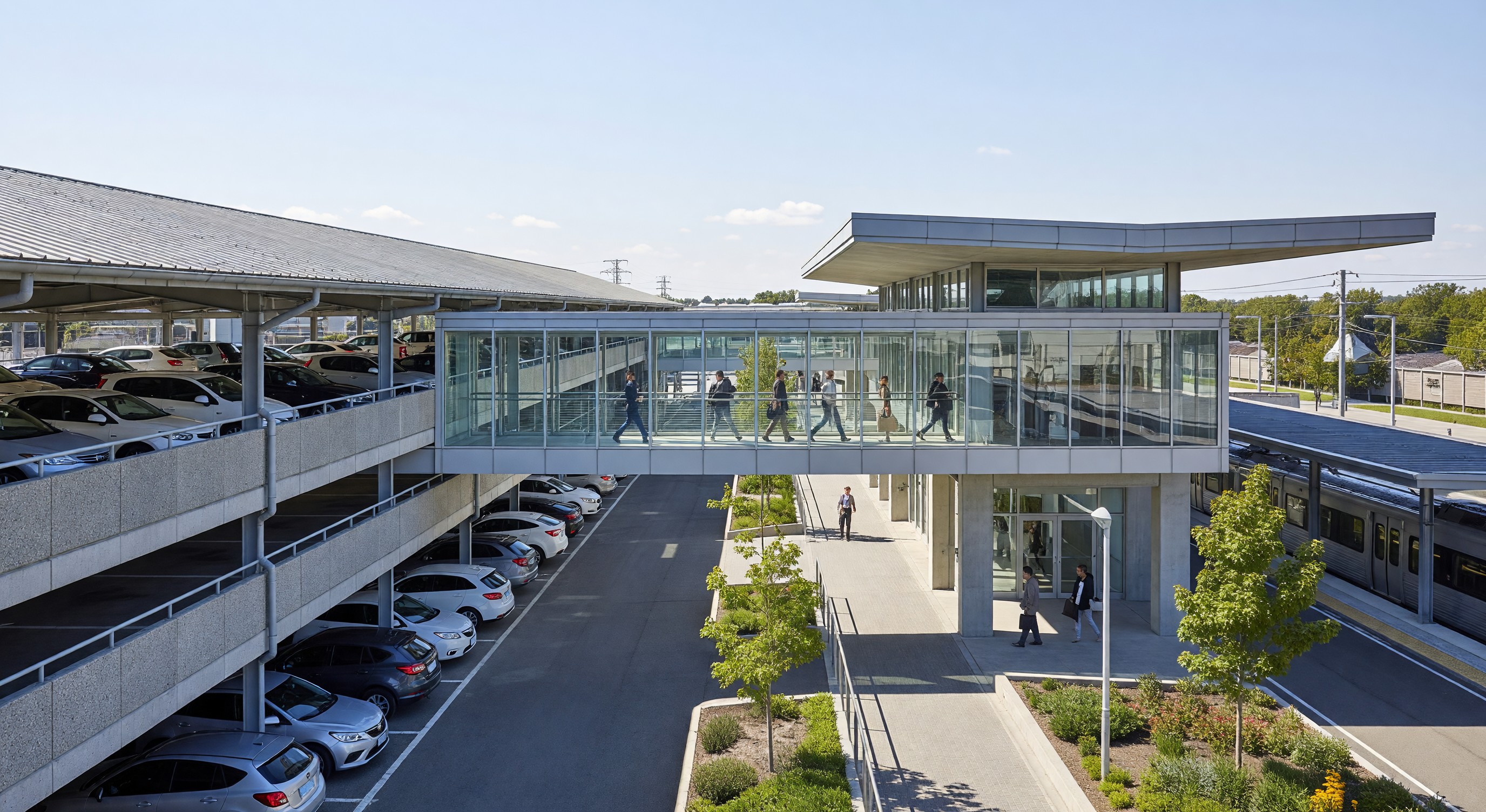
Transit-oriented development (TOD) places housing, employment, and services within walking distance of transit stations — typically within a quarter to half-mile radius. Parking in TOD contexts serves a different function than in conventional suburban development: it is a tool for capturing transit riders from beyond the walkable catchment area (park-and-ride), not a primary driver of land use. Getting parking design right in TOD is both more consequential and more nuanced than in conventional parking contexts.
The Paradox of TOD Parking
Parking quantity and location in TOD have a well-documented effect on transit ridership, land use patterns, and urban quality. Too much parking in TOD — particularly surface parking adjacent to the station — consumes walkable land, encourages driving over transit use, and degrades the pedestrian environment that makes TOD function. Too little parking restricts catchment area and reduces ridership from auto-dependent areas in the region.
Research from the Transit Cooperative Research Program (TCRP) and Victoria Transport Policy Institute consistently finds that:
- Park-and-ride facilities increase transit ridership when they serve markets where transit is already competitive but driving to the station is the necessary mode for the approach trip
- Large surface park-and-ride lots within a quarter mile of transit stations depress land value and TOD potential compared to structured parking that allows walkable development over and around it
- Reducing parking supply in walkable TOD neighborhoods does not significantly reduce transit ridership when the TOD is genuinely walkable and the transit service is frequent and reliable
Park-and-Ride Facility Design
Park-and-ride facilities serve commuters from outside the walkable transit catchment area who drive to the station, park, and ride transit to their destination. The design objectives for park-and-ride are different from urban commercial parking:
Location: Park-and-ride is most effective when located at the outer edge of the transit network — where commuters transition from the regional highway system to transit — not at the urban core, where land is too valuable for surface parking and transit is already walkable. Feeder station park-and-ride at suburban express stops typically serves most of its riders.
Pedestrian connection quality: The path from park-and-ride to the transit platform is the rider’s first and last experience. Minimum 10-foot-wide covered walkways connecting parking to the platform are a quality standard that affects both rider satisfaction and mode choice decisions. Platform proximity — not just distance — matters: a 300-foot uncovered walk in winter is a significant deterrent.
Capacity management: Peak park-and-ride demand is strongly correlated with weekday commute patterns. Most park-and-ride facilities are 90 to 100 percent utilized by 9 a.m. on weekday mornings and empty by noon. This utilization pattern is poorly matched to capital investment — the facility is underutilized 50 to 70 percent of its potential hours. Shared-use agreements for evenings and weekends (with retailers, churches, or event venues) improve asset utilization substantially.
Reservation systems: Overcrowded park-and-ride facilities generate significant rider dissatisfaction and mode abandonment. Transit agencies including BART, WMATA, Sound Transit, and many others have implemented reservation or permit systems that guarantee morning stall availability for regular commuters. Guaranteed reservation access is among the highest-rated park-and-ride amenities in rider satisfaction research.
Shared Parking in TOD Contexts
Shared parking — the practice of combining demand from multiple users who peak at different times — is the cornerstone of efficient TOD parking design. In a typical mixed-use TOD with office, retail, residential, and restaurant uses:
- Office parking demand peaks at 9 to 10 a.m. on weekdays, diminishes after 3 p.m.
- Retail demand peaks 11 a.m. to 7 p.m. on weekends and evenings
- Restaurant demand peaks 6 to 9 p.m. weekday evenings and all day weekends
- Residential demand peaks 8 p.m. to 8 a.m. nightly
These complementary demand patterns mean that a shared parking facility can serve all four user groups with substantially fewer total stalls than if each use built its own dedicated parking. The Urban Land Institute’s Shared Parking publication provides demand matrix methodology for calculating shared parking requirements by use mix.
Parking Standards for TOD: What Research Shows
ITE Trip Generation rates and standard parking ratio tables were developed from suburban auto-dependent contexts and systematically overestimate parking demand in transit-accessible urban environments. Research from Reconnecting America, Nelson/Nygaard, and multiple transit agencies shows:
- TOD near frequent transit (10-minute or better headways) generates 25 to 50 percent less parking demand than ITE rates predict for the same land uses
- Residential TOD with high transit service levels and unbundled parking averages 0.5 to 1.0 vehicles per unit (versus 1.8 to 2.2 in suburban contexts)
- Office TOD near major employment centers (downtown, medical districts) generates 1.5 to 2.5 spaces per 1,000 sf of demand (versus 4 to 5 per 1,000 in suburban areas)
Municipalities with updated TOD parking standards — including Portland, Denver, Washington DC, and Minneapolis — have established reduced or eliminated parking minimums near frequent transit, acknowledging that ITE-based minimums systematically oversupply parking in these contexts.
Frequently Asked Questions
Where should park-and-ride facilities be located relative to transit stations? Park-and-ride is most effective at suburban express stations where commuters transition from highway to transit. At urban core stations, land is too valuable for surface parking and transit is already walkable. Park-and-ride should be located to serve mode-transition demand, not walkable catchment.
How does parking quantity affect TOD quality? Excessive parking in TOD consumes walkable land, encourages driving over transit, and degrades the pedestrian environment. Research consistently shows that TOD with reduced parking near walkable, frequent transit performs well for transit ridership without the land consumption and urban quality penalties of large surface parking facilities.
What is shared parking and why is it important in TOD? Shared parking combines demand from users who peak at different times, reducing total stall count for a mixed-use development. In TOD, office, retail, restaurant, and residential peak demand patterns are complementary, allowing shared facilities to serve all uses with significantly fewer stalls than dedicated parking for each.
How should parking demand be estimated in TOD contexts? ITE Trip Generation rates significantly overestimate TOD parking demand. Research from transit agencies and planning organizations shows TOD generates 25 to 50 percent less parking demand than ITE suburban rates. Use mode-specific adjustments, local data from comparable TOD projects, and consider the Victoria Transport Policy Institute’s transit-adjusted parking demand resources.
Takeaway
Parking in TOD contexts requires a fundamentally different design philosophy than suburban parking. The goal is not maximizing parking supply but optimizing the mode-capture function of park-and-ride at appropriate network locations while minimizing parking footprint in the walkable station area. Shared parking, transit-adjusted demand standards, and structured rather than surface parking in the station area all support transit ridership goals while preserving the walkable land values that make TOD financially and urbanistically successful.
Further Reading from Authoritative Sources
- Transit Cooperative Research Program TOD parking demand and park-and-ride research — The Transportation Research Board (TRB) administers the TCRP, which is explicitly cited in the article as a source for TOD parking demand research and park-and-ride effectiveness findings.
- FHWA parking policy and transportation demand management guidance — FHWA publishes the technical standards and policy framework governing parking supply, trip generation assumptions, and transportation demand management that directly informs how TOD parking standards are developed and applied.