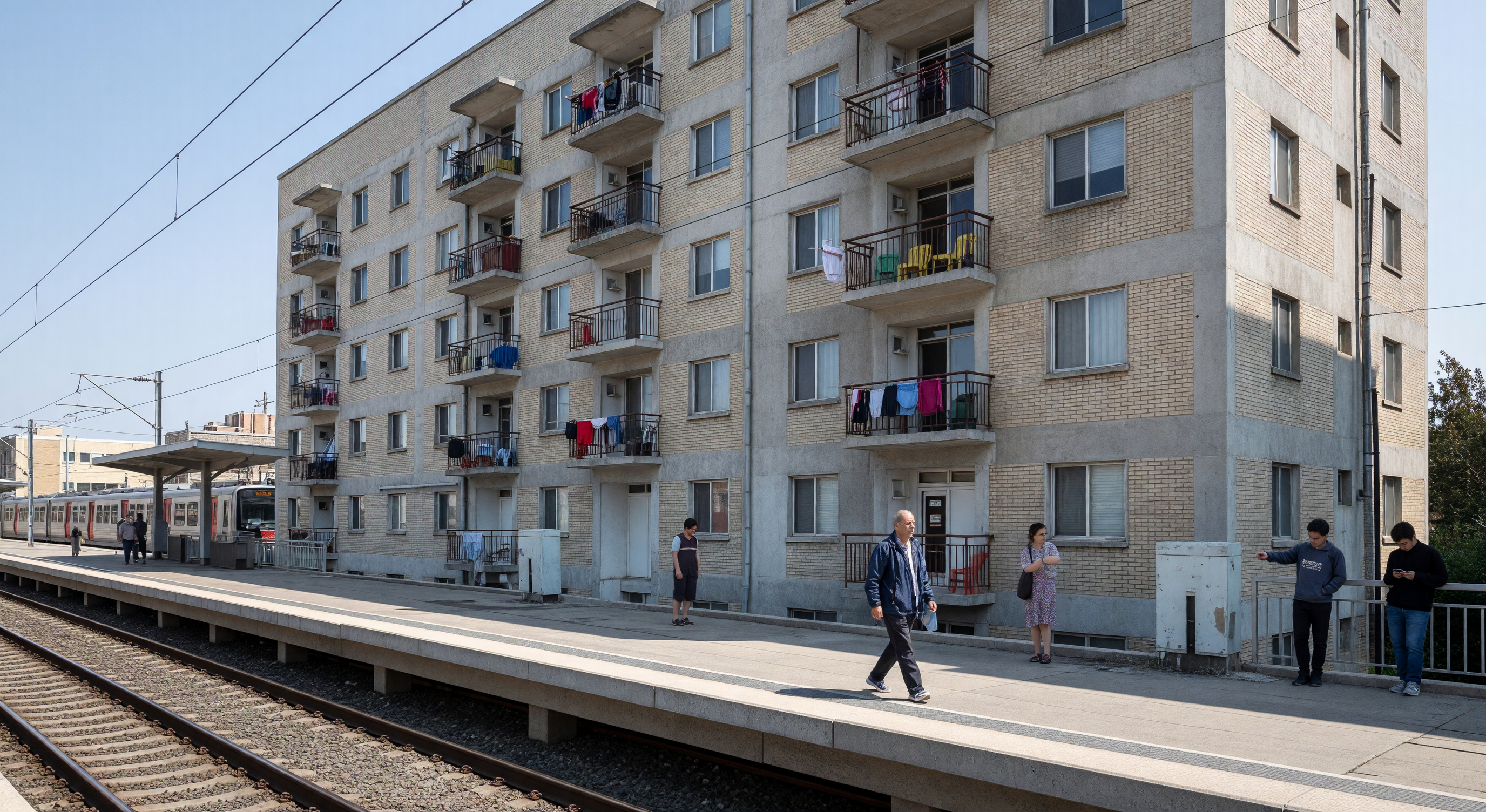
The first generation of transit-oriented development projects in North America — Arlington’s Rosslyn-Ballston corridor, Portland’s MAX-served infill, the Bay Area’s BART-adjacent redevelopment — were mostly built with conventional parking ratios applied with minor adjustments. Two to three decades of occupancy data from those projects has reshaped how contemporary TOD parking requirements are written.
What the Occupancy Data Actually Shows
Studies by the Transit Cooperative Research Program, Reconnecting America, and individual transit agencies have consistently found that TOD parking utilization runs meaningfully below both conventional suburban ratios and the ratios commonly applied to early TOD projects.
For residential TOD within a quarter-mile of high-frequency rail transit, typical observed peak utilization falls in the 0.8 to 1.2 spaces per unit range, versus conventional suburban ratios of 1.5 to 2.0. For office TOD, observed utilization is commonly 2.0 to 2.8 spaces per 1,000 square feet, versus suburban ratios of 3.5 to 4.5.
Two findings are consistent across studies. First, the quality and frequency of transit service matters more than the physical distance to the station. A project a half-mile from a station with 10-minute headway all day outperforms a project adjacent to a station with 30-minute peak-only headway. Second, household characteristics — income, household size, and workplace location — predict more of the variance in parking demand than the design of the project itself.
How Current TOD Requirements Are Written
The better-designed TOD parking frameworks have moved away from single-ratio requirements toward a tiered approach reflecting transit service quality and project context.
A representative structure might include:
- Tier 1 (high-frequency rail, mixed-use context): maximum ratios only, commonly 0.5 to 1.0 spaces per residential unit, often with no minimum at all
- Tier 2 (moderate-frequency rail or bus rapid transit): both floor and ceiling, commonly 0.75 to 1.25 per unit
- Tier 3 (local bus service, lower-density context): conventional minimums with modest TOD adjustment
Several agencies have added unbundling requirements — parking priced and leased separately from housing — to the tier structure, recognizing that bundled parking masks demand and produces oversupply even where ratios are appropriate.
The Shared Parking Question
TOD sites are unusually well-suited to shared parking arrangements. Mixed-use developments with residential, office, and retail components have diurnal and weekly demand patterns that overlap imperfectly, and shared supply can reduce total stall count by 15 to 30 percent relative to single-use ratios summed.
The Urban Land Institute has published shared parking methodology that is now the de facto standard for mixed-use TOD. The ULI tables, when applied carefully, produce reliable estimates. They fail primarily when applied to use mixes the tables do not cover well — fitness clubs, event venues, medical offices with heavy mid-morning demand — or when the shared supply is physically inaccessible to secondary users because of access control, wayfinding, or walking distance.
Underground and Above-Grade Tradeoffs
TOD sites in urban contexts typically have constrained footprints. Parking is commonly built underground, which costs two to four times more per stall than above-grade structured parking and five to ten times more than surface parking. The cost per reduced stall in well-calibrated TOD requirements is therefore substantial, and modestly wrong ratios can swing total project feasibility.
This economic reality is one of the strongest arguments for occupancy-data-driven ratios rather than margin-of-safety ratios. A 10 percent oversupply in underground parking can represent 3 to 5 percent of total project cost, which is more than sufficient to turn marginal projects infeasible.
Where TOD Parking Requirements Still Fail
Two failure modes recur. Requirements calibrated to fully operational transit can oversupply parking in the years before transit service reaches maturity, leaving developers holding empty structures. Conversely, requirements that assume imminent transit expansion that does not materialize can undersupply parking and produce overflow issues that harm adjacent neighborhoods and erode political support for future TOD.
Both failures point to the same underlying issue: TOD parking ratios are most reliable when they reflect demonstrated transit performance rather than planned transit performance. Several agencies now explicitly tie TOD requirements to ridership-based triggers, tightening ratios as transit use crosses verified thresholds.
FAQ
How much less parking does TOD actually use?
For residential TOD near high-frequency rail, peak occupancy typically runs in the 0.8 to 1.2 spaces per unit range, versus 1.5 to 2.0 in comparable suburban contexts. The reduction is real but varies substantially with transit service quality and household characteristics.
Does transit distance or transit frequency matter more?
Frequency, by most studies. A project a half-mile from 10-minute headway transit outperforms a project adjacent to 30-minute peak-only service in parking demand reduction.
Should TOD parking be unbundled from housing?
Unbundling — separating parking lease/purchase from housing — generally improves market calibration and reduces oversupply. Several jurisdictions now require unbundling above specified density thresholds.
How large a shared-parking reduction is reasonable?
Well-calibrated mixed-use TOD projects commonly realize 15 to 30 percent reductions from single-use ratios summed. ULI’s shared parking methodology is the standard reference for these calculations.