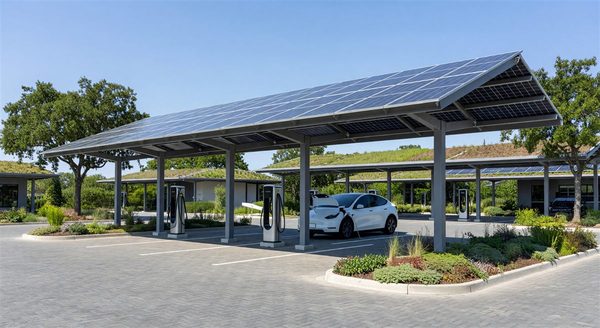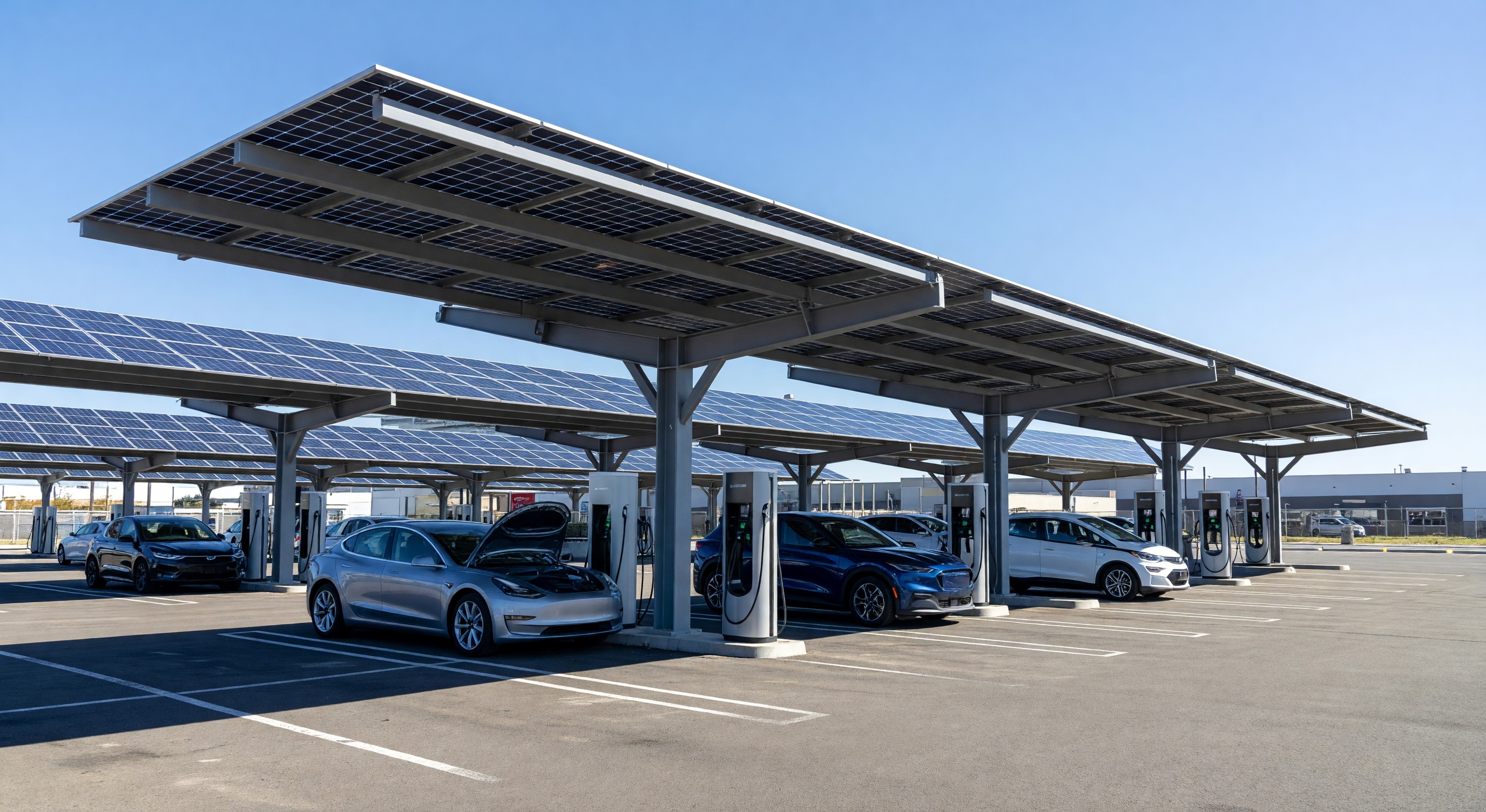
Solar canopies over parking lots represent one of the most compelling renewable energy opportunities in the built environment — using land already committed to parking to generate electricity, provide shade, and support EV charging infrastructure, all without consuming additional developable land. As solar installation costs have declined 90 percent since 2010 and EV adoption drives demand for on-site charging, solar carport systems have moved from niche sustainability statements to financially defensible capital investments for many facility types.
Structural Requirements for Solar Canopies
Solar canopies impose loads on the parking surface and foundation system that are not present in standard parking lot design. Structural design must account for:
Dead load: The photovoltaic panel array, racking system, electrical conduit, and canopy framing. A typical commercial solar canopy structure with steel framing and standard PV modules adds 12 to 20 pounds per square foot (psf) of dead load to the covered area.
Live load: Snow (in applicable climate zones), maintenance loads, and wind uplift. In Midwest and Northeast regions, ground snow loads of 25 to 50 psf may govern canopy design. In hurricane-prone coastal zones, wind uplift loads of 40 to 80 psf or more are controlling design conditions.
Seismic loads: Solar canopies in SDC C and above (moderate to high seismic hazard) must be designed for seismic forces at the canopy mass, with adequate lateral force path to the foundation.
The foundation system for solar canopies in parking lots typically uses helical piles, driven steel pipe piles, or concrete caissons drilled through the pavement into native soil or rock. Foundation design must avoid existing utility lines, storm drains, and pavement drainage patterns. The canopy column grid should be coordinated with parking stall layout to avoid placing columns within stalls — columns at stall boundary lines allow stalls to be used independently of column locations.
Minimum clear height under the canopy’s lowest structural member should be 8.5 to 9 feet to accommodate SUVs and pickup trucks with roof racks or cargo. Taller clearance (11 to 14 feet) may be needed in areas where RVs, delivery trucks, or other taller vehicles park.
Photovoltaic System Sizing
PV system sizing for parking solar canopies depends on:
Covered stall area: Each standard 9 × 18-foot parking stall provides approximately 160 square feet of canopy area. Typically 300 to 400 watts of PV capacity can be installed per stall.
Panel efficiency: Standard commercial monocrystalline silicon panels achieve 20 to 23 percent efficiency at 2024 technology levels, producing 380 to 420 watts per panel (standard 60-cell panel at approximately 5.5 square feet). Premium bifacial panels (which capture reflected light from the ground surface) can produce 5 to 10 percent more energy.
Solar resource: Annual production depends on the site’s solar irradiance. Southwest US markets (Arizona, California, Nevada, New Mexico) are the highest-production locations, with average production of 1,600 to 1,800 kWh per kWp per year. Midwest and Northeast markets average 1,200 to 1,400 kWh per kWp. Production modeling using PVsyst software with site-specific TMY (typical meteorological year) data is standard practice for project feasibility analysis.
System economics: At 300 to 400 watts per stall and $2.50 to $4.00 per watt installed for commercial solar canopy systems (including structure), a 100-stall canopy would carry a capital cost of approximately $750,000 to $1,600,000 and produce 90,000 to 160,000 kWh annually (depending on location). At $0.10 to $0.15 per kWh avoided electricity cost (plus applicable incentives), simple payback ranges from 7 to 15 years before incentives.
The Inflation Reduction Act (IRA) investment tax credit (ITC) of 30 percent (with adders for domestic content and energy community siting) significantly improves project economics for tax-exempt entities using tax equity financing or direct pay provisions.
Shading Benefits
Beyond energy production, solar canopies deliver measurable shading benefits:
Vehicle thermal management: Parked vehicles in direct sun reach interior temperatures of 130 to 160°F in summer. Shaded vehicles are 20 to 40°F cooler, reducing air conditioning startup load and improving battery performance for EVs (lithium-ion batteries degrade more rapidly at high temperatures).
Pavement heat island reduction: Shading reduces pavement surface temperatures by 30 to 60°F in summer, reducing thermal mass heat storage and ambient air temperature elevation in the parking facility.
User comfort: Covered parking is a customer amenity that influences facility choice, particularly in hot climates. Surveys of retail and medical campus parkers consistently show weather protection as a high-value feature.
EV Charging Integration
Solar canopies are natural platforms for EV charging infrastructure. The electrical conduit runs and structural capacity for the canopy framing provide ready pathways for Level 2 AC charging equipment (7 to 19 kW) directly below. DCFC (DC fast charging) installations at 50 to 350 kW are also achievable but typically require grid connection rather than on-site solar storage alone.
Integrating battery energy storage systems (BESS) with solar canopies allows facilities to store midday solar production and discharge it for peak-hour EV charging or demand charge reduction. Storage economics depend on local rate structures and the degree of demand charge exposure.
Frequently Asked Questions
How much does a solar canopy cost per parking stall? Commercial solar canopy systems cost approximately $7,500 to $16,000 per stall installed, depending on structure type, location, panel specification, and market conditions. The federal ITC of 30 percent and other incentives reduce the effective cost significantly.
What clearance height is required under a solar canopy? Minimum 8.5 to 9 feet to accommodate SUVs and pickups. Facilities serving delivery trucks, RVs, or other tall vehicles need 11 to 14 feet or more. Check the tallest expected vehicle class before specifying canopy height.
Can solar canopy power cover all EV charging at the facility? In most cases, solar production at the canopy scale covers a portion of EV charging demand during peak solar hours. Battery energy storage allows solar production to be used for evening charging demand. Grid connection is typically required as the backup and supplemental source. Sizing analysis should model both solar production and expected EV charging load profiles.
Do solar canopies require special foundation systems? Yes. Most solar canopies in parking lots use helical piles, driven piles, or drilled caissons through the pavement surface. Foundation design must accommodate wind uplift, snow loads (where applicable), seismic forces, and the dead load of the PV and structure system. Pavement must often be cored or saw-cut for foundation installation.
Takeaway
Solar canopies represent one of the highest-value, most versatile improvements available to parking facility owners — generating renewable electricity, providing shade that improves vehicle and battery performance, and creating the ideal platform for EV charging infrastructure. The economics are project-specific, but the combination of declining solar costs, strong IRA incentives, and growing EV charging demand has made solar canopies financially viable for a much broader range of applications than was possible five years ago. Coordinating structural design, PV system sizing, and EV charging infrastructure from the outset produces the most cost-effective and operationally integrated system.
Further Reading from Authoritative Sources
- U.S. Department of Energy solar energy resources and IRA tax credit guidance — The U.S.
- EPA green power partnership and renewable energy resources — The EPA’s Green Power Partnership provides context for the environmental benefits and sustainability case for solar canopy installations on parking facilities, supporting the environmental performance claims made in the article.