Parking lots are statistically among the most dangerous pedestrian environments in North America. The Insurance Institute for Highway Safety (IIHS) and the Governors Highway Safety Association (GHSA) have documented thousands of annual pedestrian fatalities and tens of thousands of injuries in parking lots and structures. The hazards are structural: drivers are distracted by parking maneuvers, visibility is limited by parked vehicles, and pedestrian and vehicle paths intersect constantly. Design cannot eliminate these conflicts, but it can reduce their frequency and severity.
The Pedestrian Conflict Problem
In a typical parking lot, every pedestrian must cross one or more drive aisles to reach the building entrance. In large surface lots, walkers may traverse hundreds of feet of shared space with moving vehicles. Every crossing is a potential conflict. Designs that minimize crossing distances, improve mutual visibility, and slow vehicles create measurably safer environments.
Urban Land Institute research and FHWA safety studies identify the highest-risk conflict points:
- Lot entry/exit lanes where drivers are focused on entry equipment or street traffic
- Aisle intersections where blind spots are created by parked vehicles
- The first and last rows of parking closest to the building entrance (highest pedestrian concentration)
- Ramp entrances and exits in parking structures
Dedicated Pedestrian Paths
The most effective safety intervention is complete separation of pedestrian and vehicle paths. Where site geometry allows, a dedicated pedestrian walkway running perpendicular to parking bays — from the parking field to the building entrance — removes walkers from drive aisles entirely.
ULI’s Parking standards and the ITE’s guidelines recommend a minimum 6-foot-wide dedicated pedestrian path between parking bays. This path should be:
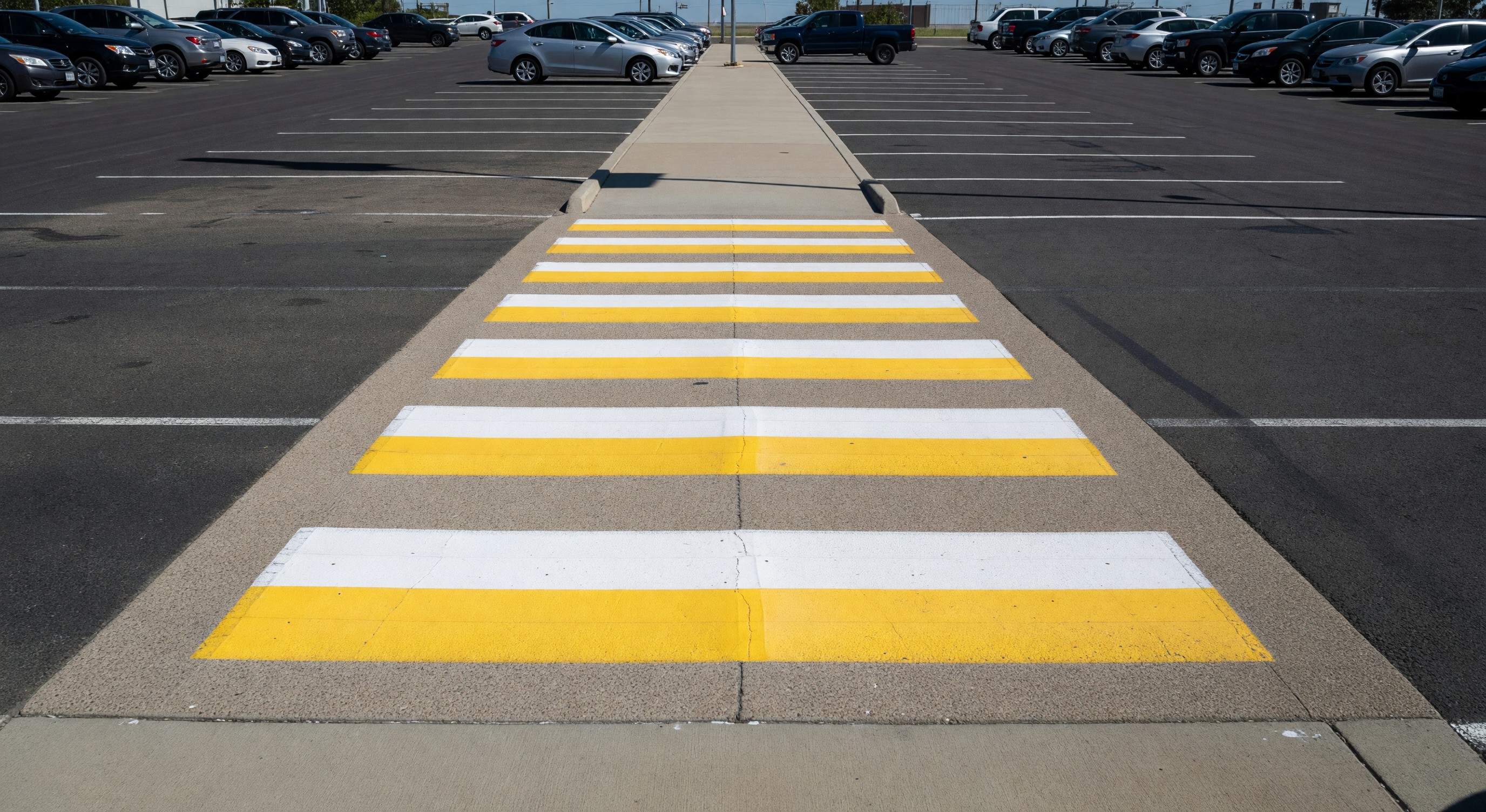
- Marked with high-visibility striping (parallel white lines perpendicular to the direction of pedestrian travel)
- Differentiated by surface material (raised concrete, colored paving, or pavers that contrast with asphalt drive surface)
- Kept free of obstructions including cart corrals, landscaping that limits visibility, and parked vehicles
Where crossings of drive aisles are unavoidable, raised crossings are the most effective physical treatment. A raised pedestrian crossing — the drive aisle surface raised to sidewalk grade, with sloped transitions on both sides — forces vehicles to slow and alerts drivers to the pedestrian priority zone. Raised crossings reduce vehicle speeds by 5 to 10 mph at the crossing point compared to flat-grade crossings.
Speed Control Measures
Vehicle speed in parking lots directly correlates with pedestrian injury severity. At 10 mph, a vehicle-pedestrian impact is survivable in most cases; at 20 mph, survival probability declines sharply. Most parking facilities post 10 to 15 mph speed limits, but posting alone achieves minimal compliance without physical speed control.
Speed humps (rounded profile, typically 3 to 4 inches high, 12 to 14 feet wide) are effective speed control measures in drive aisles. Properly designed humps reduce speeds to 10 to 15 mph at the hump location. They must be properly marked (standard pavement markings and advance warning signs per MUTCD guidance) and should not be placed in areas where emergency vehicle access is required.
Speed tables (flat-topped raised sections, 6 to 10 feet long, with ramp approaches) achieve similar speed reduction to humps but provide a longer elevated surface. Speed tables are more compatible with low-clearance vehicles and emergency vehicles and are often used at crosswalk locations.
Chicanes — horizontal alignment shifts that force drivers to navigate around obstacles — are used in parking lot entry drives to reduce speeds before drivers enter the pedestrian-intensive areas of the lot. They are less commonly used in parking aisles due to width constraints.
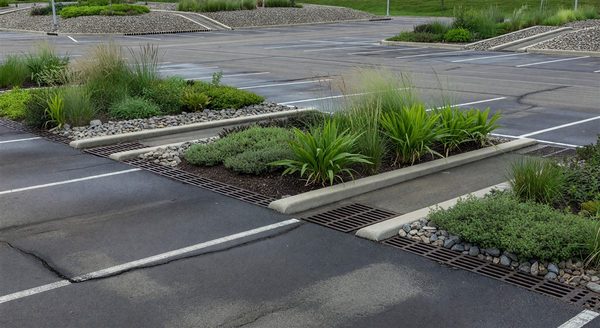
Landscaped medians and islands at regular intervals in long drive aisles interrupt straight-line sight distances and naturally reduce driving speeds, while also providing tree canopy and stormwater benefits.
Sight Line Requirements
Sight distance at drive aisle intersections and pedestrian crossings is a critical safety variable. Parked vehicles adjacent to intersections and crossings create sight line obstructions that prevent drivers from seeing pedestrians and pedestrians from seeing approaching vehicles.
ITE guidelines recommend maintaining clear sight triangles at all drive aisle intersections. For a 10 mph design speed, the required sight distance along the crossing aisle is approximately 75 to 80 feet. This means the first stall on either side of an aisle intersection should be set back from the intersection or marked as a no-parking zone to maintain the sight triangle.
In parking structures, columns and parked vehicles at stall ends create sight line problems at ramp entries. Convex mirrors at ramp entries and aisle intersections are a low-cost supplemental measure that improves sight lines without requiring structural changes.
Landscaping height control: Trees and shrubs within 15 feet of any drive aisle intersection should be maintained at heights that do not obstruct sight lines. Canopy trees (clear trunk to 7 feet) are acceptable; dense shrubs at eye height are not.
Lighting as a Safety Tool
Lighting quality directly affects pedestrian safety in parking facilities, particularly at night. Areas of highest pedestrian-vehicle conflict — crossings, first and last parking rows, building entrances — should be lit to the highest illuminance levels in the facility, ideally exceeding IES RP-20 minimums by 50 to 100 percent at these critical zones.
Frequently Asked Questions
Why are parking lots so dangerous for pedestrians? Parking lots concentrate pedestrian-vehicle conflicts at grade, with limited sight lines from parked vehicles, driver attention focused on parking maneuvers, and no formal right-of-way structure separating pedestrians from vehicles. This combination creates an environment with high conflict frequency and low predictability for both drivers and walkers.
What is the most effective physical measure to reduce parking lot pedestrian injuries? Dedicated pedestrian paths separated from drive aisles, and raised crossings at points where pedestrians must cross vehicle paths, have the strongest evidence for reducing pedestrian-vehicle conflicts and injury severity.
How wide should a parking lot pedestrian crosswalk be? A minimum of 6 feet wide for marked crosswalks; 8 to 10 feet is preferred at high-volume crossings. Crosswalks should be marked with high-visibility parallel lines or continental striping (which has better retroreflectivity than older transverse line styles).
What sight distance is required at a parking lot drive aisle intersection? For a 10 mph design speed, approximately 75 to 80 feet of sight distance along the intersecting aisle is required. Maintain this clear sight triangle by prohibiting parking in the first stall on either side of any aisle intersection.
Takeaway
Parking lot pedestrian safety is fundamentally a design problem with design solutions. Dedicated pedestrian paths, raised crossings, sight line maintenance, and speed control measures each reduce the frequency and severity of pedestrian-vehicle conflicts. Facilities that retrofit these elements into existing lots consistently see reductions in incident reports. New facilities should design pedestrian safety features from the outset — retrofitting them into a completed lot is always more expensive than incorporating them at design.
Further Reading from Authoritative Sources
- FHWA pedestrian safety tools and countermeasures for parking areas — FHWA is explicitly cited as a source of parking lot pedestrian conflict research in this article.
- NACTO crosswalk design standards and high-visibility marking guidance — NACTO publishes widely adopted urban crosswalk design standards including continental striping specifications and raised crossing geometry that directly inform the pedestrian crossing recommendations in this article.