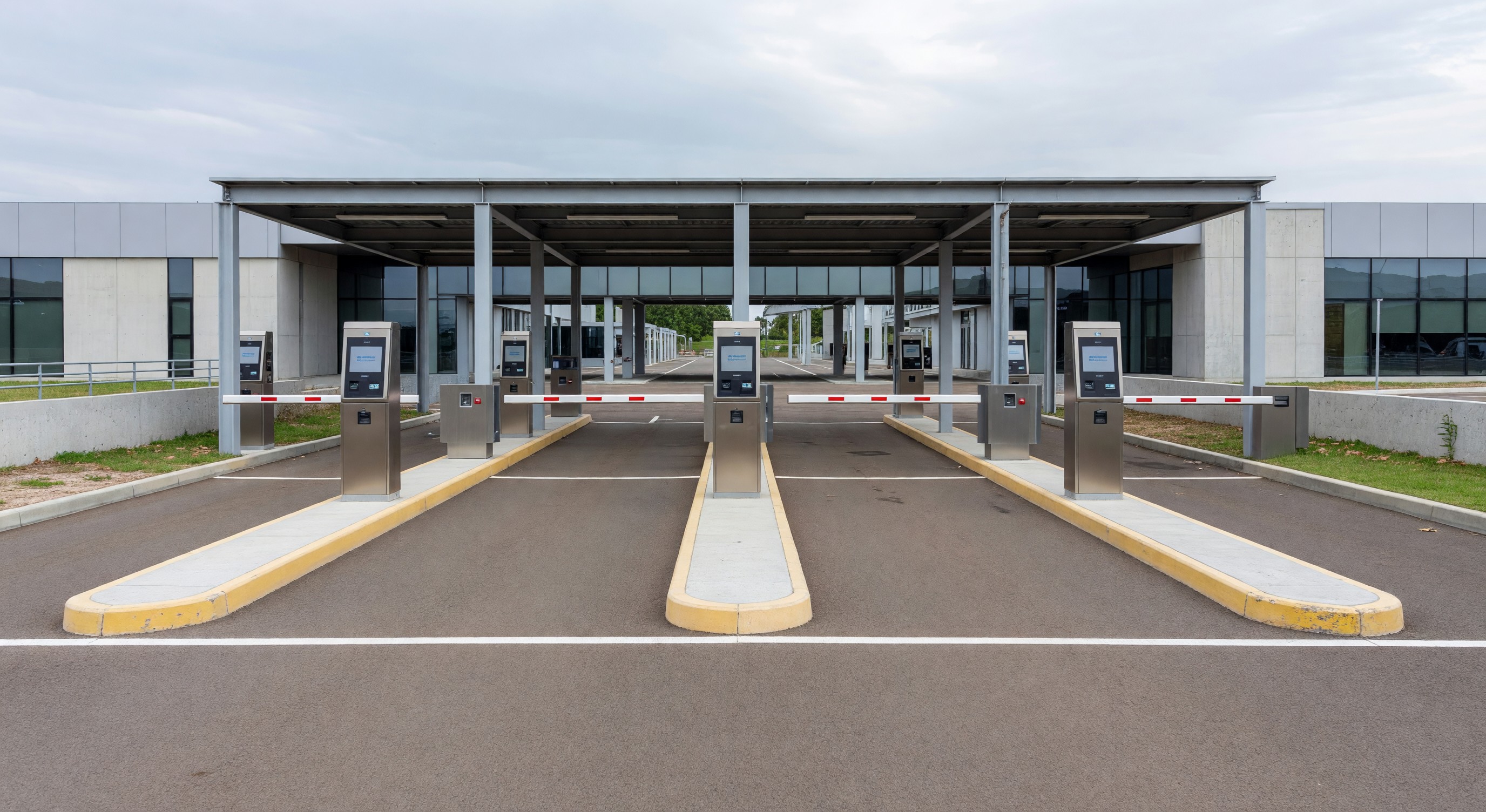
The entry and exit plaza is the most operationally critical zone of any paid parking facility. It is where revenue is collected, where the first and last driver impressions are formed, and where capacity constraints appear under peak demand. A plaza designed with adequate lane widths, appropriate queuing depth, and well-positioned equipment processes vehicles efficiently. A poorly designed plaza creates traffic backup into public streets, frustrated drivers, and revenue lost to queue abandonment.
Lane Width Standards
Entry and exit lanes for parking facilities are narrower than highway toll lanes because the design vehicle is a passenger car, not a mixed commercial vehicle fleet. Standard lane widths:
- Attended cashier lane: 12 feet minimum, 14 feet preferred. Attendant booths must be positioned so the driver’s window aligns with the cashier’s transaction window without requiring the driver to open the door.
- Unattended pay station lane: 12 feet clear at the equipment face; 10 feet acceptable at side-mounted units if the equipment does not protrude into the lane.
- LPR or transponder-only express lane: 10 to 12 feet. No transaction required; lane width accommodates gate boom clearance and vehicle passage at low speed.
- Accessible lane: At least one lane in the entry or exit plaza must meet ADA requirements for accessible customer service. Parking payment kiosks must comply with ADAAG Section 707 (Automated Teller Machines and Fare Machines) for reach range, operable parts, and audio guidance.
Lane deflectors (wheel guide curbs) should be used to center vehicles within the lane and prevent equipment strikes. Low-profile curbs of 4 to 6 inches height are effective; taller curbs create tire damage for vehicles that drift wide.
Queuing Calculations
Queuing length at entry and exit plazas must be designed to prevent queues from backing into the public street during peak demand. The standard approach uses queuing theory (M/M/c models) combined with observed arrival rate data for the specific facility type.
Key inputs:
- Arrival rate: Peak vehicles per hour arriving at entry (typically 10 to 20 percent of total capacity per hour at peak ingress)
- Service time: Transaction time per vehicle, which varies by payment method: attended cash — 20 to 30 seconds; attended credit — 25 to 35 seconds; unattended pay station — 15 to 25 seconds; LPR or transponder — 3 to 5 seconds; unattended pay-on-foot — 10 to 15 seconds at exit
- Number of lanes: Multiple lanes reduce queue length approximately proportionally (two lanes at equal arrival share halves expected queue length)
For planning purposes, on-street entry queuing should be designed to accommodate the 85th to 95th percentile peak demand without extending into the public right-of-way. Queue storage at minimum should provide 150 to 200 feet (5 to 7 vehicle lengths) per lane in large facilities.
Equipment Placement
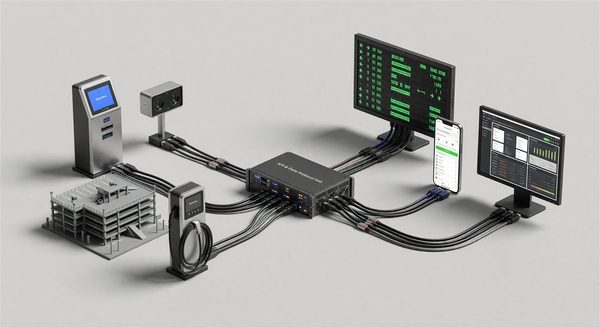
The parking revenue control system (PARCS) equipment — entry ticket dispensers, exit cashier units, pay stations, gate controls — must be positioned for efficient vehicle and pedestrian access while maintaining lane clearance.
Entry equipment: Ticket dispensers or LPR cameras are typically mounted at the left side of the entry lane, positioned so the driver’s window aligns with the push button or camera at 3 to 4 feet above ground (the typical height of a driver’s window on a passenger car). The gate arm (boom) should be set to open immediately upon valid entry to minimize dwell time.
Exit equipment: In attended booth configurations, the cashier booth is positioned at the driver’s-side window height. In unattended pay-on-foot configurations, the exit equipment reads a pre-paid ticket or validates via LPR and opens automatically; exit dwell time is typically 5 to 10 seconds.
Height clearance bars: Overhead clearance bars at garage entry lanes should be set 3 to 6 inches below the actual structural clearance to provide a warning margin. High-visibility retroreflective sheeting on clearance bars improves detection.
Plaza Layout Configurations
Common parking entry/exit plaza layouts:
Separate in/out plazas: Entry lanes and exit lanes are at different points of the facility perimeter. This eliminates entry-exit vehicle conflict and allows independent optimization of each plaza. Preferred for facilities with separate driveways.
Combined plaza: Entry and exit lanes share a single driveway throat, separated by traffic channelization. More common in constrained urban sites. Design must prevent entry-exit vehicle conflict with clear visual channelization.
Tandem plaza: Multiple entry and exit lanes arranged in a tandem configuration, where the outer lane is reached by passing through an inner position. Efficient use of width; requires careful channelization and driver guidance.
Remote pay stations with gated exits: Pay-on-foot systems eliminate exit booth congestion by moving payment to remote locations within the facility (near elevators, at stairwells). Exit lanes become pure gate control — no payment transaction. Exit processing rates of one vehicle per 5 to 10 seconds are achievable.
Canopy and Shelter Design
Entry and exit equipment in outdoor surface lots should be protected by a canopy structure. A minimum 16-foot-wide by 20-foot-deep canopy over each lane provides weather protection for both the driver and equipment. Canopy clearance must accommodate SUVs and pickup trucks with extended antennas or cargo; 14 feet clear is typical.
Drainage from canopy structures must be directed away from queuing lanes to prevent ice formation at driver transaction positions.
Frequently Asked Questions
What is the minimum lane width for a parking entry lane? Attended lanes require a minimum of 12 feet, with 14 feet preferred to allow transaction without door opening. Unattended equipment lanes can use 10 to 12 feet depending on equipment mounting configuration.
How many entry lanes does a parking facility need? Lane count is determined by peak arrival rate divided by service capacity per lane. As a rough rule, one lane handles approximately 100 to 180 vehicles per hour depending on payment method. A 1,000-stall facility may require 2 to 4 entry lanes to handle peak ingress without significant queuing.
What is pay-on-foot and how does it affect exit lane design? Pay-on-foot systems allow parkers to pay at interior kiosks before returning to their vehicle. The exit lane only validates the pre-paid credential (ticket or LPR) rather than processing payment — reducing exit dwell time to 5 to 10 seconds per vehicle and dramatically increasing exit throughput.
How deep should queuing be at a parking entry plaza? Queue storage should accommodate the 85th to 95th percentile peak demand without extending to the public street. A minimum of 150 to 200 feet (5 to 7 vehicle lengths) per lane is the planning standard for large facilities; smaller facilities may require proportionally less depending on arrival rates.
Takeaway
Parking entry and exit plaza design requires engineering discipline applied to lane widths, queuing storage, equipment placement, and plaza layout. Underdesigned plazas generate street-level congestion and lost revenue through queue abandonment; overdesigned plazas waste land in the facility’s highest-value location. Using queuing analysis to determine lane count, selecting payment methods that minimize transaction time, and designing for the full peak arrival rate produces a plaza that handles demand efficiently throughout its operational life.
Further Reading from Authoritative Sources
- Institute of Transportation Engineers parking facility design and access management standards — The Institute of Transportation Engineers publishes authoritative guidance on parking facility design including lane dimensioning, queuing analysis, and toll plaza configuration that directly underlies the design standards discussed in the article.
- Transportation Research Board parking facility operations and queuing research — The Transportation Research Board publishes research on parking operations and access control that provides the queuing model methodology and capacity analysis frameworks referenced in the article’s design guidance.