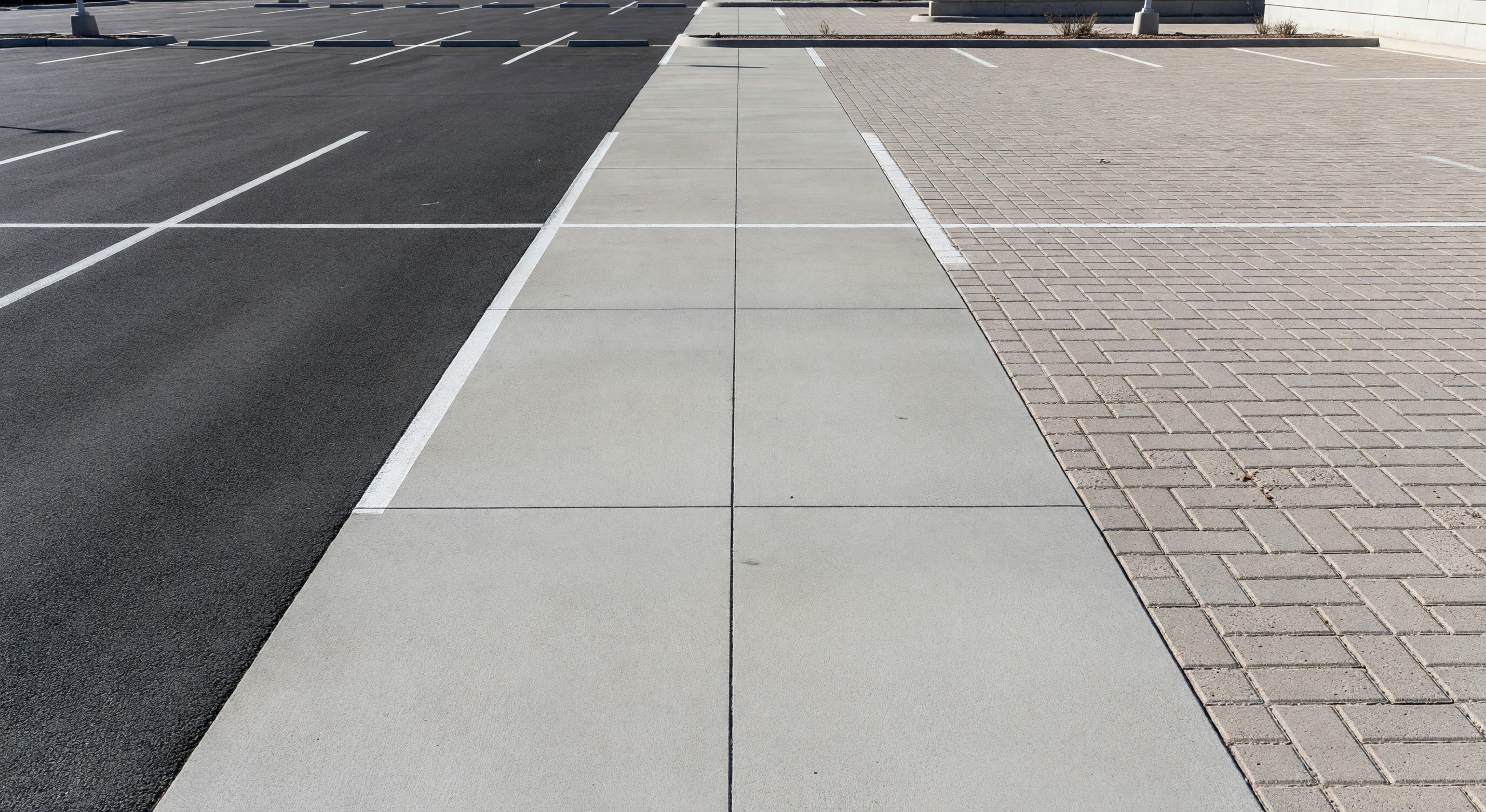
The choice of parking lot surface material is a long-term capital decision with consequences across maintenance cost, user experience, stormwater management, and sustainability performance. Asphalt and concrete dominate North American parking, but permeable alternatives — porous asphalt, pervious concrete, and interlocking pavers — are increasingly specified where stormwater management goals or incentives warrant. Each material has distinct performance profiles, and no single choice is universally optimal.
Asphalt: Performance and Limitations
Asphalt, or hot mix asphalt (HMA), is the most common parking surface in North America — estimates from the National Asphalt Pavement Association (NAPA) suggest asphalt surfaces account for over 90 percent of paved parking. Its dominance reflects upfront cost advantages and familiar installation practices.
Advantages: Lower initial cost than concrete (typically 20 to 40 percent less per square foot installed); faster installation and return to service; easier to repair (overlay or mill and fill); heat-absorbing properties reduce ice formation in moderate climates; darker color hides oil stains.
Limitations: Susceptible to oxidation, cracking, and raveling over 5 to 8 years without regular maintenance; softens in extreme heat, causing tracking and rutting under heavy vehicles; requires seal coating every 3 to 5 years to preserve surface integrity; contributes more to urban heat island effect than lighter-colored alternatives; service life of 15 to 25 years without major rehabilitation.
Structural design follows AASHTO guidelines based on subgrade strength (CBR value), traffic loading (design axle loads and volume), and climate. Parking lot design typically specifies 2 to 3 inches of HMA over 4 to 8 inches of compacted aggregate base, depending on subgrade conditions. Areas subject to heavy vehicles — delivery truck lanes, garbage truck routes — require thicker pavement sections.
Concrete: Performance and Life-Cycle Value
Portland cement concrete (PCC) parking surfaces have higher initial costs but longer service lives. A properly designed concrete parking lot with adequate joint spacing and subgrade preparation can last 25 to 40 years with minimal maintenance beyond joint sealing and occasional crack repair.
Advantages: Higher reflectivity (SRI value of 35 to 44 vs. asphalt’s 0 to 5) reduces heat island contribution; no softening under extreme heat; does not require periodic seal coating; suitable for heavy-vehicle areas without special design modifications; better long-term performance in freeze-thaw climates; LEED credits available for high-SRI surfaces.
Limitations: Higher initial cost (typically $3 to $5 per square foot more than asphalt on comparable projects); longer cure time before return to service (7 days minimum; 28 days for full strength); joint cracking requires maintenance; spalling in freeze-thaw zones exposed to deicers; more complex repair procedures if damage occurs.
Concrete joint design is critical to performance. Control joints (sawcut 1/4 of slab depth, typically 1 inch deep in a 4-inch slab) are placed at 10 to 15-foot intervals in parking areas to control cracking location. Expansion joints at building interfaces and large panel boundaries accommodate thermal movement. Doweled construction joints provide load transfer where panels abut without continuity.
Permeable Paving Options
Permeable surfaces allow stormwater to infiltrate through the pavement surface into an aggregate reservoir below, then percolate into native soil or be captured in a subdrainage system. Permeable paving is a stormwater management tool as much as a surface material choice.
Porous asphalt: Open-graded HMA with fine particles removed, creating interconnected voids. Requires a crushed stone reservoir base. Infiltration rates of 100 to 1,000 inches per hour when clean. Service life comparable to conventional asphalt; clogging of voids with sediment reduces infiltration over time. Vacuum sweeping twice per year maintains performance.
Pervious concrete: Similar concept using gap-graded cement mix. Higher void content (15 to 25 percent) than porous asphalt; more susceptible to clogging from fine sediment. Structural performance adequate for light-vehicle parking; not recommended for heavy truck areas. Infiltration rates of 200 to 2,400 inches per hour when clean.
Interlocking concrete pavers (PICP): Manufactured concrete units with open joints filled with aggregate. More aesthetically flexible than porous asphalt or pervious concrete. Joint infiltration is the limiting factor; periodic joint replenishment required. Durable surface; individual units replaceable for utility access without full-depth repair.
Grass pavers / gravel grid systems: Cellular plastic or concrete grid systems supporting turf or gravel fill. Appropriate for low-use overflow parking or emergency vehicle access routes. Not suitable for primary parking surfaces in high-use facilities. Maintenance-intensive; turf areas require irrigation and mowing.
Stormwater Credit and Incentives
Permeable paving is a recognized stormwater management best management practice (BMP) in most state and municipal stormwater programs. Credit against impervious surface calculations varies by jurisdiction, but many programs allow 50 to 100 percent credit for properly designed permeable pavement, reducing or eliminating required detention infrastructure.
LEED v4 Rainwater Management credits and local green building incentives frequently reference permeable paving. Some municipalities offer stormwater fee reductions for properties with demonstrated permeable surface coverage.
Pavement Selection Framework
Matching surface material to site conditions requires evaluating:
- Subgrade soil permeability and bearing capacity
- Climate (freeze-thaw frequency, extreme heat exposure)
- Traffic loading (heavy vehicles, frequency)
- Stormwater management requirements or incentives
- Budget (initial vs. life-cycle)
- Maintenance capacity
For most general-purpose parking applications, asphalt remains the cost-effective default. Where life-cycle costs over 30+ years are prioritized, concrete becomes competitive. Where stormwater management goals, LEED credits, or municipal requirements support it, permeable alternatives warrant a detailed analysis that accounts for stormwater fee savings and reduced infrastructure costs.
Frequently Asked Questions
Which is cheaper: asphalt or concrete for a parking lot? Asphalt is typically 20 to 40 percent less expensive upfront. However, concrete’s longer service life (25 to 40 years vs. 15 to 25 for asphalt) and lower maintenance requirements often make it cost-competitive or superior on a life-cycle cost basis over 30+ year analysis periods.
How does permeable paving affect stormwater management requirements? Most state and municipal stormwater programs allow significant credit for permeable paving against impervious surface calculations. Depending on jurisdiction, this can reduce or eliminate required detention basin infrastructure, which can offset the higher material cost of permeable surfaces.
How long does a porous asphalt or pervious concrete surface last? Structural service life is comparable to conventional surfaces — 15 to 25 years for porous asphalt. Infiltration performance degrades over time as fine sediment clogs voids; regular vacuum sweeping (twice annually minimum) is essential to maintain permeability.
Can I use permeable paving in a heavy truck loading zone? Porous asphalt can be designed for heavier loads with appropriate base thickness, but pervious concrete is generally not recommended for heavy truck areas due to structural limitations. Consult a pavement engineer for load-specific design.
Takeaway
Asphalt, concrete, and permeable alternatives each serve specific conditions optimally. The decision requires a holistic analysis of initial cost, life-cycle cost, subgrade conditions, climate, traffic loading, and stormwater management requirements. Facilities that base material selection on upfront cost alone often pay more over the long run in maintenance, resurfacing, and foregone stormwater incentives. A pavement design engineer’s input early in planning pays consistent dividends throughout the surface’s service life.
Further Reading from Authoritative Sources
- US EPA stormwater management best practices for parking lots — The US EPA is the federal authority on stormwater management BMPs and NPDES permit programs that govern how parking lot runoff is managed.
- FHWA sustainable pavement design and life-cycle cost resources — FHWA publishes pavement design resources including life-cycle cost analysis tools and AASHTO design guidance cited in this article, making it the appropriate authority reference for operators evaluating long-term pavement material choices.