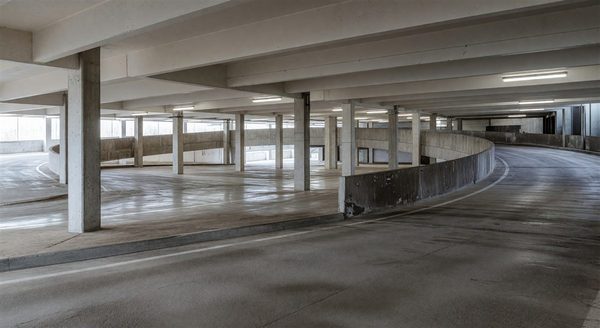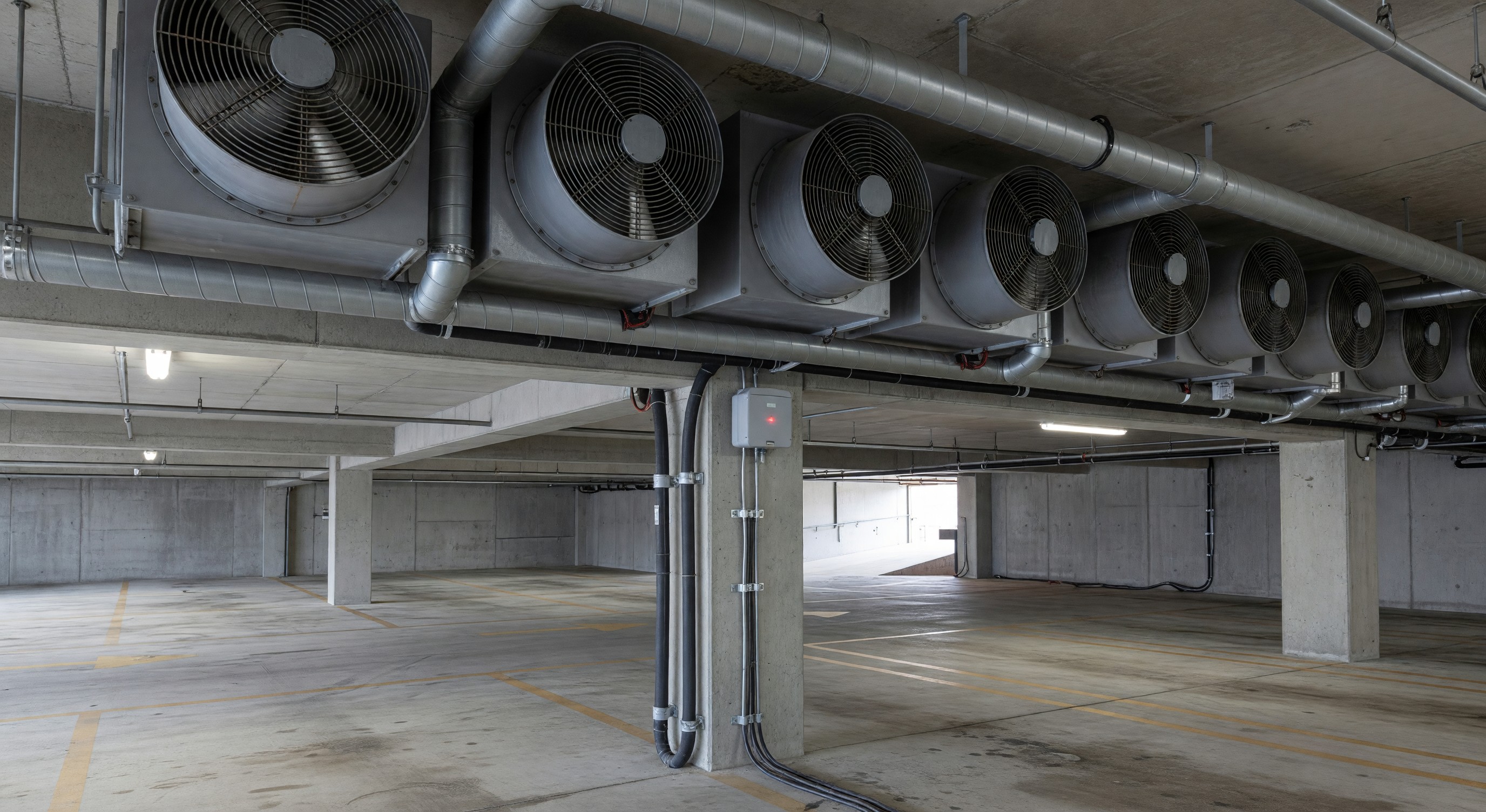
Parking structure ventilation exists to manage carbon monoxide (CO) concentrations produced by internal combustion engine vehicles. In enclosed or semi-enclosed structures, CO can reach dangerous levels during peak ingress and egress periods. Ventilation design must meet code-mandated concentration limits while minimizing energy consumption — a balance that has become both more achievable with modern controls and more complex with the growth of electric vehicles.
Carbon Monoxide Standards and Exposure Limits
OSHA permissible exposure limits (PEL) for CO are 50 parts per million (ppm) averaged over an 8-hour workday. The National Institute for Occupational Safety and Health (NIOSH) recommended exposure limit is 35 ppm. For transient occupants (parkers, not workers), the American Society of Heating, Refrigerating and Air-Conditioning Engineers (ASHRAE) Standard 62.1 and local building codes typically reference ASHRAE guidelines or ACGIH Threshold Limit Values (TLV-C), which set short-term ceiling values in the 100 to 200 ppm range.
Building codes governing parking structures — the International Building Code (IBC), International Mechanical Code (IMC), and NFPA 88A Standard for Parking Structures — establish ventilation requirements. Most code requirements are expressed as air change rates (ACH) or as minimum exhaust volume per square foot, with provisions for CO-controlled ventilation as an alternative to constant-rate systems.
IBC and IMC generally require 1.5 CFM per square foot of floor area in enclosed garages as a continuous ventilation rate, or CO sensor-based control with a minimum of 0.05 ACH as a standby rate. NFPA 88A provides alternative provisions for open and partially open structures.
Open vs. Enclosed Structure Classification
Ventilation requirements depend critically on the structure’s classification as “open” or “enclosed.” NFPA 88A defines an open parking structure as one where at least 20 percent of the perimeter wall area on two or more sides is open and the openings are uniformly distributed. Open structures rely on natural ventilation through these openings to dilute CO.
Enclosed structures — those that do not meet the open structure criteria — require mechanical ventilation systems. Many structures fall into an intermediate category: partially open designs where mechanical ventilation supplements natural ventilation on enclosed levels. The classification affects not only ventilation requirements but also fire suppression requirements (enclosed structures require sprinkler systems; open structures are generally exempt).
Mechanical Ventilation Systems
For enclosed and semi-enclosed parking structures, two primary mechanical ventilation approaches are used:
Duct-and-plenum systems: Conventional duct systems distribute supply air from air handling units (AHUs) and collect exhaust air through return plenum or dedicated exhaust ducts. Well-suited to larger enclosed structures. Provides predictable air distribution but requires significant ceiling space and coordination with structural systems.
Jet fan systems (impulse ventilation): High-velocity jet fans mounted in the drive aisles generate longitudinal airflow patterns that push contaminated air toward exhaust openings without the need for extensive ductwork. Increasingly the preferred system for parking structures because they require less ceiling clearance, are easier to install in retrofit situations, and allow zone-by-zone control based on CO sensor readings. Colt, Systemair, and Windox are major suppliers in the North American market.
Jet fan systems must be designed using computational fluid dynamics (CFD) modeling to verify that airflow patterns achieve code-compliant CO dilution throughout the occupied space. This modeling is now a standard deliverable from mechanical engineers on parking structure projects using jet fan systems.
CO Monitoring and Demand-Controlled Ventilation
CO sensor-based demand-controlled ventilation (DCV) reduces energy consumption by running ventilation fans only when CO levels require it, rather than at constant rates. ASHRAE 62.1-2019 and most building codes permit DCV in parking garages.
CO sensors are electrochemical devices that respond to CO concentration in parts per million. Manufacturer specifications vary, but sensors should be installed at heights representing the breathing zone — 5 to 6 feet above finished floor — and at spacings of no more than 3,000 to 5,000 square feet per sensor depending on the system design. Sensors require annual calibration and have service lives of 3 to 5 years before replacement.
Typical DCV setpoints:
- Below 25 ppm: ventilation at minimum (standby) rate
- 25 to 50 ppm: graduated fan speed increase
- Above 50 ppm: fans at full speed; alarm triggered
Emergency alarm setpoints vary by code and application, but 100 to 200 ppm is typical for non-worker occupancy.
Energy Implications of DCV
DCV can reduce ventilation energy consumption by 50 to 80 percent compared to constant-speed ventilation in facilities where peak CO is intermittent. The energy savings are greatest in facilities with mixed-use parking (not 24/7 high-turnover) and in regions with extreme outdoor temperatures where conditioning ventilation air is costly.
Variable frequency drives (VFDs) on fan motors enable proportional speed control as DCV systems respond to CO levels. The energy savings from VFD-controlled fans are substantial: fan power varies as the cube of fan speed (half speed = one-eighth the power), making even modest speed reductions highly energy-efficient.
EV Fleet Considerations
The growth of electric vehicles presents a meaningful change in parking structure ventilation parameters. EVs produce no CO exhaust emissions, which reduces the CO load on the ventilation system in proportion to the EV fraction of the parked fleet. As EV market share increases, facilities that were designed for all-ICE vehicle fleets will progressively see reduced CO concentrations and reduced ventilation demand under DCV control.
However, EVs charging in parking structures do present new considerations: hydrogen off-gassing from lithium-ion batteries under thermal runaway conditions is a safety concern, and EV charging infrastructure produces localized heat loads. Some engineers recommend maintaining ventilation capacity regardless of ICE/EV mix to address these concerns, while others argue that the reduced CO from EV fleets allows right-sizing ventilation for the actual load.
Frequently Asked Questions
What is the code limit for carbon monoxide in a parking structure? Building codes and OSHA establish different thresholds. OSHA’s PEL for workers is 50 ppm (8-hour TWA). For transient building occupants, codes typically reference ASHRAE or ACGIH values; short-term concentrations above 100 to 200 ppm trigger alarm conditions in most DCV systems.
What is the difference between a duct system and jet fan ventilation in parking garages? Duct systems use air handling units and distribution ductwork to supply and exhaust air. Jet fan (impulse ventilation) systems use high-velocity fans to generate directional airflow without extensive ductwork. Jet fans are increasingly preferred for their lower ceiling space requirements and flexibility in zone control.
How many CO sensors are needed in a parking structure? Sensor spacing of one sensor per 3,000 to 5,000 square feet is typical, depending on the ventilation system design. Sensors should be placed at breathing zone height (5 to 6 feet AFF) and distributed to provide representative coverage of the occupied space.
Do EV-heavy parking facilities still need CO ventilation systems? Current codes require ventilation systems sized for the full potential CO load regardless of current EV fraction. As fleets transition to EV, CO loads will reduce and DCV systems will operate at lower rates, reducing energy consumption — but the infrastructure must still be in place.
Takeaway
Parking structure ventilation design requires coordination among the code requirements for CO concentration, the choice between natural and mechanical ventilation, the specific characteristics of the building configuration, and the growing influence of electric vehicles on CO load profiles. CO sensor-based demand-controlled ventilation, combined with variable-speed fans, represents the current best practice for balancing air quality compliance with energy efficiency. CFD modeling is increasingly standard practice for confirming that jet fan and impulse ventilation systems achieve code-compliant distribution throughout the occupied space.
Further Reading from Authoritative Sources
- NIST air quality and CO exposure research for enclosed spaces — NIST conducts and publishes foundational research on air quality standards, occupant exposure limits, and ventilation effectiveness in enclosed spaces.
- DOE energy efficiency guidance for demand-controlled ventilation systems — The U.S.