Parking structures have a documented history of poor seismic performance in major earthquakes. The 1994 Northridge earthquake collapsed multiple precast parking structures in the Los Angeles area. The 1971 San Fernando earthquake and the 1989 Loma Prieta earthquake produced significant parking structure damage. These events drove fundamental changes to seismic design codes for parking structures, but a substantial inventory of pre-1980 and even pre-1994 parking structures remains in service in seismically active regions — many without adequate retrofit.
Seismic Risk in Parking Structures
Parking structures are susceptible to specific seismic failure modes that differ from office buildings and other occupancy types:
Precast concrete connection failures: Parking structures built between 1960 and 1994 frequently used precast concrete double-T deck members connected to precast beams with simple bearing connections rather than moment-resisting connections. Under seismic loading, these connections can lose bearing and allow the deck to fall. This was the primary failure mode in the Northridge earthquake parking structure collapses.
Soft-story failures: Structures with open ground floors (commercial space or vehicular passage) and load-bearing walls or shear walls only at upper levels can develop a soft-story mechanism — the ground floor collapses while upper floors remain largely intact. Some older parking structures with retail ground floors exhibit this configuration.
Diaphragm inadequacy: Parking decks must transfer lateral (seismic) forces from the deck plane to the lateral force-resisting system (shear walls, moment frames). Precast deck systems without positive diaphragm connections may not reliably transfer these forces.
Ramp failures: Helical ramps are complex structural elements with bending, torsion, and lateral force combinations. Ramps that are not properly connected to the main structure can fail independently under seismic loading.
Code-Based Design Requirements
Current seismic design for parking structures in the United States is governed by ASCE 7 (Minimum Design Loads and Associated Criteria for Buildings and Other Structures) and IBC Section 1613. The design ground motion is determined from USGS Seismic Hazard Maps based on the site’s location and Seismic Design Category (SDC).
Parking structures are classified as Risk Category II (standard occupancy), which corresponds to an Importance Factor (Ie) of 1.0. Life safety seismic performance at the Design Basis Earthquake (DBE) — the 10 percent in 50-year ground motion — is the design objective.
The structural system must be selected from those pre-qualified in ASCE 7 Table 12.2-1 for the applicable SDC. In SDC D through F (the highest seismic hazard zones, including much of California, the Pacific Northwest, and parts of the Mountain West), special moment-resisting frames, special reinforced concrete shear walls, or dual systems are required. Ordinary or intermediate systems are not permitted in SDC D and above.
Seismic Assessment of Existing Structures
For existing parking structures that predate current codes or were designed to older editions of UBC or ASCE 7, a seismic assessment determines whether the structure meets current life safety standards.
ASCE 41 (Seismic Evaluation and Retrofit of Existing Buildings) is the primary standard for evaluating and retrofitting existing structures. The three tiers of evaluation in ASCE 41:
- Tier 1 (Screening): Checklist-based assessment to identify potential deficiencies without analysis. Appropriate for initial screening to determine if further evaluation is needed.
- Tier 2 (Deficiency-Based Analysis): Simplified analytical procedures to evaluate specific deficiencies identified in Tier 1.
- Tier 3 (Systematic Analysis): Full linear or nonlinear structural analysis meeting ASCE 41 performance objectives.
Performance levels for retrofit design range from Immediate Occupancy (minimal damage, full post-earthquake use) to Life Safety (significant damage but no collapse) to Collapse Prevention (structure on the verge of collapse but occupants can escape). Most parking structure retrofits target Life Safety or Collapse Prevention, as Immediate Occupancy is costly and parking structures are typically not critical post-earthquake facilities.
Retrofit Strategies
Common seismic retrofit approaches for parking structures:
Adding shear walls: Cast-in-place reinforced concrete shear walls added within the existing structural frame provide lateral force resistance. Requires drilling and doweling into existing foundation and slab systems; significant construction disruption.
Precast connection repair/replacement: For structures with inadequate precast connection capacity, new steel hardware or grouted mechanical connections can improve bearing and moment transfer at precast-to-precast joints. Often the most targeted and cost-effective retrofit for Northridge-era connection deficiencies.
Carbon fiber reinforced polymer (CFRP) wrapping: FRP composite wrapping of columns improves confinement and ductility, increasing the column’s ability to deform under seismic loading without fracturing. Relatively non-invasive; does not require structural demolition.
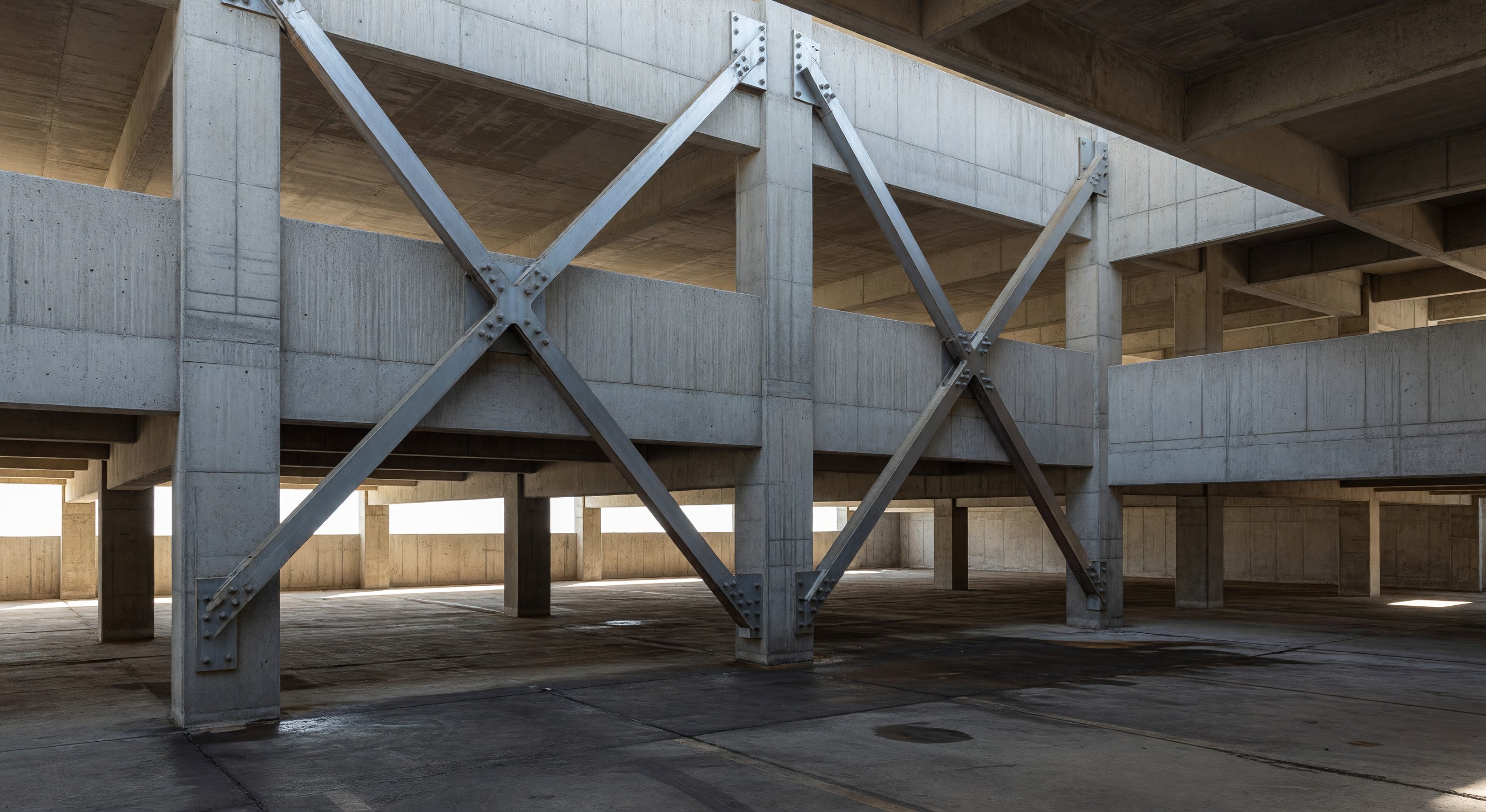
Steel moment frame additions: Exterior or interior steel moment frames bolted to the existing structure provide supplemental lateral resistance. Minimally invasive to the existing concrete structure.
Frequently Asked Questions
Why have parking structures historically performed poorly in earthquakes? The primary reason is inadequate precast concrete connections that cannot transfer seismic forces reliably — particularly in structures built before the 1994 Northridge earthquake revealed widespread connection failures. Soft-story configurations and diaphragm deficiencies also contribute.
What seismic design standard applies to new parking structures? New parking structures must meet ASCE 7 and IBC requirements for their Seismic Design Category. In SDC D through F, special structural systems (special moment frames or special shear walls) are required; ordinary systems are not permitted.
How do I know if my existing parking structure needs a seismic assessment? Structures in SDC D through F built before approximately 1994 (California) or 2000 (Pacific Northwest) should be considered for Tier 1 ASCE 41 screening. Structures with precast double-T connections designed before Northridge, or with open ground floors and limited lateral systems, are highest priority for assessment.
How much does a seismic retrofit cost for a parking structure? Costs vary widely depending on the structural system, deficiency scope, and retrofit approach. Targeted precast connection upgrades can cost $1 to $5 million for a mid-size structure. Comprehensive shear wall additions may cost $5 to $20 million or more. A seismic assessment and conceptual retrofit study is the starting point for budgeting.
Takeaway
Seismic design for parking structures has advanced significantly since the failures of the 1971, 1989, and 1994 earthquakes. New structures in seismically active regions must be designed to ASCE 7 special structural systems requirements. The larger near-term risk lies in the existing inventory of pre-1994 structures, particularly those with precast connections designed before Northridge-era code revisions. Owners in SDC C through F zones should evaluate their existing structures against ASCE 41 criteria and understand their retrofit options before the next significant seismic event reveals deficiencies in the most costly way possible.
Further Reading from Authoritative Sources
- FHWA seismic design and retrofit resources for transportation structures — FHWA publishes seismic design guidance and research for transportation structures including bridges and parking facilities, providing authoritative federal context for the seismic design code requirements and retrofit methods discussed in the article.
- Transportation Research Board seismic performance research for parking structures — The Transportation Research Board publishes research on parking structure seismic performance that provides the technical evidence base for the failure mode analysis and retrofit effectiveness claims in the article.