Parking structures have long been among the least loved elements of the built environment. Exposed concrete decks, blank perforated walls, and utilitarian finishes communicate function over place, which is precisely why municipalities, urban designers, and property owners have increasingly mandated or incentivized architectural treatment of parking facade conditions. The goal is not purely aesthetic — well-designed parking structure facades contribute to walkability, street activation, and property values in ways that bare concrete cannot.
Why Facade Design Matters
The Congress for New Urbanism (CNU) and Urban Land Institute (ULI) both identify the ground-floor treatment of parking structures as a significant determinant of street-level urban quality. A parking structure with a blank concrete wall at street level kills pedestrian activity on that block. Retail, office, or residential uses at the ground level — even just animated facade treatments — activate the streetscape and support adjacent land values.
Municipal design guidelines in cities including Chicago, Portland, Denver, and Miami explicitly regulate parking structure appearance. Common requirements include:
- Minimum percentage of ground-floor perimeter with active uses or transparent facades
- Architectural screening or cladding requirements for upper deck perimeters
- Materials palette requirements (masonry, metal, glass — not exposed concrete)
- Lighting integration and signage control
- Landscaping requirements at base and top of structure
Understanding and designing to local guidelines before schematic design saves costly redesign. Design review boards in urban municipalities may reject projects that do not meet facade standards.
Architectural Screening Systems
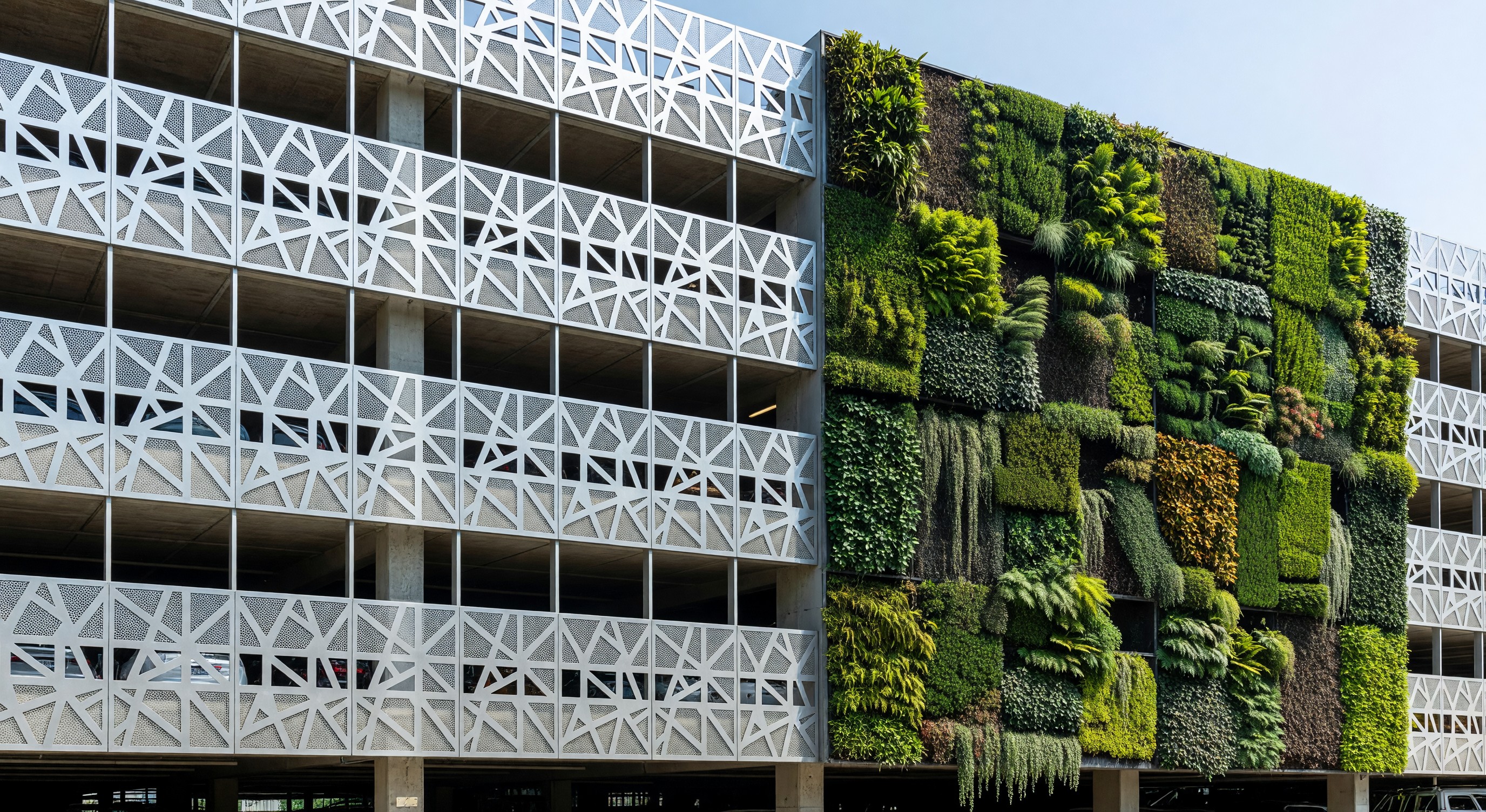
Perforated metal panel systems are the most common architectural facade treatment for parking structures in North America. Powder-coated aluminum or steel panels with a 40 to 60 percent open area satisfy most code requirements for natural ventilation in open parking structures while providing a finished appearance. Panel systems are:
- Lightweight (reducing structural load on cantilevered deck edges)
- Available in a wide range of perforation patterns, colors, and profiles
- Manageable in terms of replacement and maintenance
- Able to incorporate gradient patterns, logos, and art motifs
Fabricators including McNICHOLS, Brandon Industries, and multiple architectural metalwork suppliers offer standard and custom perforation patterns. Some high-profile projects have used computer-generated image-derived perforation patterns to create photographic or artistic effects across facade panels.
Cast-in-place and precast concrete facades can be architecturally finished with form liners (creating textured patterns in the concrete surface), exposed aggregate, or applied coatings. These approaches can achieve aesthetic integration with adjacent masonry buildings but add cost and require coordination with the concrete structure’s schedule.
Brick masonry veneer on parking structures is used in historic districts and traditional urban neighborhoods where the design context demands masonry materials. Steel backup framing supports the veneer; the weight and connection detailing are more complex than panel systems.
Glass curtain wall and glazing systems are used on premium urban garages to maximize transparency and visual integration with adjacent commercial buildings. Cost and waterproofing complexity are higher than panel systems.
Green Wall Systems
Green walls — vertical vegetation systems on building facades — have been applied to parking structures as a sustainability and aesthetic strategy. They can reduce the urban heat island contribution of a structure’s facade, improve air quality marginally, provide habitat, and create distinctive visual character.
Two primary green wall system types:
Trellis and climbing vine systems: The simplest and lowest-cost approach. A steel trellis structure supports climbing plants (Virginia creeper, Boston ivy, wisteria, or others suited to local climate). Vines establish over 2 to 5 years and provide canopy coverage increasing with maturity. Maintenance involves annual pruning to control growth, prevent roof penetration, and clear ventilation openings.
Panel-based hydroponic systems: Factory-grown panels with pre-established plant communities in growing media supported by a structural frame bolted to the building. Irrigation and fertilization are provided through an integrated drip system. Plants are typically ferns, sedums, grasses, and other low-height species. Systems can achieve full coverage immediately upon installation but carry significantly higher installation and maintenance costs than climbing vine systems. Structurally, panel systems add 15 to 30 pounds per square foot to the facade — significant for large-scale applications.
Climate suitability is the primary consideration for green walls on parking structures. In climates with sustained freezing winters, many plant species go dormant or are damaged; irrigation systems must be properly drained and winterized. Desert climates require high-volume irrigation to sustain vegetation. Green wall systems are most reliably successful in temperate coastal climates (Pacific Northwest, parts of the Southeast).
Art Integration
Many cities with percent-for-art ordinances applicable to public facilities and publicly subsidized parking developments require a percentage of construction cost be allocated to public art. Parking structure facades, which offer large, publicly visible surfaces, are natural locations for murals, bas-relief, light installations, and other art forms.
Art integration should be planned from schematic design — both to coordinate with structural and facade systems and to allow an artist selection process. Art installed after construction often requires expensive structural modifications or is constrained to superficial application.
Frequently Asked Questions
Are architectural facades required on parking structures? Many municipalities with design review processes and urban design guidelines require architectural treatment of parking structure facades — particularly at street level and at highly visible elevations. Requirements vary by jurisdiction; check local zoning and design review codes before schematic design.
What is the most cost-effective facade treatment for a parking structure? Perforated metal panel systems are the most commonly used and generally the most cost-effective architectural screening approach. They are lightweight, durable, and available in a wide range of aesthetic options.
Can green walls be applied to all parking structures? Green walls are feasible in most climates with appropriate plant selection and irrigation design, but they perform most reliably in temperate, moist climates. In cold climates, deciduous species go dormant seasonally; in arid climates, high irrigation demand may not align with sustainability objectives.
Do parking structure facades affect property values? Yes. Research from ULI and urban economics studies consistently shows that parking structures with activated ground floors, architectural treatment, and landscaping have less negative impact on adjacent property values than bare-concrete structures. In urban contexts, poorly designed parking facilities can depress adjacent retail rents and residential values.
Takeaway
Parking structure facades are an opportunity to demonstrate design quality and community investment, not merely a regulatory hurdle. Perforated metal panel systems, masonry, green walls, and art integration each serve different contexts and budgets. The most successful parking structures in urban settings treat their facades as part of the public realm — engaging street-level activity and contributing to the visual quality of the neighborhood rather than detracting from it. Early engagement with local design review requirements ensures that facade investment is made strategically and avoids costly late-design changes.
Further Reading from Authoritative Sources
- NACTO urban design guidance on parking structure street activation — NACTO publishes the Urban Street Design Guide and related standards that address how buildings, including parking structures, interface with the public street realm.
- EPA urban heat island effect and green infrastructure for parking structures — The EPA publishes authoritative guidance on urban heat island mitigation strategies, including green walls and vegetation as facade treatments for buildings in urban environments.