Expansion joints in parking structures are among the most maintenance-intensive and failure-prone elements of the building system. They must accommodate thermal movement, creep, shrinkage, seismic drift, and live load deflection — while remaining watertight over decades of service. When they fail, water infiltration begins the chloride-induced corrosion cycle that is the primary cause of structural deterioration. Proper design, specification, and maintenance of expansion joints significantly extends parking structure service life and reduces lifecycle rehabilitation costs.
Why Parking Structures Need Expansion Joints
Concrete structures expand and contract with temperature changes. For a 300-foot-long parking deck in a climate with an annual temperature range of 100°F (typical of the Midwest), the theoretical thermal movement is approximately 0.6 to 0.8 inches over the deck length. Without expansion joints, this movement is accommodated by cracking and deformation of the concrete — not a controlled process and not watertight.
Shrinkage and creep add additional movement in post-tensioned concrete systems. Seismic drift adds differential movement between structural elements during earthquakes. Live load deflection — the elastic deflection of deck panels under vehicle loads — creates small but cyclical movements at joint locations.
The function of an expansion joint is to provide a planned, controlled location for all of these movements to occur, with a predesigned, waterproof seal that accommodates the full range of movement while preventing water infiltration to the structural deck below.
Joint Sizing
Joint width is sized to accommodate the maximum expected movement without overstressing the seal or armor nosing. The design movement is calculated from:
- Thermal movement: Coefficient of thermal expansion for concrete (approximately 6 × 10⁻⁶/°F) × joint tributary length × temperature range × factor of safety (1.5 to 2.0)
- Shrinkage movement: Typically 0.5 to 1.5 times the thermal movement for cast-in-place concrete; lower for post-tensioned systems
- Seismic drift: Per ASCE 7 Story Drift analysis for the structure’s seismic design category; typically 0.5 to 2 percent of story height
- Live load deflection: Typically 0.1 to 0.25 inches at the joint for standard post-tensioned parking deck spans
Joints in parking structures in the continental United States are typically sized at 1 to 3 inches wide, with wider joints in structures with longer spans, larger thermal ranges, or significant seismic design requirements.
Joint System Types
Field-applied sealant joints: Backer rod and sealant applied in the field to the joint opening. The simplest and lowest-cost joint system. Appropriate for control joints and smaller expansion joints (up to 1 inch of expected movement). Sealant service life is 5 to 10 years under traffic in parking applications. Failure occurs through adhesion loss, cohesion failure from fatigue cycling, UV degradation, or mechanical damage from vehicle traffic. Requires periodic inspection and proactive replacement before leakage begins.
Preformed compression seals: Closed-cell neoprene or silicone seals preformed to the joint width, inserted in the field and held by compression. Accommodate joint widths of 1 to 4 inches. Self-cleaning under vehicle traffic; compression maintains watertight contact. Service life of 10 to 20 years with proper installation. Requires that the joint faces are prepared to specific tolerances for the seal size selected.
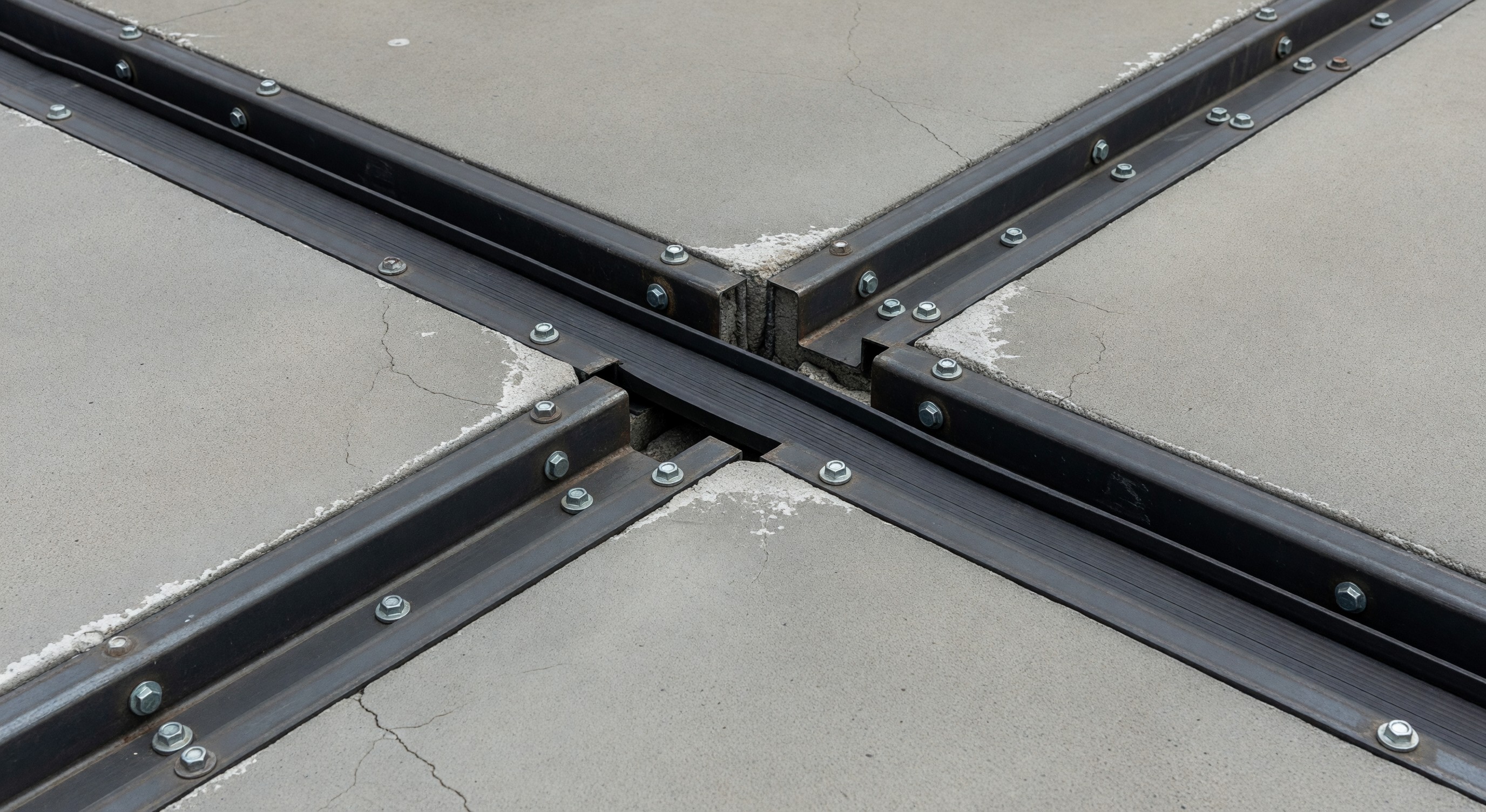
Armored joint systems: The highest-performance joint type for parking structure drive aisles. Steel angle or channel nosings protect the concrete edges of the joint from vehicle tire impact and spalling. An elastomeric seal element (silicone, neoprene, or proprietary compound) spans the joint between the armor nosings. Armored systems accommodate joint widths of 1 to 4 inches and provide the best resistance to vehicle damage of joint edges. Service life of 15 to 25 years for the armor nosing; seals are replaceable in place.
Preformed strip seals: A factory-fabricated combination of metal nosings and an integrated elastomeric seal, installed as a complete unit. Used in bridge and parking structure applications. Accommodates large movements (up to 4 to 6 inches in some products). Higher installation cost; most appropriate for large joints in seismically active regions.
Sealant Material Selection
For field-applied sealants in parking joint applications, the material must resist:
- Chloride-laden water (from de-icers)
- Petroleum hydrocarbons (oil, gasoline)
- UV exposure (at open deck locations)
- Freeze-thaw cycling
- Abrasion from vehicle tire traffic
High-performance polyurethane or polysulfide sealants (ASTM C920 Class 50 minimum) meet these requirements better than standard construction caulks. Silicone sealants have excellent UV and temperature resistance but poor adhesion to concrete in wet environments and poor resistance to abrasion from traffic. For traffic-exposed joints, polyurethane or specialized traffic-grade compounds are preferred.
Joint Maintenance and Replacement
Expansion joints should be inspected annually. Inspection should assess:
- Sealant integrity (cracks, gaps, adhesion loss, extrusion from joint)
- Armor nosing condition (corrosion, loosening from substrate, concrete spalling adjacent to nosing)
- Presence of debris that prevents joint movement
- Evidence of water infiltration below the joint (efflorescence, rust staining on soffit below)
Field-applied sealants should be budgeted for replacement every 5 to 10 years. A proactive sealant replacement program prevents infiltration-related concrete damage — the true cost of deferred joint maintenance. An expansion joint seal replacement of $50 to $100 per linear foot prevents concrete spall repairs costing $200 to $500 per square foot.
Frequently Asked Questions
How wide should expansion joints be in a parking structure? Joint width is calculated from the expected movement (thermal, seismic, shrinkage, creep) with a factor of safety. Typical widths in North American parking structures range from 1 to 3 inches; larger joints are used in long structures with significant seismic requirements.
What is the difference between a control joint and an expansion joint? Control joints are pre-cracked locations designed to concentrate concrete shrinkage cracking — they accommodate one-directional contraction movement only. Expansion joints accommodate both expansion and contraction over the full operational temperature range and are typically spaced more widely, at structural bay intervals or at building/parking connection points.
How long does an expansion joint sealant last in a parking structure? Field-applied sealants last 5 to 10 years under traffic in parking applications. Preformed compression seals last 10 to 20 years. Armored joint systems with replaceable seal elements last 15 to 25 years for the armor component, with seal replacement possible in place.
When should expansion joint armor nosings be replaced? Replace armor nosings when they show active corrosion compromising structural integrity, when they have become detached from the concrete substrate, or when adjacent concrete has spalled significantly. Proactive nosing replacement every 25 to 40 years may be appropriate for facilities with active maintenance programs.
Takeaway
Expansion joints are the highest-maintenance component of a parking structure and the most common waterproofing failure point. Proper joint sizing, specification of appropriate joint system types for the expected movement and traffic conditions, and proactive seal replacement programs are the keys to long-term joint performance. The cost of maintaining joints is a small fraction of the cost of the concrete and structural repairs that failed joints cause. Facilities with systematic joint inspection and proactive replacement programs consistently demonstrate lower lifecycle rehabilitation costs than those that address joints only after water damage is visible.
Further Reading from Authoritative Sources
- Federal transportation infrastructure maintenance and concrete structure guidance — The U.S.
- Transportation Research Board parking structure maintenance research — The Transportation Research Board publishes research on parking structure durability and maintenance, including expansion joint performance studies that provide the evidence base for the service life and material performance claims in the article.