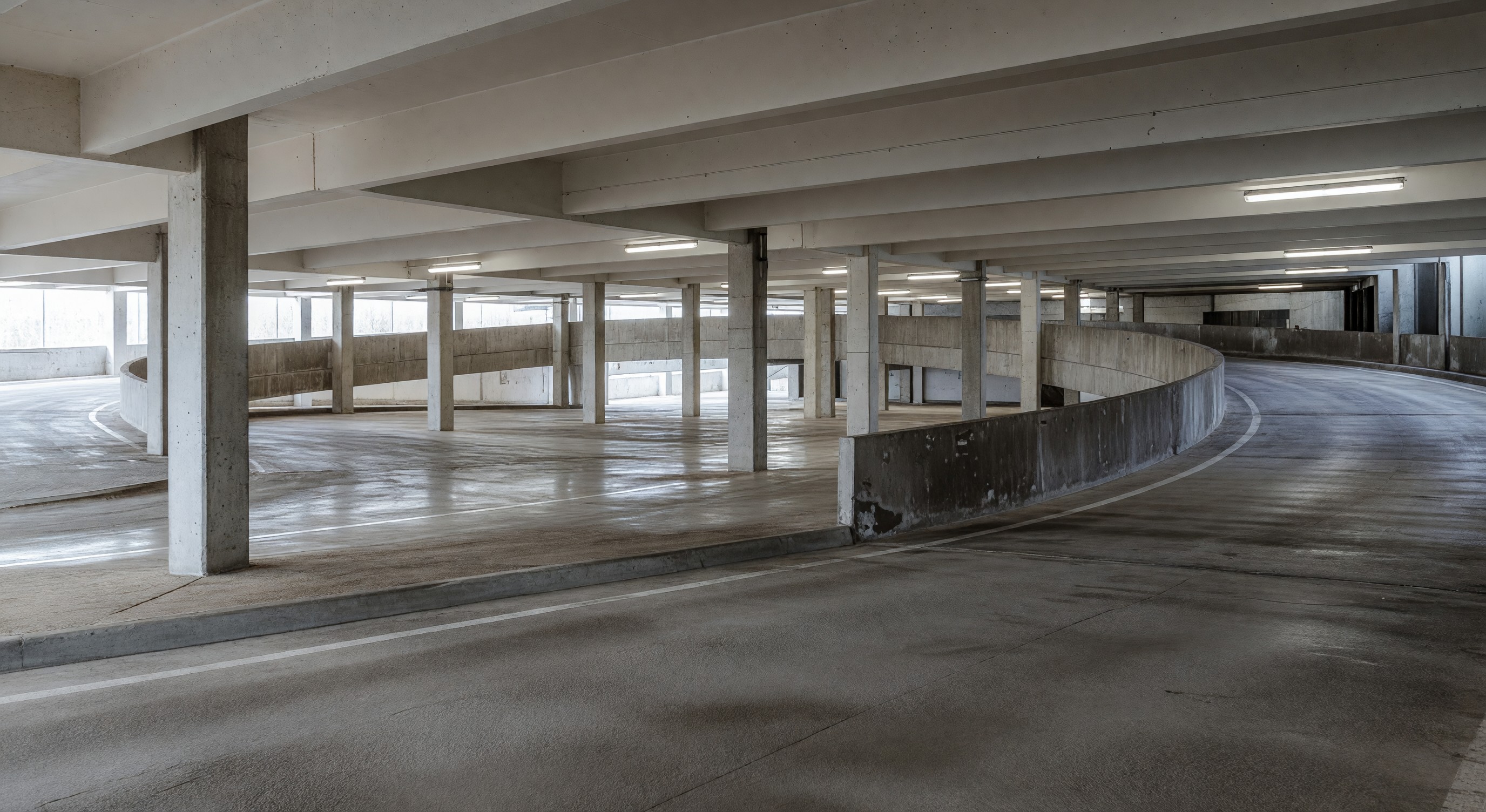
Parking structure design sits at the intersection of structural engineering, traffic engineering, and architecture. Unlike surface lots where mistakes can be corrected with restriping, structural decisions are locked in at construction. Getting ramp geometry, clear heights, and column spacing right from the outset determines whether a garage serves its users effectively for decades or generates perpetual complaints and operational workarounds.
Ramp Design: Slope, Width, and Geometry
Ramps are the most operationally critical element of parking structure design. The maximum recommended slope for a straight ramp is 15 percent (approximately 8.5 degrees), with 12 percent preferred in high-volume or publicly accessible garages. Slopes exceeding 15 percent cause ground clearance problems for low-profile vehicles and create discomfort and traction concerns in wet or icy conditions.
Ramp width minimums depend on traffic flow: one-way ramps should be at least 14 feet clear; two-way ramps require 20 to 22 feet to allow simultaneous passage of two vehicles. Where ramps curve — the standard being a 180-degree helix in a compact site — widths must increase to account for swept path geometry. The inside edge of a curved ramp should have a minimum inside radius of 30 feet for passenger vehicles; 35 feet accommodates larger vehicles and improves driver sight lines on the curve.
Transition zones at the top and bottom of each ramp prevent high-centering of long-wheelbase vehicles. A 10-foot parabolic transition with slope not exceeding half the ramp grade addresses most vehicle profiles. Concrete humps or abrupt grade breaks are common sources of vehicle damage claims in older garages that predate current transition standards.
The Urban Land Institute’s Parking publication, along with guidance from the International Parking and Mobility Institute (IPMI), identifies three basic ramp configurations:
- Straight ramps between levels: simplest to navigate, consume more plan area
- Split-level or split-deck: interlocking half-level decks reduce ramp runs but add navigational complexity
- Helical (spiral) ramps: efficient for compact urban sites; one-way flow is standard
Vertical Clearance Requirements
Minimum vertical clearance in parking structures is established by the Americans with Disabilities Act, ADAAG, and most state building codes. The minimum clear height in accessible routes is 8 feet 2 inches (98 inches). However, this is widely recognized as inadequate for operational purposes.
A more defensible minimum for general parking levels is 8 feet 6 inches clear — measured to the lowest hanging obstruction, including structural beams, sprinkler heads, and mechanical ducting. For facilities expected to serve vans, pickup trucks with bed covers, and cargo vehicles, 9 feet clear is the functional standard. Long-term care facilities and any structure where accessible van parking is provided must achieve 9 feet 8 inches in van-accessible spaces and their access aisles.
Roof or top-deck levels have no overhead constraint, but stair towers and elevator lobbies serving the top deck must maintain clear heights consistent with the levels below. Signage warning of height restrictions should be posted at every entry lane, not merely at the street approach, since drivers who enter an undersized structure have no safe way to turn around without risking contact with overhead elements.
Column Grid Spacing
Column grid spacing governs every aspect of parking module width, stall layout, aisle geometry, and structural efficiency. The most widely used grid for parking structures in North America is based on a 60-foot bay width — accommodating a parking module of two rows of stalls flanking a two-way drive aisle. This 60-foot module (9-foot stalls × 2 = 18 feet per stall row, plus a 24-foot aisle = 60 feet) has been the default for post-tensioned concrete structures since the 1970s.
Column placement directly affects stall usability. Columns that fall within a stall reduce effective stall width by 6 to 18 inches — the effective-width loss depends on column size and eccentricity within the stall. Designers should locate columns at the boundary between two stalls (the striped line), never within a stall body. This requires close coordination between the structural engineer and the traffic/parking layout designer early in design development.
Cantilever configurations allow wider column spacing by eliminating interior columns from the parking module, but increase structural depth. Some designers prefer an 8-bay × 60-foot module (480-foot length) with columns at stall lines only, producing zero column intrusion. This is the most operationally efficient configuration but demands longer spans and greater structural investment.
Expansion and Adaptability Considerations
Parking structures built today will likely be converted to other uses within 30 to 50 years as autonomous vehicle penetration reduces demand. Adaptable garage design accounts for this by using flat floor plates (rather than ramped split-deck configurations), 10-foot minimum floor-to-floor height (to allow future commercial or residential conversion without floor reconstruction), and structural loading of at least 100 pounds per square foot live load rather than the 50 psf minimum for parking. The Urban Land Institute and Congress for New Urbanism have published guidance on adaptive reuse design principles that inform these decisions.
Frequently Asked Questions
What is the maximum slope for a parking ramp? Most codes and design guidelines set the maximum at 15 percent for straight ramps and 12 percent for curved ramps. Slopes above 15 percent are generally avoided in publicly accessible facilities due to vehicle clearance and safety concerns.
What clear height is required in a parking structure? The ADA minimum for accessible routes is 98 inches (8 feet 2 inches), but the operational standard for general parking is 8 feet 6 inches minimum, with 9 feet preferred in facilities serving vans and larger vehicles.
How does column spacing affect stall layout? Columns should be positioned at stall boundary lines rather than within stalls. The 60-foot bay width — two rows of 9-foot stalls plus a 24-foot aisle — is the standard module that achieves this without column intrusion.
Should new parking structures be designed for adaptive reuse? Yes. Design guidance from ULI and IPMI increasingly recommends flat floor plates, taller floor-to-floor heights, and heavier structural loading to enable future conversion to residential, office, or commercial use.
Takeaway
Parking structure design is a discipline where geometry, structure, and operations must be resolved together from early schematic design. Ramp slopes, clear heights, and column grids each carry long-term operational consequences that are costly to correct after construction. Designing to current ITE, ULI, and IPMI standards — while building in adaptability for future use changes — positions a structure to serve its market effectively across its full economic life.
Further Reading from Authoritative Sources
- IPMI parking structure design body of knowledge and guidance — IPMI is one of the two organizations explicitly cited in this article as the source of ramp configuration guidance and adaptive reuse design recommendations.
- ITE parking structure design technical resources and standards — ITE is explicitly cited alongside IPMI as a design standard reference for parking structures.