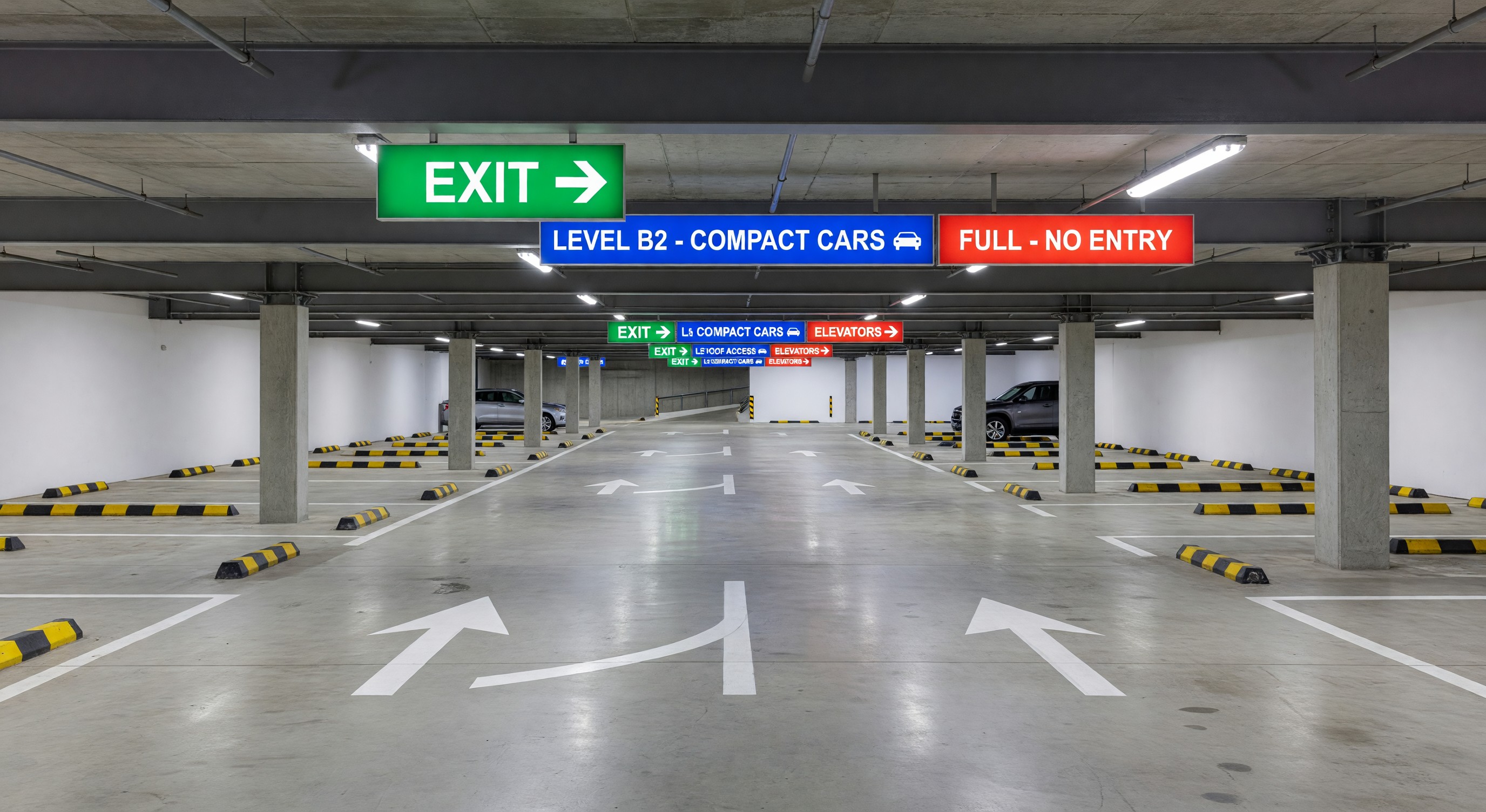
Signage in parking facilities does two things simultaneously: it complies with legal standards and it guides user behavior. Facilities that treat these as separate objectives — posting required signs for code compliance while designing wayfinding as an afterthought — routinely generate driver confusion, conflict points, and complaints. A unified signing program integrates regulatory, warning, and guidance signs into a coherent system that drivers can follow instinctively.
The MUTCD Framework for Parking Signage
The Manual on Uniform Traffic Control Devices (MUTCD), published by the Federal Highway Administration, establishes standards for traffic control signs on public roadways. Many jurisdictions extend MUTCD applicability to private parking lots and structures that are open to the public, and most operators adopt MUTCD conventions regardless of strict legal requirement because standardization improves driver comprehension.
Key MUTCD categories applicable to parking include:
- Regulatory signs (R series): Stop, yield, speed limit, do not enter, one-way, no parking, parking time limits
- Warning signs (W series): Speed humps, pedestrian crossings, blind intersections, clearance warnings
- Guide signs (D series): Destination markers, arrows, facility identification
MUTCD specifies sign colors, reflectivity classes, and minimum letter heights. Retroreflective sheeting meeting ASTM D4956 standards is required for all traffic control signs used at night. Type III or Type IV sheeting (high-intensity prismatic) is appropriate for most parking applications; Type VII or IX sheeting provides enhanced visibility for overhead clearance signs at garage entries.
Wayfinding Hierarchy: Approach, Orient, Navigate, Confirm
Effective wayfinding in parking is built on four sequential driver needs: approach (find the facility from the street), orient (understand facility layout upon entry), navigate (find a stall), and confirm (verify correct parking). Signage must address each phase with appropriate content and placement.
Approach signs are placed on public streets within 500 to 1,000 feet of facility access points. These typically use blue or white backgrounds with a standard parking symbol (P) and directional arrow. In shared facilities, approach signs may identify validated parking for specific businesses.
Orientation signs are posted at entry plazas and just beyond access equipment. A facility map or level-by-level diagram, maximum height warning, rate and hours, and entry instructions should all be visible from the queuing area before a driver commits fully to entry.
Navigation signs guide drivers through the facility: aisle direction arrows, level identification markers, stairwell and elevator locations, exit signs. These signs must be visible from the driver’s eye level while seated, which means mounting heights between 7 and 9 feet for wall-mounted signs in garages and appropriate heights for overhead signs.
Confirmation signs — particularly reserved zone identification, permit-only area markers, and validation instructions — appear at the stall level. These signs must be readable from within a parked vehicle.
ADA Signage Requirements
The ADA requires specific signage for accessible parking spaces and accessible routes. Van-accessible spaces must be designated with a “Van Accessible” designation below the standard International Symbol of Access. Signs must be mounted at a height of 60 to 66 inches from the ground to the bottom of the sign — positioned where they will not be blocked by a parked vehicle.
Every accessible route — from accessible stalls to building entrances — must be marked with appropriate signage and pavement markings. ADA also requires that permanent accessible route signs include the ISA and, where the accessible route diverges from a general circulation path, directional arrows.
Typography, Color, and Retroreflectivity
Effective parking signage uses fonts and letter sizes calibrated for the reading speeds and distances involved. The MUTCD specifies minimum letter heights for regulatory signs by posted speed. In low-speed parking environments (10 to 15 mph), a 4-inch capital letter height is standard for overhead signs; larger is better where visual clutter competes with sign messages.
High-contrast color combinations — white text on green, white on blue, black on white — achieve the best legibility. Mixed backgrounds across a facility create visual noise and impede comprehension. Adopting a consistent color system for different sign functions (regulatory, wayfinding, informational) improves driver learning over repeated visits.
All externally mounted signs and any sign visible from a driving lane at night must use retroreflective sheeting. Painted signs or uncoated aluminum signs in parking facilities are a compliance risk and a safety issue.
Dynamic Signage Integration
Modern parking facilities increasingly combine static regulatory and wayfinding signs with dynamic electronic signs displaying real-time occupancy. LED variable message signs (VMS) at entry plazas and aisle entries communicate available stall counts by zone. These signs, when integrated with parking guidance systems (ultrasonic sensors or camera-based occupancy systems), allow drivers to navigate directly to available stalls without circulating.
Dynamic signs must maintain static fallback messaging during system outages. A VMS that goes dark or displays a generic error in a high-volume facility creates immediate operational problems. Facilities should specify minimum display standards for failure modes and test them during system commissioning.
Frequently Asked Questions
Does MUTCD apply to private parking lots? Technically, MUTCD applies to traffic control devices on streets and highways open to public travel. However, many states extend these requirements to private lots open to the public, and most operators adopt MUTCD standards regardless, as they represent the established baseline for sign design and driver comprehension.
What height should accessible parking signs be mounted? ADA requires accessible parking signs to be mounted so the bottom of the sign is between 60 and 66 inches above the ground — positioned to be visible even when vehicles are parked in adjacent spaces.
What retroreflectivity standard applies to parking signs? ASTM D4956 establishes retroreflective sheeting types. Type III or IV (high-intensity prismatic) sheeting is appropriate for most parking applications. Clearance bars at garage entries benefit from Type VII or IX sheeting for maximum night visibility.
How many wayfinding sign levels should a parking system have? A robust wayfinding hierarchy has at minimum four phases: approach, orientation, navigation, and confirmation. Each addresses a distinct driver information need and should be supported by dedicated sign types and placements.
Takeaway
Parking signage is not a single sign type but a system — one that must address every stage of the driver’s journey from public street to parked vehicle. MUTCD compliance establishes minimum standards; effective wayfinding hierarchy and consistent typography and color systems are what transform a compliant sign program into one that actually works for users. Investment in well-designed signing pays consistent dividends in reduced driver confusion, fewer conflict points, and lower staff workload for directing lost drivers.
Further Reading from Authoritative Sources
- FHWA Manual on Uniform Traffic Control Devices — sign design standards — The Federal Highway Administration publishes the MUTCD, which is explicitly referenced in the article as the national framework for sign design including color standards, retroreflectivity, and letter height that parking facilities adopt.
- U.S. Access Board ADA signage requirements for parking facilities — The U.S.