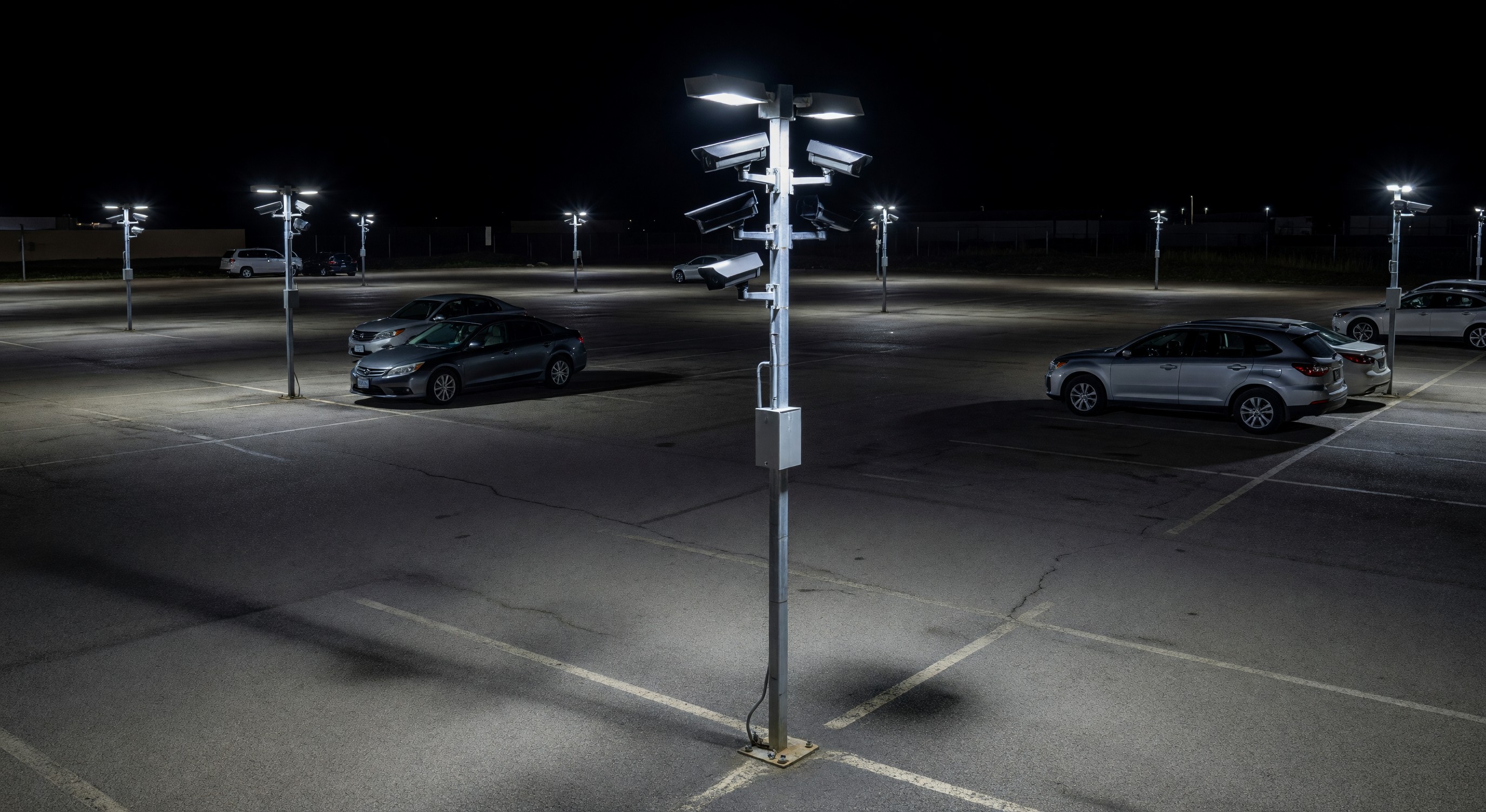
Security lighting and surveillance camera systems in parking facilities are not independent systems — their effectiveness is deeply interdependent. A camera network that cannot capture usable images due to inadequate lighting is a liability documentation system, not a crime deterrence tool. A well-lit facility without cameras may deter opportunistic crime but provides no forensic evidence when incidents occur. Designing these systems together, with shared performance objectives, produces a security infrastructure that serves both deterrence and evidentiary purposes.
Security Lighting Standards
The Illuminating Engineering Society’s Recommended Practice for Parking Facilities (IES RP-20) establishes two tiers of illuminance for parking areas based on security level:
Standard parking (general illumination): 1.0 footcandle (fc) maintained average; 0.25 fc minimum; uniformity ratio (average/minimum) ≤ 4:1.
Enhanced security parking: 3.0 fc maintained average; 0.6 fc minimum; uniformity ratio ≤ 3:1. This tier is appropriate for facilities with documented security concerns, facilities in high-crime areas, facilities serving vulnerable populations (hospitals, transit centers), and any area with security cameras where image quality is a priority.
Vertical illuminance — the light falling on vertical surfaces including columns, walls, and people’s faces — is not specified by RP-20 alone but is critical for security camera performance. Security consultants and lighting designers working on CCTV-integrated systems typically specify minimum vertical illuminance of 1 to 2 fc throughout the field of view of each camera.
How Lighting Affects Camera Performance
Modern security cameras can operate in lower light than legacy systems, but performance — image resolution, color accuracy, facial recognition capability — degrades as light levels drop. Camera manufacturers publish minimum illuminance specifications for their products; these specifications should drive the lighting design for camera-covered areas, not just IES RP-20 minimums.
Key lighting parameters for camera integration:
Minimum illuminance at camera coverage area: Most current-generation CCTV cameras designed for outdoor/parking use specify a minimum of 0.5 to 2 fc for their rated performance at typical security camera resolution (1080p to 4K). Below this threshold, cameras switch to infrared mode (night vision), which loses color information.
Color temperature: Cameras capture license plate characters and clothing colors more accurately under 4000K to 6000K (neutral to cool white) lighting than under 2700K to 3000K warm white. If license plate capture is a priority — for LPR-based access control or enforcement documentation — specify 4000K minimum color temperature for the lighting system.
Uniformity and high-contrast avoidance: Security cameras have limited dynamic range (the ability to capture detail in both bright and dark areas simultaneously). A lighting system that creates bright spots and dark shadows forces cameras to choose between overexposing the bright area and underexposing the dark area. Uniform lighting with a maximum-to-minimum ratio of 5:1 or better produces the most usable images across an entire camera frame.
Backlight and silhouetting: If a bright light source is in the camera’s field of view — a luminaire, a building-mounted fixture — it can cause lens flare or silhouette the scene in front of it, obscuring license plates and faces. Cameras should be aimed away from luminaires, or fixture hoods/shields should prevent direct glare into camera lenses.
Camera Placement Designed Around Lighting
Effective security system design starts with camera placement planning that accounts for lighting conditions. For each camera position, the designer should verify:
- Adequate horizontal illuminance within the camera’s field of view
- Adequate vertical illuminance for face and vehicle identification
- No direct luminaire in the camera field of view
- No deep shadows or extreme contrast within the coverage area
Camera mounting heights in parking areas of 10 to 20 feet produce good coverage of vehicle rooftops and license plates. Taller mounting (20 to 30 feet) improves area coverage but loses detail resolution for face capture. The balance depends on the primary security objective: area surveillance versus individual identification.
In parking structures, elevator lobbies, stairwells, and entry/exit lanes are the highest-priority camera locations. These are also the locations where lighting quality most directly affects camera performance. Stairwells should have lighting specifically optimized for vertical illuminance (wall-wash fixtures rather than ceiling downlights) to capture facial detail of stairwell users.
License Plate Capture Lighting
LPR cameras used for access control or enforcement documentation have specific lighting requirements. Most LPR-grade cameras use IR (infrared) illuminators to capture plates under varying ambient conditions — the camera pairs with a dedicated IR emitter that illuminates only the plate area.
For dedicated LPR lanes (entry/exit gates), the IR illuminator and camera are integrated into the PARCS equipment and do not require separate lighting design. For area LPR coverage (surveillance LPR across a parking field), ambient lighting at 2 to 4 fc with appropriate color temperature supports visible-light plate capture.
Emergency Lighting
Parking facilities must comply with NFPA 101 Life Safety Code and IBC emergency lighting requirements, which mandate maintained illumination during power failure on egress paths, stairwells, and exit access corridors. Emergency lighting at a minimum of 1.0 fc along the egress path for 90 minutes following power failure is the standard requirement. Battery-backed LED fixtures or central emergency lighting inverter systems both meet this requirement.
Frequently Asked Questions
What footcandle level is required for security camera operation in a parking lot? Most current-generation parking security cameras require a minimum of 0.5 to 2 fc for rated performance. At lower levels, cameras switch to infrared mode, losing color information. IES RP-20’s enhanced security tier of 3 fc average meets camera requirements with margin.
What color temperature is best for parking security lighting with cameras? 4000K to 6000K (neutral to cool white) provides the best license plate character contrast and color accuracy for security camera capture. Warm white (2700 to 3000K) reduces color accuracy and character contrast.
How does lighting uniformity affect security camera performance? Cameras have limited dynamic range and perform poorly when lighting creates extreme contrast within the frame. Uniformity ratios of 5:1 maximum-to-minimum or better produce the most usable security images across the full camera field of view.
Where should security cameras be prioritized in a parking facility? Elevator lobbies, stairwells, entry/exit lanes, and pedestrian crossings are the highest-priority camera locations. These areas also require the highest lighting quality for camera performance — specifically, adequate vertical illuminance for face capture.
Takeaway
Security lighting and camera systems must be designed as an integrated system, not specified independently. Camera performance specifications should drive illuminance levels in camera-covered areas; lighting placement should avoid creating backlight or high-contrast conditions in camera fields of view. The investment in high-quality security lighting — targeting IES RP-20 enhanced security levels with 4000K color temperature and uniformity ratios better than 5:1 — directly determines whether the camera network delivers actionable security footage or merely confirms that incidents occurred without providing usable evidence.
Further Reading from Authoritative Sources
- US Department of Energy commercial lighting standards and efficiency resources — The DOE’s commercial lighting resources cover ENERGY STAR and DLC certification criteria, efficiency benchmarks, and rebate program guidance directly relevant to operators selecting LED fixtures for security lighting in parking facilities.
- NIST photometric measurement standards for illuminance verification — NIST maintains the national photometric measurement standards that underlie the footcandle uniformity and illuminance verification testing used to confirm IES RP-20 compliance in security lighting design.