Parking lot restriping is one of the highest-impact, lowest-cost maintenance investments a facility owner can make. Fresh, visible striping organizes parker behavior, communicates regulatory requirements, and improves the appearance of the lot. Yet restriping is routinely deferred until lines are nearly invisible — which means lost revenue from disorganized parking, safety risks from unclear lane and crosswalk markings, and ADA compliance risk from faded accessible stall designations. Understanding when to restripe, what to change when restriping, and how to handle ADA reconfiguration is essential for proactive facility management.
Restriping Triggers
Visual inspection: Lines should be repainted when they are visibly faded, worn narrow (below 3 inches from the original 4-inch width), or no longer clearly visible from normal driving positions. Inspection should be done under varying light conditions — markings that are visible in full daylight may be invisible or dangerously dim at dusk or at night.
Retroreflectivity measurement: The technically correct trigger is retroreflectivity measurement using a retroreflectometer. When white markings drop below 100 to 150 mcd/m²/lux (compared to 300 mcd/m²/lux for new markings), nighttime visibility is compromised. Measurement is appropriate for facilities that operate heavily at night or have documented nighttime safety concerns.
Pavement resurfacing: Restriping must always follow any pavement resurfacing. Seal coat, fog seal, and asphalt overlay all cover existing markings. Restriping should occur as soon as the new surface is ready for marking (typically 24 to 72 hours after seal coat; 48 to 96 hours after asphalt overlay).
ADA compliance audit findings: Any finding of ADA non-compliance in accessible stall dimensions, access aisle width, or ISA marking legibility triggers immediate restriping of the affected spaces, regardless of the overall lot marking condition.
Operational changes: Changes in facility use, tenant mix, or traffic patterns that require reconfiguring stall layout or adding/removing designated areas (reserved zones, EV charging, fire lanes) require restriping of the affected areas.
When to Reconfigure Instead of Replicate
Standard restriping — repainting the existing layout — is appropriate when the current layout functions well and meets all applicable standards. Reconfiguration is warranted when:
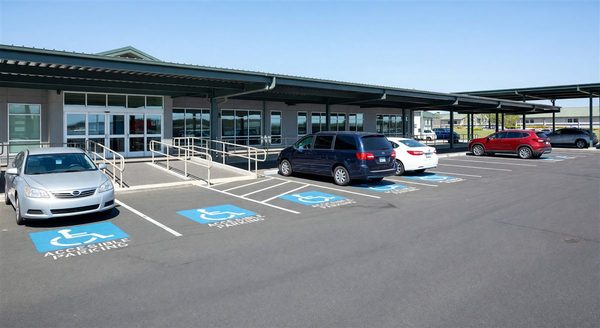
ADA deficiencies exist: If the existing layout does not provide the required number of accessible stalls, or if existing accessible stalls do not meet current dimension requirements (8-foot stall + 5-foot aisle for standard; 8-foot stall + 8-foot aisle for van-accessible), reconfiguration is required. Current 2010 ADA Standards apply to any resurfacing or remarking project that constitutes an “alteration” under ADA — which includes routine restriping in many circumstances.
Layout efficiency can be improved: Restriping projects are low-cost opportunities to reconfigure stall angles, adjust aisle widths, add compact stall sections, relocate reserved spaces, or add pedestrian crosswalk markings. Improvements that would require lane closure and traffic control during a standalone project can be incorporated at no additional disruption cost when done as part of a restriping project.
Technology additions require new markings: EV charging stall markings, payment zone markings for mobile-pay areas, or LPR zone identification all require new or modified pavement markings. These are most economically added during a comprehensive restriping project.
ADA Reconfiguration Requirements
The ADA requires that when an existing parking facility is “altered” — which DOJ interpretation has consistently included routine restriping — the altered portion must be brought into compliance with current ADA standards. In practice, this means:
- Correct the total count of accessible stalls to meet the current ratio for the total stall count
- Ensure at least 1 in 6 accessible stalls is van-accessible
- Verify all accessible stall dimensions meet 2010 ADA Standards (not 1991 ADAAG)
- Confirm access aisles are correctly marked and positioned
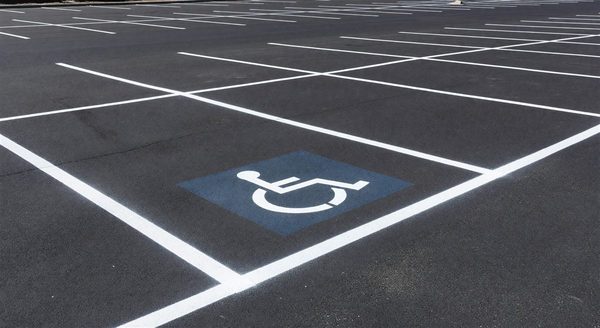
- Replace faded ISA symbols with fresh, full-size markings
- Post or replace accessible stall signs at 60 to 66 inches mounting height above finish floor
Facilities that have not been restriped since before the 2010 Standards took effect (March 2012) may find their current accessible parking layouts non-compliant with current standards. The most common deficiencies: van-accessible access aisle is on the passenger side (required) not the driver side; not enough van-accessible stalls; stall or aisle dimensions below current minimums.
Project Planning and Contractor Coordination
Layout drawing: Before any restriping project, create or update a dimensioned as-built drawing of the lot layout, including all accessible stalls, fire lanes, crosswalks, and reserved areas. This drawing becomes the basis for the new layout and the quality control document for contractor review.
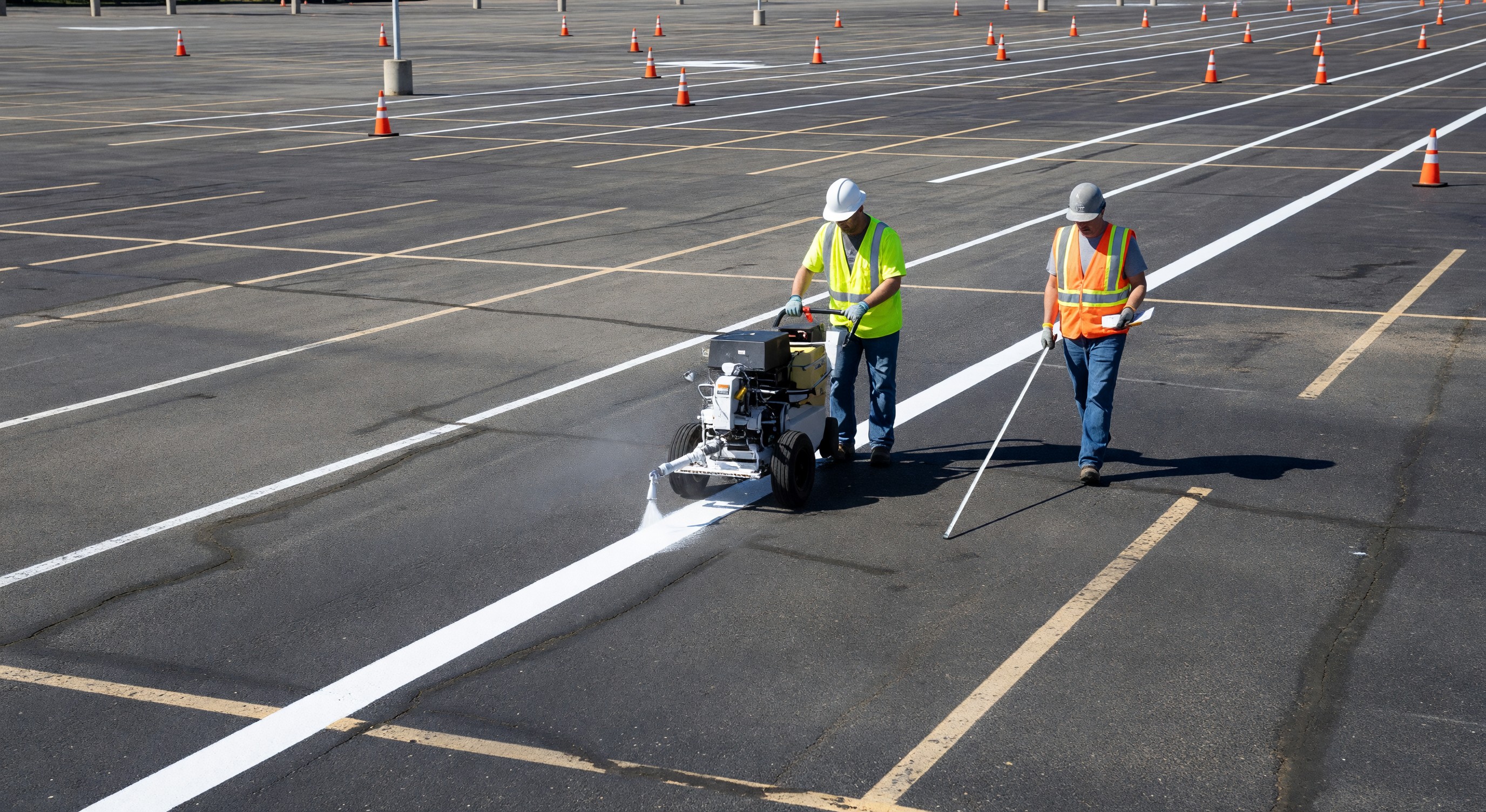
Paint selection: Select paint appropriate for the surface type (asphalt vs. concrete), expected service life, and retroreflectivity requirements. Latex traffic paint with glass beads is appropriate for most applications; epoxy paint provides longer service life in high-wear areas.
Surface preparation: Lot must be clean and dry. Sweep or blow free of debris. Fill any cracks or potholes that would be covered by new marking. Ghost markings — old lines to be eliminated — should be sandblasted or ground off before restriping to avoid driver confusion.
Traffic control: Sequence restriping by section, reopening sections as paint dries. Work schedules should be coordinated with facility operators to minimize closure during peak hours.
Frequently Asked Questions
How often should a parking lot be restriped? Traffic paint on asphalt lasts 1 to 3 years; epoxy extends this to 5 to 8 years. Annual visual inspection determines restriping timing. Retroreflectivity measurement provides a more precise trigger for facilities with significant nighttime operations.
Is restriping considered an ADA “alteration” that triggers upgrades? DOJ interpretation is that routine restriping constitutes an alteration that triggers ADA requirements for the area being restriped. Operators should bring all accessible stalls in the restriped area into current 2010 ADA Standards during any restriping project.
Can I use the same layout when restriping, or must I reconfigure? You can replicate the existing layout if it meets current standards. If the current layout has ADA deficiencies or operational problems, restriping is the lowest-cost opportunity to address them. Ghost-marking old lines and restriping a corrected layout requires only modest additional cost during a planned restriping project.
What causes parking lot stripes to fade faster? UV exposure (south-facing lots receive more), traffic volume (heavy traffic wears markings faster), surface texture (rough asphalt wears paint faster), and water ponding (standing water accelerates adhesion failure) all accelerate stripe fading. Epoxy paint and high-quality retroreflective glass beads extend service life.
Takeaway
Parking lot restriping is not merely cosmetic maintenance — it is a compliance, safety, and operational matter. The restriping trigger should be annual inspection rather than visible failure. Every restriping project is an opportunity to address ADA deficiencies, improve layout efficiency, and add modern facility features (EV charging markings, pedestrian crosswalks, technology zones). Investing in a dimensioned layout drawing before the project, selecting appropriate paint materials, and coordinating with a qualified line marking contractor produces a restriping result that serves the facility effectively for its full material service life.
Further Reading from Authoritative Sources
- 2010 ADA Standards for Accessible Design parking requirements — ADA.gov is the official federal source for the 2010 ADA Standards for Accessible Design directly referenced in the article.
- U.S. Access Board accessible parking design technical guidance — The U.S.