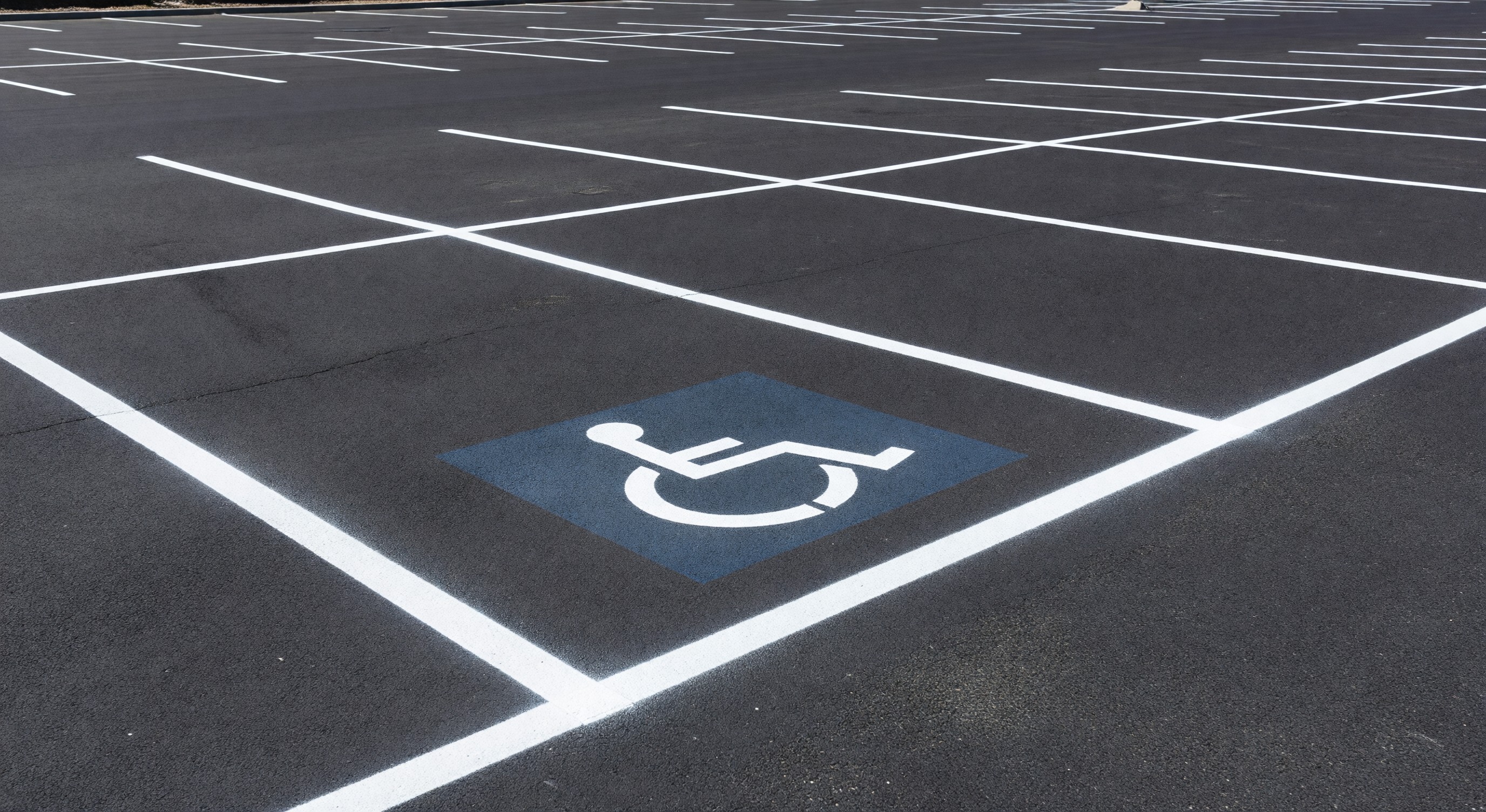
Pavement markings in parking lots perform three critical functions: they define stall boundaries and maximize organized use of available space, they communicate regulatory requirements (accessible spaces, fire lanes, no-parking zones), and they guide pedestrian and vehicle circulation. When markings fade, are incorrectly placed, or fail to meet ADA requirements, the consequences range from user confusion and inefficiency to legal liability.
Pavement Marking Materials
Traffic paint (latex or alkyd water-borne formulas) is the most common marking material for parking lots. Latex traffic paint dries in 20 to 30 minutes, is low in VOCs, and adheres to both asphalt and concrete. Typical dry film thickness is 10 to 15 mils per coat. Service life on asphalt is 1 to 3 years; on concrete, 2 to 4 years. Many paint manufacturers include glass beads in the formula to improve retroreflectivity.
Epoxy paint provides significantly longer service life (5 to 8 years on asphalt; 7 to 10 years on concrete) due to its chemical-cure bond. Higher material and application cost, longer cure time (4 to 8 hours before reopening to traffic), and more complex surface preparation requirements limit its use to higher-value applications — garages, high-turnover facilities, and ADA marking zones.
Thermoplastic markings are heat-applied preformed or extruded materials that bond to the pavement surface as they cool. Service life of 4 to 8 years is common. Thermoplastic is less commonly used in parking lots than in roadways due to higher equipment requirements, but is effective for fire lane markings and accessible stall hatching where durability is a priority.
Preformed tape markings (Stimsonite, 3M, or equivalent) are adhesive-backed polyester or rubber sheets applied to cleaned pavement. Service life varies by product and application surface — 2 to 6 years is typical. Preformed tape is commonly used for ADA symbols, arrows, and logos where complex shapes are difficult to paint consistently.
Retroreflectivity Standards
Retroreflective markings — those that reflect light back toward its source (headlights) — are critical for parking facilities that operate after dark. ASTM D6628 Standard Specification for Color of Pavement Marking Materials and ASTM D7585 Standard Practice for Evaluating Retroreflective Pavement Markings govern material performance.
Minimum retroreflectivity for new white pavement markings is specified in RL (retroreflected luminance) units: 300 mcd/m²/lux for new white markings and 250 mcd/m²/lux for new yellow markings are common state DOT specifications. Parking facilities served by artificial lighting may accept lower retroreflectivity thresholds, but facilities with underlit areas or outdoor perimeter sections should maintain road-standard retroreflectivity.
Glass bead application is the primary method for adding retroreflectivity to traffic paint. Beads are broadcast into the wet paint surface at rates of 5 to 7 pounds per gallon of paint. Bead quality, size distribution, and application rate significantly affect retroreflective performance.
ADA Pavement Marking Requirements
The 2010 ADA Standards for Accessible Design require specific pavement markings for accessible parking spaces:
Stall markings: Accessible stalls must be delineated by white lines. The access aisle must be marked with diagonal hatching in a contrasting color or with “NO PARKING” text. The access aisle marking prevents parking within the aisle and must be visible from the parking position.
ISA (International Symbol of Accessibility): The wheelchair symbol must be marked on the pavement surface of each accessible stall in addition to the required sign. ADAAG does not specify exact symbol dimensions for pavement markings, but the standard ITE template (36 inches wide × 54 inches tall) is widely accepted. The symbol should be painted in blue, centered within the stall.
“VAN ACCESSIBLE” marking: Van-accessible stalls should have “VAN ACCESSIBLE” text or the van-accessible ISA on the pavement in addition to the required sign. While pavement marking of van accessible status is not explicitly required by ADA, it is best practice and required by some state accessibility codes.
Accessible route markings: Where the accessible route to building entrances crosses drive aisles, crosswalk markings (parallel white lines perpendicular to the direction of travel, typically 6-inch-wide stripes at 12-inch spacing) are required.
Fire Lane Markings: In many jurisdictions, fire lanes must be delineated with red curb paint and/or “FIRE LANE — NO PARKING” pavement text. NFPA 1 and local fire codes govern fire lane marking requirements. Fire lane markings must be maintained in legible condition — faded fire lane markings are a common code enforcement citation.
Line Width and Layout Standards
Standard stall delineation lines are 4 inches wide. Some operators use 6-inch lines in high-turnover facilities where line visibility is critical for customer behavior. The ITE recommends 4-inch-wide lines as the minimum, with wider lines (6 inches) for enhanced visibility.
Stall lines extend the full depth of the stall — typically 18 to 20 feet from aisle edge to wheel stop or curb. Double lines (two parallel 4-inch stripes with a 4- to 6-inch gap between them) are sometimes used at stall ends to indicate do-not-park areas at aisle transitions. This is an operational choice, not a code requirement, but helps prevent encroachment into turning areas.
Maintenance and Restriping Schedule
Pavement markings should be inspected annually. Restriping triggers include: retroreflectivity below minimum thresholds, paint width reduced by wear to less than 3 inches, ADA markings no longer legible, or after any resurfacing or significant pavement repair.
Before restriping, any layout changes required by ADA audit findings, stall reconfiguration, or changed traffic patterns should be incorporated. Restriping over existing lines without correcting layout issues locks in deficiencies for another maintenance cycle.
Frequently Asked Questions
How often should parking lot lines be repainted? Traffic paint on asphalt typically lasts 1 to 3 years before restriping is needed. Epoxy paint extends this to 5 to 8 years. Annual inspection with retroreflectivity measurement is the standard approach to determining restriping timing.
Are glass beads required in parking lot line paint? Glass beads are not universally mandated for parking lots, but they are essential for retroreflectivity in facilities operating after dark or in any area where headlight illumination of markings is important for safety and driver guidance.
What pavement marking is required in an ADA accessible parking access aisle? The access aisle must be marked with diagonal hatching or “NO PARKING” text to prevent vehicles from parking within it. The ISA (wheelchair symbol) must be marked in the accessible stall itself, and the accessible route crosswalk must be marked where it crosses a drive aisle.
Can I restripe over old faded lines without removing them first? Yes, as long as the new layout is identical to the old one. If the layout is changing (stall reconfiguration, new ADA arrangement), old lines must be obliterated before new lines are applied to avoid driver confusion from ghost marks.
Takeaway
Pavement markings are the lowest-cost, highest-impact tool for organizing parking lot use and communicating regulatory requirements. Specification of the right material for the application, application of retroreflective glass beads for night visibility, and rigorous compliance with ADA marking requirements are the three pillars of a professional line marking program. Annual inspection and a proactive restriping schedule maintain the system’s effectiveness throughout the pavement surface’s service life.
Further Reading from Authoritative Sources
- FHWA Manual on Uniform Traffic Control Devices pavement marking standards — The Federal Highway Administration publishes the MUTCD, which is the authoritative source for traffic control device standards including pavement markings.
- U.S. Access Board ADA accessible parking space marking requirements — The U.S.