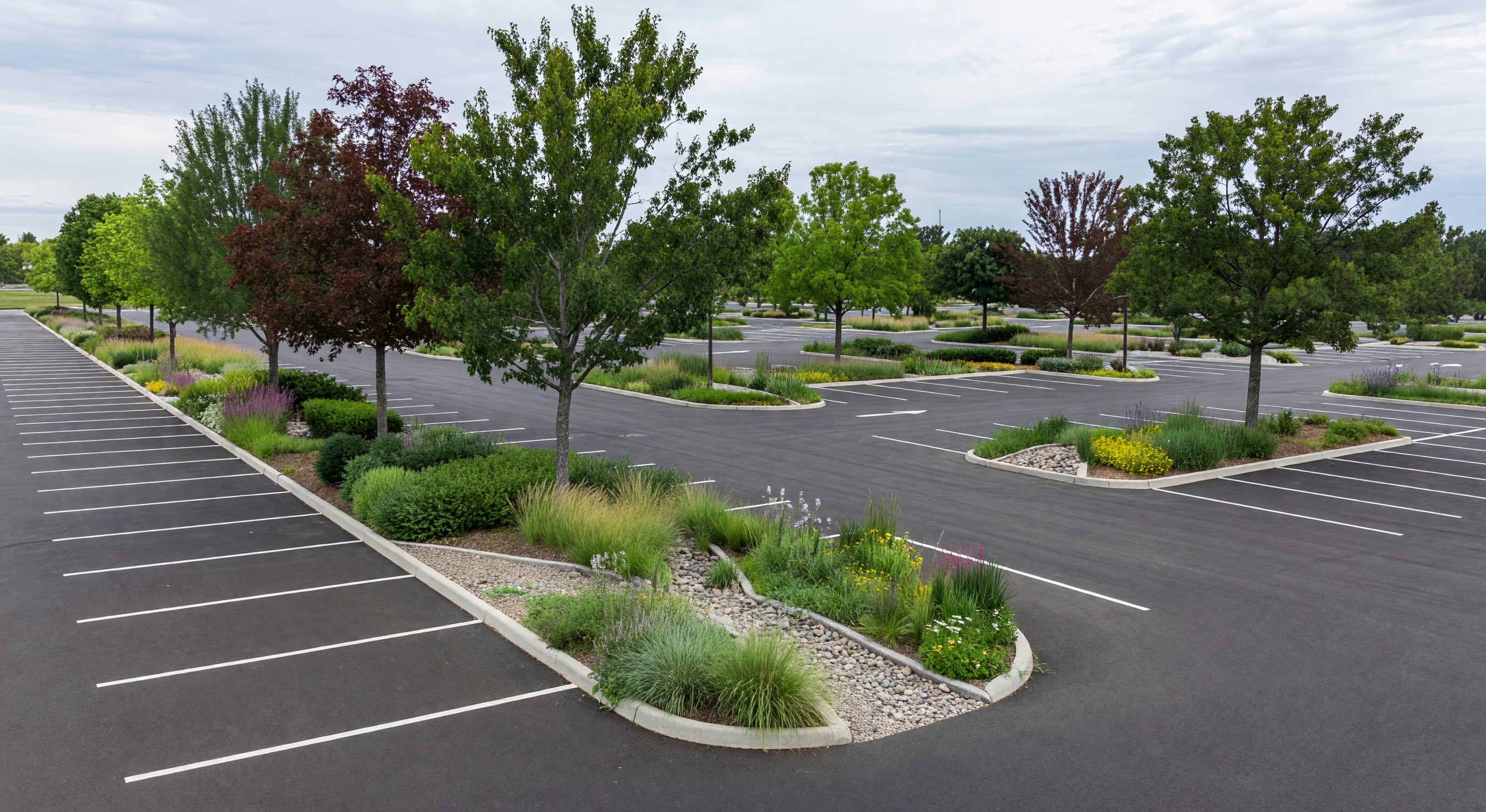
Parking lots are among the largest impervious surfaces in most suburban landscapes. A single-story suburban shopping center may dedicate more land to parking than to the store itself. This concentration of asphalt amplifies urban heat island effects, accelerates stormwater runoff, and creates harsh pedestrian environments. Strategic landscaping — not decorative planting, but functional green infrastructure — addresses all three while improving the user experience and meeting increasingly stringent municipal requirements.
Heat Island Effect and Parking
The urban heat island (UHI) effect elevates surface temperatures in developed areas 2 to 5°F above rural surroundings, driven largely by dark impervious surfaces that absorb solar radiation and radiate it as heat. Parking lots with exposed asphalt can reach surface temperatures of 140 to 160°F on summer afternoons, creating a significant heat load that affects ambient air temperature, vehicle interiors, and pedestrian comfort.
Three landscaping strategies meaningfully reduce parking lot UHI contribution: tree canopy coverage, high-reflectance surface materials, and vegetated areas (islands, swales, and perimeter buffers). The EPA’s Heat Island Effect resources and research published in Urban Climate journal consistently show that mature tree canopy over 40 to 50 percent of a parking area’s surface can reduce ambient temperatures by 3 to 5°F and pavement surface temperatures by 20 to 40°F.
Tree canopy in parking lots is achieved primarily through parking lot islands — raised or flush vegetated areas within the parking field. ASHRAE and local energy codes in California (Title 24), New York, and other states increasingly require minimum canopy coverage percentages for new parking facilities. LEED Sustainable Sites credits for heat island reduction require either SRI-rated paving surfaces or 50 percent tree canopy within 10 years.
Tree Island Design Standards
Tree islands serve multiple functions: they break up large asphalt expanses, direct traffic flow, reduce stormwater runoff, provide canopy, and create a more humane pedestrian environment. Effective design requires enough soil volume for tree survival.
Minimum tree island dimensions for a single tree: 8 feet wide × 10 feet long is a common minimum, but research from the Urban Tree Foundation and urban forestry literature consistently shows that trees in soil volumes below 400 cubic feet rarely achieve full canopy development or long-term survival in paved environments. An 8 × 10 × 4-foot deep island provides only 320 cubic feet — inadequate for large-canopy species.
Continuous tree trenches or “Silva Cells” — structural soil cells beneath pavement that extend rooting volume under driving surfaces — allow trees in constrained parking islands to access substantially more soil volume, improving survival and growth rates. These systems are used in urban parking facilities where expansion of above-ground island area is not feasible.
Species selection for parking lot trees should favor: drought tolerance once established, high-canopy form (not low-branching shrubs that block sight lines), resistance to road salt and reflected heat, and resistance to root heave. Urban forestry consultants typically recommend native species suited to local hardiness zones. Swamp white oak, honeylocust, American elm cultivars, and green ash alternatives have been widely used in North American parking lot applications.
Bioswales: Stormwater Management in Parking Lots
Bioswales are vegetated channels designed to slow, filter, and infiltrate stormwater runoff. In parking lots, they replace or supplement traditional curb-and-gutter systems that route runoff directly to storm drains. A well-designed bioswale can remove 80 to 90 percent of total suspended solids, 30 to 50 percent of total nitrogen, and significant volumes of petroleum hydrocarbons from parking lot runoff before it enters the municipal storm system.
Parking lot bioswales are typically designed as:
- Linear swales along row ends: channeling runoff from drive aisles into vegetated depressions at the end of each parking bay
- Perimeter bioswales: capturing sheet flow from the entire lot before it reaches the street
- Internal bioretention cells: depressed planted areas within the parking field that accept concentrated inflow from multiple rows
Design slope for bioswales should be 1 to 5 percent longitudinally. Inflows are slowed by check dams or level spreaders. Vegetation — typically native grasses, rushes, and shrubs tolerant of both inundation and drought — filters particulates and enables biological treatment of dissolved pollutants.
Many municipalities now accept or require bioswale credits toward stormwater management requirements, allowing developers to reduce or eliminate traditional detention basin infrastructure. This can significantly reduce site grading and infrastructure costs while achieving better environmental outcomes.
LEED and Sustainability Credits
Parking lot landscaping contributes to multiple LEED credit categories under LEED v4 and v4.1:
- SS Credit: Rainwater Management: Bioswales and bioretention reduce runoff to 25th-percentile storm event volume
- SS Credit: Heat Island Reduction: Tree canopy plus high-SRI paving achieves the parking area credit
- SS Credit: Open Space: Qualifying vegetated areas within a parking lot can count toward open space ratios
Local green building programs — SITES certification (Sustainable SITES Initiative), municipal stormwater fee credit programs, and state-level incentive programs — may offer additional financial recognition for well-landscaped parking facilities.
Operational Considerations
Landscaping introduces maintenance obligations. Tree island vegetation requires irrigation during establishment (typically the first 3 years), mulch replenishment, pruning to maintain sight lines, and periodic tree removal and replacement for failed specimens. Bioswales require seasonal cleanout of sediment accumulation, vegetation management, and inspection of inflow structures after major storm events.
Irrigation systems in parking lot landscapes must be designed to avoid puddling in drive aisles and stalls. Drip irrigation in tree islands and targeted spray in bioswales minimizes water waste and avoids creating slippery pavement conditions.
Frequently Asked Questions
How much tree canopy is needed to reduce parking lot heat island effects? Research suggests that 40 to 50 percent canopy coverage over the parking area surface achieves meaningful ambient temperature reductions of 3 to 5°F. LEED Heat Island Reduction credits require 50 percent canopy within 10 years of planting.
What is the minimum soil volume for a parking lot tree to thrive? Urban forestry research recommends a minimum of 400 cubic feet of uncompacted soil volume per tree. Standard 8 × 10-foot parking islands rarely achieve this without structural soil cells extending beneath adjacent pavement.
Can bioswales replace traditional detention basins? In many jurisdictions, yes — at least partially. Bioswales and bioretention cells are credited in stormwater management calculations, often allowing reduction or elimination of traditional detention infrastructure. Specific credit depends on local stormwater regulations.
What species work best in parking lot tree islands? Species tolerant of compacted soils, drought, salt, and reflected heat perform best. Honeylocust, swamp white oak, and disease-resistant American elm cultivars are widely used in North American parking applications. Consult a certified arborist for regionally appropriate selections.
Takeaway
Parking lot landscaping is green infrastructure, not decoration. Properly designed tree islands provide canopy that measurably reduces heat island effects; bioswales manage stormwater on-site and reduce pollutant loading. Both require adequate design investment — soil volume for trees, proper slope and vegetation for swales — to deliver the outcomes they promise. Facilities that treat landscaping as a compliance checkbox typically end up with struggling trees and failing swales; facilities that invest in proper design reap long-term environmental and operational benefits.
Further Reading from Authoritative Sources
- EPA heat island effect resources and parking lot surface guidance — The EPA’s Heat Island Effect program is the authoritative federal reference for the environmental performance benefits of parking lot landscaping, including the temperature reduction and stormwater quality claims discussed in the article.
- NACTO urban street design and green infrastructure guidance — NACTO’s Urban Street Design Guide and green infrastructure guidance provide authoritative context for the bioswale and stormwater management practices described in the parking lot landscaping article, particularly for urban parking facilities.