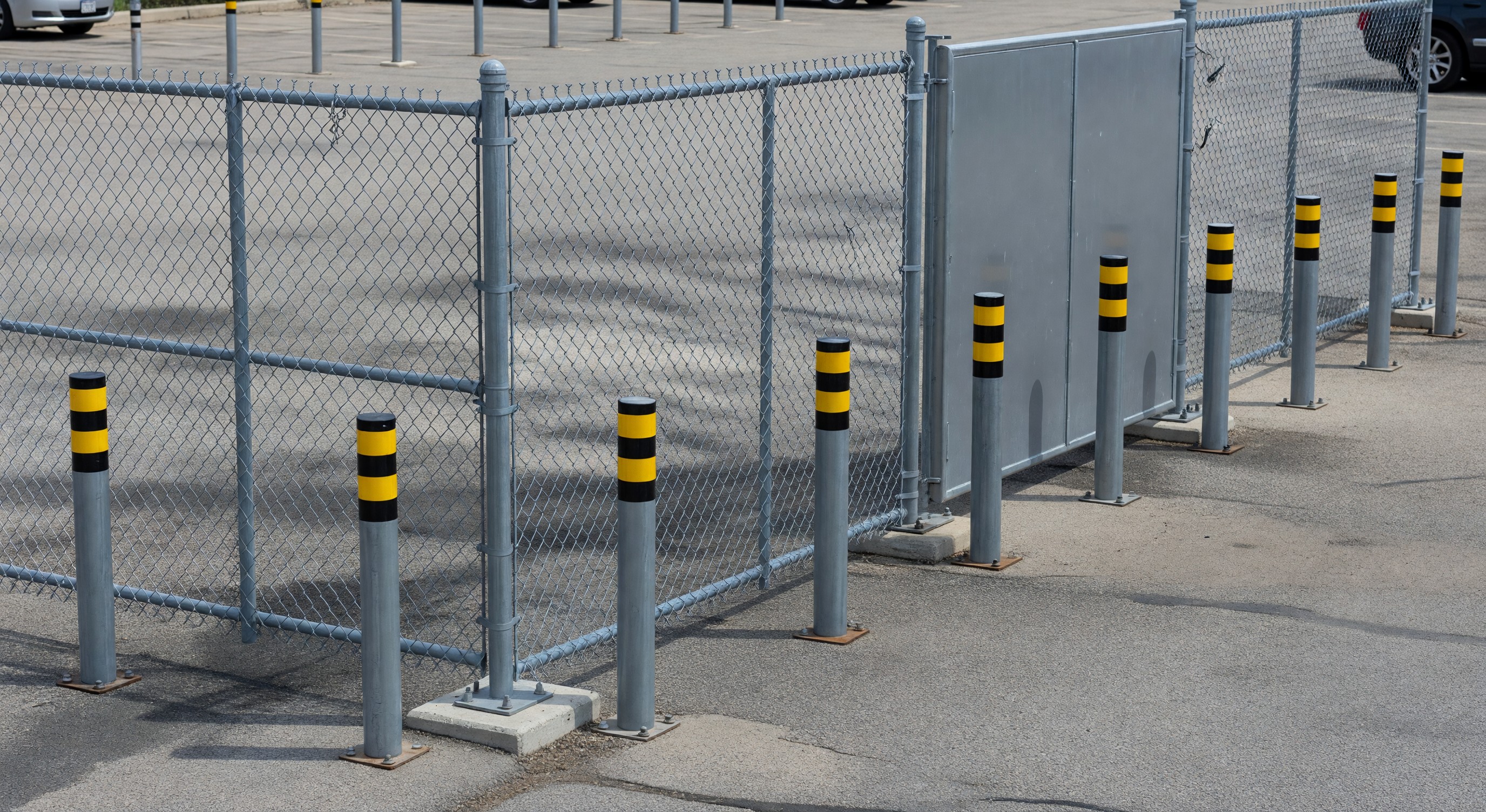
Parking lot perimeter design is a balance between security, access control, aesthetics, and cost. Facilities that install robust perimeter security reduce unauthorized access, vehicle theft, and after-hours trespass — but perimeter elements that impede customer access, present visual barriers to the street, or require constant maintenance undermine the operational value of the security investment. Effective perimeter design right-sizes security to the actual risk profile of the facility.
Assessing Perimeter Security Needs
Before specifying perimeter elements, operators should assess the actual security risks:
- Vehicle theft and break-in rates: Facilities in areas with high vehicle crime rates justify higher perimeter investment than facilities with minimal incident history.
- After-hours access: Facilities that should be closed after hours (residential, private employer) require perimeter elements that physically deter after-hours entry. Publicly accessible facilities (municipal parking) typically do not close perimeter access at night.
- Adjacent land uses: Facilities adjacent to retail or entertainment districts may experience pedestrian intrusion, skateboarding, or congregation issues; pedestrian fencing or landscaping buffers may be more appropriate than vehicle security fencing.
- Liability exposure: Facilities where unauthorized vehicle access has led to incidents (accidents, trespass, assaults) face higher liability exposure and may require more robust perimeter control.
Fencing Types and Applications
Chain link fencing: The most cost-effective perimeter fencing option for utility applications. 6-gauge galvanized or vinyl-coated chain link in 6-foot height is standard for parking perimeter applications. Vinyl coating (black or green) improves aesthetics over galvanized-only finish. Chain link provides visual permeability (not a sight line obstruction) while marking a clear perimeter. Not an effective deterrent against determined intruders; appropriate for low-to-moderate security applications.
Ornamental steel or aluminum fencing: Provides a more finished appearance than chain link, appropriate for facilities adjacent to commercial or upscale residential properties. Vertical bar spacing of 4 inches or less prevents climbing footholds. Heights of 4 to 6 feet with finial tops provide both security and aesthetic character. Higher cost than chain link; lower maintenance than wood.
Concrete masonry unit (CMU) walls: Solid perimeter walls provide complete sight obstruction and physical security. Appropriate for high-security applications (government facilities, storage facilities) or noise/light buffer applications. Creates blank street walls that are incompatible with pedestrian-friendly urban design guidelines in most municipalities.
Weld mesh panel systems: Factory-fabricated welded wire panels in rigid frames, typically 8 gauge wire at 3-inch × 3-inch grid. More resistant to climbing than chain link due to rigidity. Commonly specified in industrial and transit facility perimeters.
Vehicle Access Gates
Vehicle access gates are required wherever a fenced perimeter must be crossed by authorized vehicles. Gate selection depends on the cycle frequency required, the security level, and the budget:
Swing gates: Hinged gate panels that swing open on a fixed pivot. Single-leaf (one gate panel) or double-leaf (two panels meeting at center). Automated via electromechanical operators (Liftmaster, FAAC, ET, or equivalent). Cycle times of 15 to 30 seconds are typical. Swing gates require clear swing arc space — a full-width gate swinging into the facility needs 12 to 14 feet of clearance behind the closed position.
Slide gates: The gate panel slides parallel to the fence line to open. Requires a clear space equal to the gate width plus vehicle clearance behind the fence line. Cycle times similar to swing gates. Better suited to sites with limited swing arc space. Slide gate track requires regular cleaning of debris to prevent jamming.
Vertical lift barriers: Crash-rated bollard barriers or drop-arm barriers that prevent vehicle through-access are used where high-security vehicle exclusion is required (government facilities, critical infrastructure). Not standard for commercial parking; specified where IED or vehicle ramming threats exist.
Access control integration: Automated vehicle gates should integrate with the PARCS or access control system. Keypads, card readers, LPR cameras, remote intercoms, and telephone entry systems are all standard gate access interfaces. The gate operator must be specified for the cycle frequency expected — residential operators are rated for low-cycle use; commercial operators are rated for 100 to 300 cycles per day.
Bollards
Bollards are vehicle-stopping barriers used to protect building entrances, pedestrian areas, and equipment from vehicle intrusion — intentional or accidental.
Fixed bollards: Steel-filled concrete bollards (4 to 6-inch diameter, 3.5 to 4 feet exposed height) anchored in concrete footings. The standard bollard can stop a 5,000-pound vehicle at 10 to 30 mph depending on installation depth and anchor design. Used at building entries, equipment perimeters, and pedestrian refuge areas.
Decorative bollards: Cast iron or aluminum bollards with architectural profiles, used at retail and commercial entries where aesthetics matter as much as vehicle exclusion. Provide comparable stopping force to plain steel bollards at higher cost per unit.
Removable bollards: Bollards with a locking socket mount that allows removal when vehicle access is needed (maintenance periods, emergency access). Key-locked receivers hold the bollard securely during normal operation.
Crash-rated bollards: ASTM F2656 or DOS K-ratings for bollards tested against specific vehicle speeds and weights. Required where vehicle ramming threat is assessed at government or high-security facilities. Standard commercial bollards are not crash-rated; they deter but may not stop high-speed impacts.
Bollard spacing must prevent vehicle passage: maximum 4-foot center-to-center spacing for compact vehicles; 3-foot or less for bicycle/pedestrian passage-only. ADA requires that bollard arrays not obstruct accessible routes — minimum 36-inch clear width between bollards on accessible routes, wider for wheelchair clearance.
Frequently Asked Questions
What is the best fencing type for a commercial parking lot? For most commercial applications, ornamental steel or aluminum fencing (4 to 6-foot height) balances security, aesthetics, and maintenance cost effectively. Chain link is the budget option for utility applications. Solid walls are generally inappropriate for street-adjacent commercial parking.
How do automated vehicle gates integrate with parking systems? Automated gates typically integrate with PARCS, card access control systems, or LPR systems. Access is granted by proximity card, keypad code, LPR recognition of registered plates, or remote intercom approval. Gate operators should be rated for the expected daily cycle count.
What stopping force do standard parking lot bollards provide? Typical fixed bollards (4 to 6-inch steel-filled concrete, anchored per manufacturer specifications) can stop a 5,000-pound vehicle at 10 to 30 mph, depending on installation depth. They deter accidental incursion but are not crash-rated for high-speed intentional attacks. ASTM F2656 crash-rated bollards are required for high-security applications.
How close together should bollards be spaced? Maximum 4-foot center-to-center to prevent compact vehicle passage. On accessible routes, maintain at least 36 inches of clear width between bollards per ADA requirements.
Takeaway
Parking lot perimeter design should be matched to the actual security risk profile of the facility — not systematically over-secured at high cost or under-secured in ways that expose operators to documented incident risks. The right combination of fencing, vehicle gates, and bollards creates a perimeter that is clear, functional, and proportionate to the facility’s use and location. Integration of gate control with existing PARCS and access control systems minimizes operational overhead and provides a consistent access management platform for the facility manager.
Further Reading from Authoritative Sources
- US Access Board ADA accessible route requirements and bollard clearances — The US Access Board is the authoritative federal source for ADA accessible route requirements, directly governing the bollard spacing and clearance standards described in this article’s guidance on perimeter design near accessible routes.
- FHWA parking facility security and access control design guidance — FHWA has published research and guidance on parking facility security design including perimeter access control strategies, relevant to operators assessing the risk-appropriate level of fencing and gate infrastructure for their specific facility type and location.