Drainage is not a secondary concern in parking lot design — it is a primary determinant of pavement longevity, user experience, and regulatory compliance. Poorly drained parking lots suffer accelerated pavement deterioration, ponding that creates safety hazards and ice, and stormwater discharges that may trigger regulatory enforcement. A well-designed drainage system manages water at the surface, within the pavement structure, and at the site boundary.
Grading Fundamentals for Parking Lots
The goal of surface grading is to move water off the pavement surface as quickly as possible without creating erosion or directing concentrated flow onto adjacent properties. Cross slope standards for parking areas specify:
- Drive aisles and stalls: 2 percent minimum slope to promote drainage; 5 percent maximum slope in stalls (steeper slopes are uncomfortable for vehicle parking and pedestrian movement)
- Accessible parking stalls and access aisles: 2 percent maximum in any direction (ADA requirement)
- Pedestrian walkways: 1:20 (5 percent) maximum longitudinal slope without handrails; 1:48 (2 percent) maximum cross slope
Drainage patterns are established by the grading plan. Typical parking lots use one of three basic drainage patterns: uniform crown grading (lot drains toward perimeter inlets), basin grading (lot drains toward central inlets), or banding (alternating crown and valley sections draining to aisle inlets). Each pattern has implications for inlet placement, maintenance access, and ponding risk.
Low points where water can accumulate — sag inlets — should be avoided in stall areas and pedestrian crossings. Where site topography forces a sag point, an area drain or catch basin must be sized to handle the design storm without allowing water to overtop into stalls or pedestrian areas.
Stormwater Inlet Design
Parking lot stormwater inlets (catch basins and area drains) are sized based on the rational method or more detailed hydrologic analysis:
Rational Method: Q = CiA, where Q is peak runoff in cubic feet per second, C is the runoff coefficient (0.85 to 0.95 for asphalt or concrete), i is rainfall intensity for the design storm frequency and duration, and A is drainage area in acres. Most municipal stormwater codes specify the design storm frequency — commonly the 10-year, 24-hour event for on-site infrastructure and the 100-year event for off-site conveyance capacity.
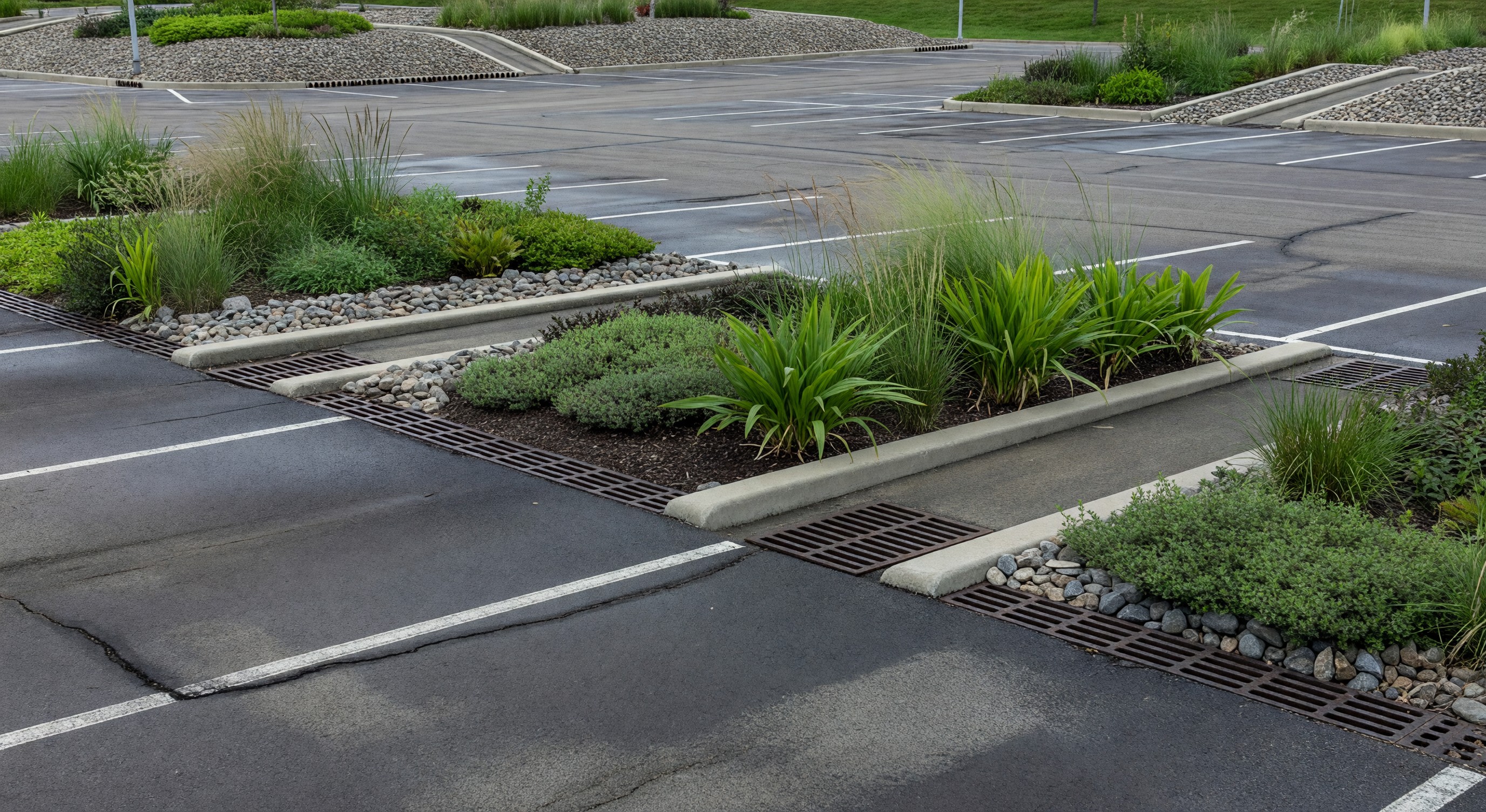
Grate inlets in parking areas must be bicycle-safe (AASHTO M326 or equivalent) and must not create trip hazards for pedestrians. Grate openings must be oriented perpendicular to the predominant direction of travel. In locations where ponding water freezes, grates with reduced bar spacing may accumulate ice more readily; heated grates or inlet de-icing may be appropriate in high-latitude applications.
Inlet spacing along curbs follows hydraulic design charts published by state DOTs and FHWA. For typical parking lot applications, curb inlet spacing of 100 to 200 feet is common, with adjustments based on gutter slope, curb reveal height, and inlet efficiency.
Detention and Retention Design
Pre-development stormwater discharge rates must be maintained or reduced in most jurisdictions. Parking lot developments typically achieve this through:
Detention basins: Constructed impoundments that capture runoff and release it at a controlled rate through an outlet structure. Designed to attenuate peak discharge to pre-development levels for the specified design storms (commonly 2-year, 10-year, and 100-year events). Dry detention basins drain completely between events; wet detention basins maintain a permanent pool.
Underground detention: Prefabricated chamber systems (StormTech, Brentwood Aquacell, Cultec, or equivalent) installed beneath parking or landscape areas. Higher installation cost than open basins; no above-ground footprint. Maintenance access is more constrained.
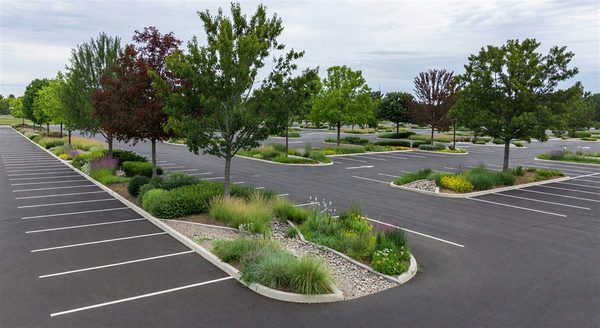
Bioretention (rain gardens): Excavated landscape areas filled with engineered soil media and planted with moisture-tolerant vegetation. Provide both water quality treatment and limited volume attenuation. Increasingly accepted as BMP credit in stormwater management plans.
Oil-Water Separators and Water Quality
Parking lot runoff contains petroleum hydrocarbons (oil and grease from vehicle leaks), heavy metals (zinc, copper, lead from brake and tire wear), and suspended solids. Many municipal and state stormwater programs require treatment of parking lot runoff before discharge.
Oil-water separators (OWS) are gravity-separation devices installed in the drainage system. Coalescing plate or API separator designs achieve oil removal efficiencies of 95 to 99 percent for free (non-emulsified) oil droplets. Separators require periodic inspection and pumping — typically annually for active facilities.
First-flush stormwater treatment is increasingly required: the first 0.5 to 1 inch of runoff from a storm event carries the highest pollutant concentrations and is the target for water quality treatment systems.
LEED Stormwater Credits
LEED v4 and v4.1 offer two Rainwater Management credits relevant to parking development:
Option 1 (Percentile event management): Retain the 95th percentile regional storm event on-site using green infrastructure — bioretention, permeable paving, green roofs, or a combination. Achievable with aggressive green infrastructure design.
Option 2 (Zero-lot-line projects): For constrained urban sites, manage 50 or 80 percent of average annual rainfall volume on-site using green infrastructure.
Additional Water Efficiency credits may apply for rainwater harvesting systems that capture and reuse parking lot runoff for irrigation or non-potable building uses.
Site-level stormwater management that qualifies for LEED credits typically requires documentation of pre- and post-development runoff volumes and peak rates, with evidence that the proposed green infrastructure meets the credit threshold.
Frequently Asked Questions
What minimum slope is required for parking lot drainage? Drive aisles and stall areas require a minimum 2 percent cross slope for drainage. Accessible spaces and routes must not exceed 2 percent slope in any direction per ADA requirements.
How are parking lot stormwater inlets sized? Inlets are sized using the Rational Method (Q = CiA) or more detailed hydrologic modeling. Design storm specifications vary by jurisdiction; the 10-year storm is commonly used for on-site drainage design.
What stormwater LEED credits apply to parking lots? LEED v4 Rainwater Management credits apply to parking lot development. Credit achievement requires retaining the 95th percentile regional storm event on-site, typically through green infrastructure such as bioretention, permeable paving, or a combination.
Are oil-water separators required for parking lot runoff? Requirements vary by jurisdiction, but many states and municipalities require oil-water separators for parking lots above a threshold size (commonly 1 to 5 acres). Check local stormwater regulations and any MS4 permit conditions applicable to the site.
Takeaway
Parking lot drainage design is an engineering discipline that integrates surface grading, inlet hydraulics, stormwater management, and water quality treatment. Facilities that invest in proper drainage design — with adequate slopes, correctly sized inlets, and stormwater management infrastructure sized for code-required design storms — experience lower pavement maintenance costs, fewer safety incidents from ponding, and lower regulatory risk. LEED stormwater credits and municipal green infrastructure incentives make well-designed drainage systems increasingly cost-effective to implement.
Further Reading from Authoritative Sources
- EPA green infrastructure approaches for parking surface stormwater — The EPA is explicitly referenced in the article as promoting green infrastructure for parking surfaces.
- FHWA hydraulic design guidance for parking lot drainage inlets — FHWA is explicitly cited in the article as publishing hydraulic design charts used for parking lot drainage inlet spacing.