A well-designed CCTV system in a parking facility provides forensic evidence when incidents occur, deters opportunistic crime through visible installation, and supports operational monitoring of facility status. A poorly designed system — cameras in the wrong locations, at incorrect heights, with inadequate lighting, or with overlapping blind spots — creates a false sense of security while delivering unusable footage when it is most needed. Camera placement design requires systematic coverage planning rather than ad hoc fixture placement.
Camera Type Selection for Parking Applications
Fixed cameras: Cameras with a set field of view — the most common type in parking facilities. A fixed camera covers a defined area consistently and provides reliable coverage of specific locations (entry lanes, payment stations, elevator lobbies). The field of view is determined by lens focal length: wide-angle lenses (2.8 to 4mm) cover broad areas at reduced detail; telephoto lenses (8 to 16mm) capture distant subjects with high detail.
PTZ cameras (Pan-Tilt-Zoom): Motorized cameras that can be remotely directed to any angle and zoom level. Useful as supplemental cameras for active monitoring by security personnel, but cover only where they are currently pointed — not a substitute for fixed cameras in comprehensive coverage plans.
Multi-sensor panoramic cameras: Cameras with multiple sensors providing 180 or 360-degree views with a single unit. Effective for coverage of open parking areas with a single mounting point, reducing infrastructure cost. Resolution per sensor may be lower than dedicated fixed cameras; verify resolution at the maximum monitoring distance.
LPR cameras: License plate recognition cameras are optimized for plate capture rather than general surveillance. Typically installed at entry/exit lanes, LPR cameras have narrow fields of view with enhanced sensitivity to plate illumination. They complement but do not replace general surveillance cameras.
Resolution standards: Minimum 1080p (Full HD) for all new parking facility cameras; 4K cameras increasingly cost-competitive and appropriate for locations where large areas must be monitored with detail (facility perimeter, large open lots). Resolution requirements should be specified as pixels per foot at the maximum monitoring distance, not camera megapixel rating alone.
Coverage Planning Methodology
Effective camera coverage planning uses a systematic zone-by-zone approach:
Step 1: Identify coverage zones and priorities: Map the facility and identify high-priority areas (entry/exit lanes, payment stations, elevator lobbies, stairwells, ADA spaces) and general coverage areas (parking field, perimeter, drive aisles). Assign coverage priority levels.
Step 2: Define coverage objectives for each zone: Is the objective facial identification, vehicle identification (license plate), area surveillance, or operational monitoring? Facial identification requires higher resolution at shorter distances (typically 30 to 50 feet). Vehicle/plate identification needs high contrast and resolution at 40 to 80 feet. Area surveillance can use wide-angle cameras at greater distances.
Step 3: Determine camera type and mounting position: For each zone, select the camera type and identify mounting positions that achieve the coverage objective at the specified resolution. Typical mounting heights:
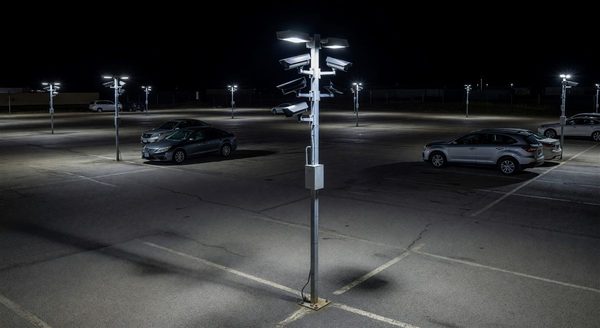
- General parking field: 20 to 30 feet (on pole mounts or building structure)
- Entry/exit lanes and payment stations: 8 to 12 feet (adjacent to PARCS equipment or overhead canopy)
- Elevator lobbies and stairwells: 8 to 10 feet (wall or ceiling mounted for face-height coverage)
- Perimeter: 15 to 25 feet on fence or building-mounted fixtures
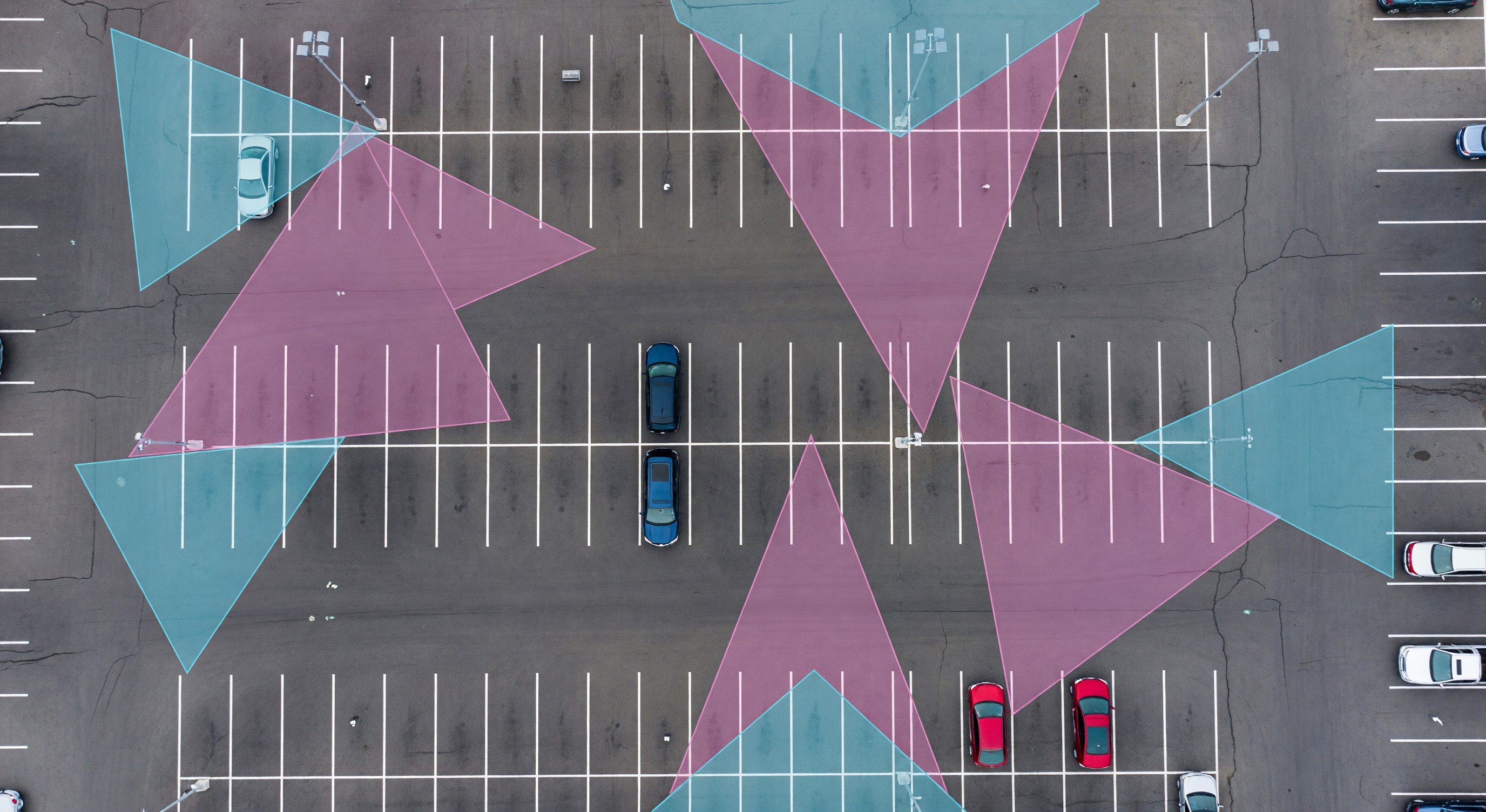
Step 4: Model field of view and verify coverage: Use camera manufacturer FOV calculators or security design software (IPVideoSystem, JVSG, or equivalent) to model each camera’s coverage area. Confirm overlap at the edges of adjacent camera fields and verify no blind spots exist in the critical coverage zones.
Step 5: Identify and eliminate blind spots: Any area consistently beyond camera coverage is a blind spot — a location where incidents can occur without being recorded. Common blind spots in parking facilities:
- Behind parked vehicles (ground-level cameras at vehicle height cannot see over parked cars)
- Stairwell landings not covered by stairwell cameras
- The approach to elevator lobbies from parking bays not visible to lobby cameras
- Ramp transitions in parking structures
Lighting Integration
Camera performance is directly dependent on lighting conditions (see the parking lot security lighting article for detailed standards). Coverage plan design should include verification that:
- Every camera’s field of view has adequate horizontal illuminance (minimum 1 to 3 fc depending on camera specification)
- Vertical illuminance (for face capture) is provided in high-priority facial identification zones
- No bright light sources (luminaires, daylight openings) fall within cameras’ fields of view creating backlight silhouetting
- Color temperature is 4000K or higher for cameras used for license plate and color-accurate vehicle identification
Storage, Retention, and Network Design
Camera system design must address storage and network requirements:
Video retention: Most parking facility security policies require minimum 30 days of video retention for incident investigation. High-definition cameras at full frame rate (30fps) generate 1 to 5 GB per camera per day depending on compression settings. A 50-camera facility requires 1.5 to 7.5 TB of storage per month.
Network infrastructure: IP cameras require network infrastructure (structured cabling or fiber, PoE switches, network video recorders or cloud storage). Network design should provide redundancy at the recorder/storage level; failure of a single network component should not take down the entire system.
Cybersecurity: IP camera systems are network-connected devices and present cybersecurity risks if not properly configured. Default credentials must be changed, firmware must be kept updated, cameras should be on a network segment isolated from general IT traffic, and access to the VMS should be role-controlled.
Frequently Asked Questions
How high should parking lot security cameras be mounted? General parking field cameras: 20 to 30 feet for broad area coverage. Entry/exit lane and payment station cameras: 8 to 12 feet for transaction capture. Elevator lobby and stairwell cameras: 8 to 10 feet for face-height coverage.
What resolution is adequate for parking facility CCTV? Minimum 1080p for all new installations. 4K is increasingly cost-effective and provides more useful coverage for large open areas. Specify resolution requirements as pixels per foot at the maximum monitoring distance, not simply camera megapixels.
How many cameras does a parking facility need? Camera count depends on facility size and coverage objectives. A systematic zone coverage plan based on camera field-of-view modeling determines the actual count. Rule-of-thumb estimates of 1 camera per 10 to 20 stalls are a starting point but cannot substitute for coverage planning.
How long should parking CCTV footage be retained? Most security policies and legal counsel recommend 30 days minimum. Incident investigation typically requires footage from 1 to 30 days prior to the incident report. Storage capacity planning should be based on minimum 30 days retention for all cameras.
Takeaway
Effective parking facility CCTV design requires systematic coverage planning — zone identification, objective definition, camera type selection, field-of-view modeling, and blind spot elimination — rather than ad hoc camera placement based on mounting convenience. The system is only as effective as its weakest link: inadequate lighting, uncovered blind spots, or insufficient resolution at the monitoring distance all produce footage that fails at the moment it is most needed. Integrating camera placement design with lighting design from the earliest stages of facility planning produces the most cost-effective and operationally effective security infrastructure.
Further Reading from Authoritative Sources
- NIST video surveillance and physical security standards guidance — The National Institute of Standards and Technology (NIST) publishes technical standards and guidelines for physical security and video surveillance systems that provide authoritative technical foundations for the camera performance and system design requirements discussed in the article.
- Institute of Transportation Engineers parking facility security design resources — The Institute of Transportation Engineers publishes parking facility design guidance that addresses security infrastructure including CCTV placement, which is directly relevant to the coverage planning and camera positioning methodology described in the article.