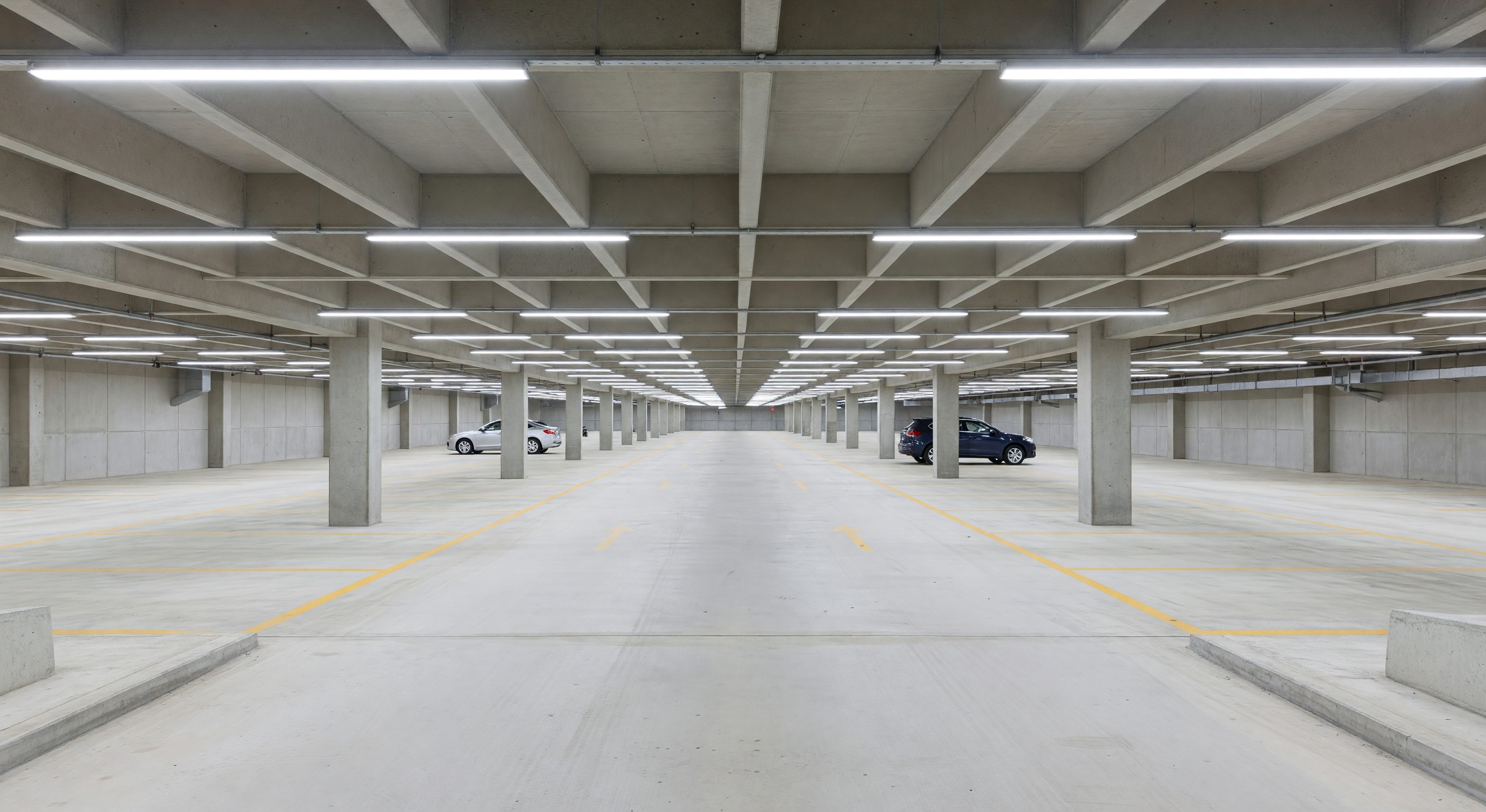
Lighting is one of the highest-impact investments a parking operator can make. It affects user safety, security camera performance, ADA compliance at accessible routes, energy costs, and the perceived quality of the facility. Yet parking lighting is routinely under-specified at design, run to failure without maintenance, or replaced with LED without proper photometric analysis. This guide covers the standards, metrics, and practical decisions that produce well-lit, cost-effective parking facilities.
IES Illuminance Standards for Parking
The Illuminating Engineering Society (IES) publishes the Recommended Practice for Parking Facilities (RP-20), which is the authoritative standard for parking lighting design in North America. RP-20 establishes maintained horizontal illuminance targets (footcandles, or fc) measured at the pavement surface after accounting for fixture depreciation over the maintenance cycle.
Key RP-20 targets by application:
- Open parking lots (general areas): 1.0 fc maintained average; 0.25 fc minimum
- Open parking lots (enhanced security): 3.0 fc maintained average; 0.6 fc minimum
- Covered parking structures (open sides): 5.0 fc maintained average; 1.25 fc minimum
- Enclosed parking structures: 5.0 to 10.0 fc maintained average depending on transition zone requirements
- Entrance/exit transition zones: 50 fc at day peak (to manage adaptation from daylight); 5 fc at night
- Pedestrian walkways and stairwells: 5.0 fc minimum
Uniformity is as important as average illuminance. IES RP-20 specifies that the ratio of average to minimum illuminance should not exceed 4:1 for general parking areas and 3:1 for enhanced-security areas. Uniformity ratios worse than 4:1 create dark pockets that undermine camera coverage and create real and perceived security risks.
Vertical illuminance — the light falling on vertical surfaces like columns, walls, and people’s faces — is increasingly emphasized in parking guidance because camera-based security systems depend on facial recognition and license plate capture across vertical planes. A well-designed system achieves 1 to 2 fc of vertical illuminance throughout the facility.
LED Retrofit Economics
The conversion of parking facilities from high-pressure sodium (HPS) or metal halide (MH) to LED has been widespread since 2012. LED fixtures in parking applications deliver 100 to 160 lumens per watt, compared to 70 to 100 lumens per watt for HPS and 70 to 95 for metal halide. The practical energy reduction from a properly designed LED retrofit is typically 40 to 60 percent of baseline electrical consumption.
Beyond energy savings, LED offers significant maintenance cost reductions. HPS and MH lamps have rated lives of 12,000 to 24,000 hours and require lamp replacement every 3 to 4 years in 24-hour parking operations. LED fixtures are rated at 50,000 to 100,000 hours (L70 lumen maintenance — the point at which output declines to 70 percent of initial). A parking structure operating 24/7 will require its first group LED fixture replacement after 5 to 11 years, compared to HPS lamp changes every 3 to 4 years.
Simple payback for LED retrofits in commercial parking ranges from 3 to 7 years depending on electricity rates, incentive programs, and existing fixture efficiency. Utility rebates and federal tax incentives have historically reduced payback to 2 to 4 years in many markets. ENERGY STAR and DLC (DesignLights Consortium) certifications are prerequisites for most utility rebate programs.
Fixture Selection and Photometric Analysis
Not all LED fixtures perform equally, and “equivalent wattage” comparisons between LED and legacy sources are unreliable. Proper fixture selection requires a photometric analysis — a computer simulation of fixture placement, aiming angles, and output that models the resulting footcandle distribution across the parking surface.
Canopy fixtures for covered lots and garages should be specified with a beam pattern matched to the bay width and mounting height. In garages with 9-foot floor-to-floor heights, a wide-distribution fixture (Type V or Type VS) delivers better uniformity than a narrow-distribution fixture. Wall-mounted fixtures must be aimed carefully to avoid direct glare into approaching drivers’ eyes.
Color temperature selection affects both visual comfort and camera performance. 4000K (neutral white) to 5000K (cool white) are the standard range for parking LED. Warmer temperatures (3000K) render colors less accurately, which can affect license plate legibility in camera systems. Systems designed with cameras should specify fixtures at 4000K minimum.
Lighting Controls and Smart Systems
Occupancy-based dimming controls are now standard in new parking structure lighting. Occupancy sensors dim fixtures to 20 to 30 percent output when no motion is detected, while maintaining minimum IES RP-20 footcandle levels. When motion is detected, fixtures ramp to 100 percent within 0.5 to 1 second. The energy savings from occupancy-based dimming in 24-hour structures with typical occupancy patterns range from an additional 30 to 50 percent beyond the base LED savings.
Networked lighting control systems allow remote monitoring of fixture status, dimming levels, and energy consumption. Facilities with hundreds of fixtures benefit from these systems by eliminating manual walkdowns to identify burned-out fixtures and reducing maintenance dispatching time.
Safety and Security Considerations
Lighting quality directly affects reported crime rates in parking facilities. Research published by the Urban Land Institute and security consultants consistently links poor lighting uniformity — not merely low average levels — to user fear and crime opportunity. A facility averaging 3 fc but with 0.1 fc dark spots provides less functional security than one averaging 2 fc with a 0.5 fc minimum and 4:1 uniformity.
Stairwells deserve particular attention. IES recommends a minimum 5 fc average in stairwells, with fixtures positioned to illuminate face height (vertical illuminance) rather than only the treads. Wall-washing fixtures in stairwells achieve this better than ceiling-mounted downlights.
Frequently Asked Questions
What is the minimum illuminance required for a parking lot? IES RP-20 sets the maintained average at 1.0 footcandle for standard open parking, with a minimum of 0.25 fc. Enhanced security areas require 3.0 fc average and 0.6 fc minimum.
How long does an LED parking fixture last? LED parking fixtures are typically rated to L70 (70 percent lumen maintenance) at 50,000 to 100,000 hours. In 24/7 operations, that translates to roughly 6 to 11 years before group relamping is needed.
What uniformity ratio is acceptable for parking lighting? IES RP-20 calls for an average-to-minimum uniformity ratio of 4:1 or better for general parking and 3:1 for enhanced-security applications. Worse ratios create dark zones that undermine both security and camera performance.
Do parking structures need special transition zone lighting? Yes. Entrance/exit zones require significantly higher illuminance during daytime — up to 50 fc — to manage eye adaptation between outdoor daylight and the interior. At night, 5 fc is the standard for transition zones.
Takeaway
Effective parking lighting design starts with IES RP-20 illuminance targets, applies photometric analysis to confirm fixture placement and beam distribution, and incorporates LED technology and occupancy controls to minimize energy cost while meeting uniformity standards. Lighting quality — measured by both average illuminance and uniformity ratio — is as important as raw brightness for user safety, security camera performance, and the perceived quality of a parking facility.
Further Reading from Authoritative Sources
- US Department of Energy parking garage lighting retrofit resources — The US DOE publishes technical guidance and resources on commercial lighting retrofits including parking facilities, covering the energy savings calculations, rebate programs, and DLC/ENERGY STAR certification criteria directly referenced in this article.
- NIST photometry and lighting measurement standards — NIST maintains the US national standards for photometric measurements underlying the footcandle and lumen-per-watt metrics central to this article’s guidance on LED selection and IES RP-20 compliance verification.