Entry and exit lanes are the functional interface between the public street and the parking facility. They control access, facilitate payment, and create the first and last impression of the facility for every customer. Undersizing entry/exit capacity creates queuing that backs into the public street — a serious safety and regulatory problem. Oversizing wastes expensive real estate in the facility’s most prominent location. Queuing analysis, combined with sound geometric design, produces the right balance.
Lane Geometry Fundamentals
Each entry or exit lane must accommodate the physical dimensions of the design vehicle while providing clearance for door opening, equipment interaction, and safe approach. For standard passenger vehicle lanes:
Lane width at equipment: 12 feet minimum; 14 feet preferred at attended cashier positions where drivers open doors.
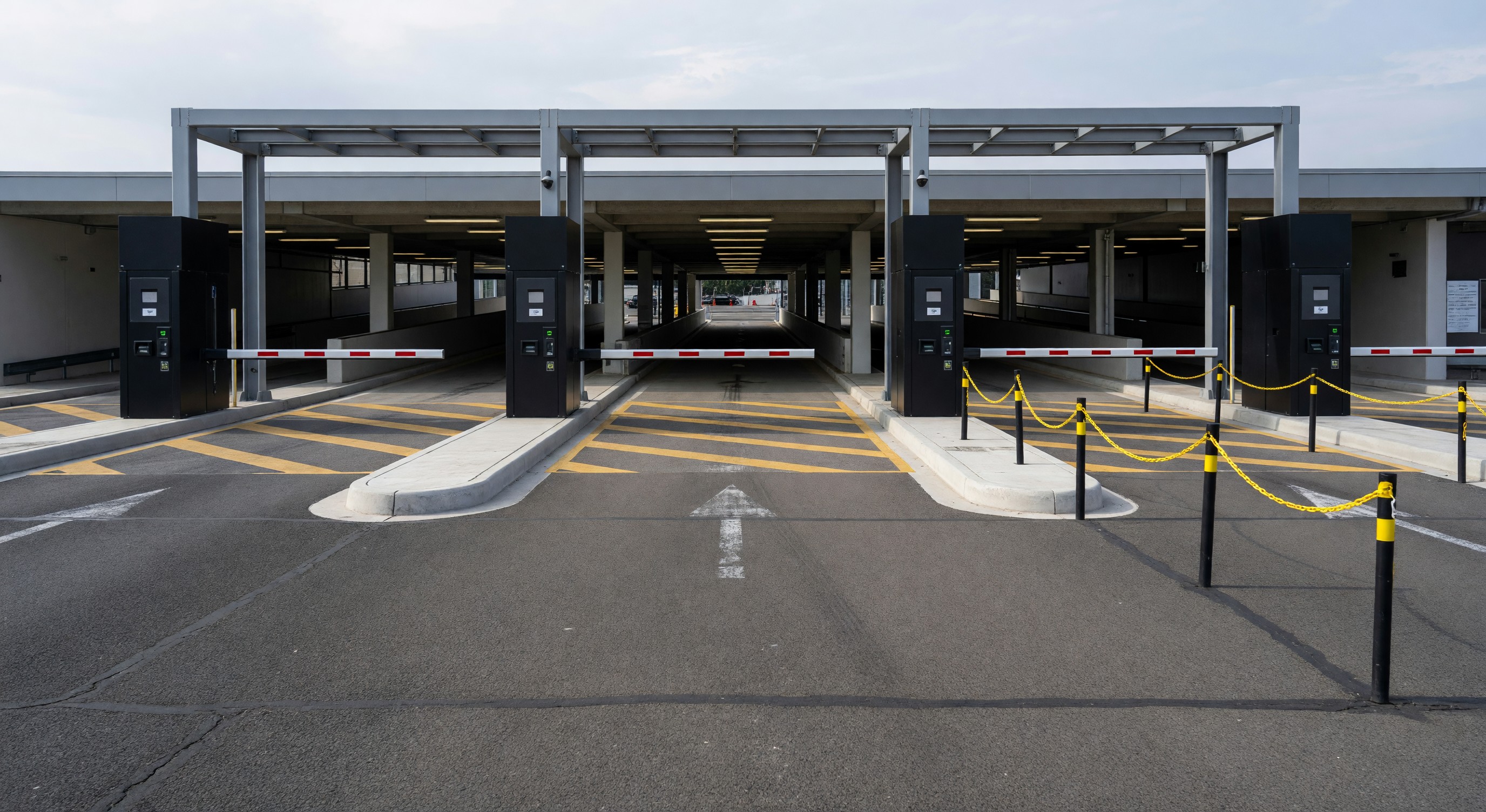
Approach geometry: Lanes should have a straight approach of at least 50 feet before the first gate arm or ticket dispenser. Curved approaches that require a driver to simultaneously navigate a turn and interact with equipment increase error rates and gate contact incidents. Where a curved approach is unavoidable, a minimum 35-foot inside radius and generous pavement markings help drivers track correctly.
Throat width: The total width of the entry/exit plaza (all lanes combined plus any curb or median separators) should provide adequate width for the expected lane count with structural clearance from columns and walls. Minimum 2-foot clearance between lane edges and any fixed obstruction is required.
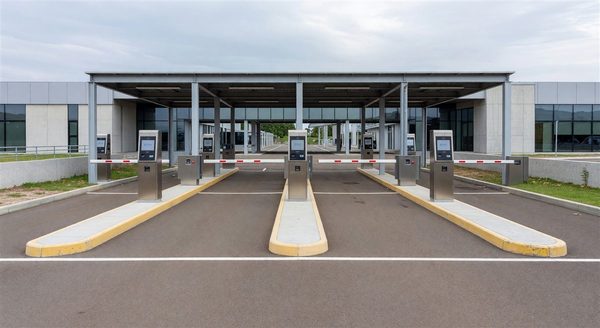
Island/separator design: When multiple entry or exit lanes are provided side by side, raised concrete islands between lanes prevent lane straddling and protect equipment from sideswipe contact. Island width of 18 to 24 inches, with a 6-inch curb reveal, is standard. Islands should taper at both ends with a 1:8 taper ratio to guide vehicles into individual lanes.
Queuing Theory Applied to Parking Lane Design
Queuing analysis uses M/M/c models (Poisson arrival distribution, exponential service times, c servers/lanes) to estimate expected queue lengths and wait times. The inputs required are:
- Arrival rate (λ): Vehicles arriving per minute during the design period. For morning ingress, this is typically 10 to 15 percent of total facility capacity arriving in a 30-minute window.
- Service rate (μ): Vehicles processed per minute per lane. Service rate is the inverse of service time (transaction time including gate opening, vehicle clearance, and gate closing).
- Number of lanes (c): The variable being optimized.
Typical service times by payment method:
- Attended cash: 25 to 40 seconds per vehicle
- Attended credit card: 30 to 45 seconds per vehicle
- Unattended ticket dispenser: 8 to 15 seconds
- Unattended pay station at exit: 15 to 25 seconds
- LPR or transponder pass-through: 3 to 6 seconds
- Pay-on-foot pre-paid exit: 5 to 10 seconds
The M/M/c formula produces expected average queue length (Lq) and average wait time (Wq) as functions of traffic intensity (ρ = λ/(c×μ)). At traffic intensity above 0.85 (lanes operating above 85 percent capacity), queue lengths grow rapidly and become sensitive to arrival variability. Designing for a maximum 80 percent traffic intensity at peak provides a reasonable safety margin.
Physical queue storage: Queue must be accommodated within the facility or on-site access drives without reaching the public street. Design queue storage at the 95th percentile of modeled queue length. Typical provision is 150 to 250 feet (5 to 8 vehicle lengths at 25 feet per vehicle) per lane for large facilities.
Payment Method Mix and Lane Type Design
Modern parking facilities rarely use a single payment method. Designing lane type mix for the expected payment method mix maximizes throughput per lane:
Express/contactless lanes: Dedicated transponder or LPR lanes process 10 to 20 vehicles per minute (3 to 6 seconds per vehicle). These lanes disproportionately benefit monthly parkers and frequent users. Facilities with 30 to 50 percent monthly parker volume should dedicate 1 to 2 express lanes.
General pay lanes: Unattended ticket dispensers at entry (8 to 15 seconds per vehicle) with pay-on-foot or exit lane payment produce entry processing rates of 4 to 7 vehicles per minute — significantly higher than attended cash lanes.
Attended cashier lanes: 1.5 to 2.4 vehicles per minute for cash and credit transactions. Justifiable in high-volume facilities with significant validation programs, valet operations, or populations requiring assistance. Often the bottleneck in exit plazas if the payment mix includes high cash fractions.
Mixed-mode lanes: Many facilities configure lanes for both attended and unattended operation (daytime attended; off-hours unattended). Equipment must support both modes; signage must clearly communicate current operating mode to approaching drivers.
Reverse Queuing and Exit Lane Design
Exit queuing is frequently the more critical design challenge. Entry arrivals are spread over the ingress period; exit departures are concentrated in short windows at event end, shift change, or closing time. An exit plaza designed for average demand will be severely undersized for peak exit demand.
For event venues and facilities with predictable concentrated egress events, exit lane count should be designed for the peak egress rate — which may be 2 to 3 times the average departure rate. Pay-on-foot systems dramatically increase exit throughput by decoupling payment from the exit lane transaction, converting exit transactions from 15 to 45 seconds to 5 to 10 seconds.
Frequently Asked Questions
How many entry lanes does a parking facility need? Lane count depends on peak arrival rate and service time per lane. At a typical service rate of 4 to 6 vehicles per minute per unattended lane, one lane handles approximately 240 to 360 vehicles per hour. A 500-stall facility with 15 percent turnover in a peak 30-minute window needs approximately 2 to 3 lanes to maintain queue below design thresholds.
What is the minimum lane width for an attended cashier lane? Minimum is 12 feet, but 14 feet is preferred for attended lanes where drivers must open their door to reach the cashier window. Narrower lanes force drivers to lean dangerously out of open windows or reduce transactions to window-crack level.
Why is exit queuing often worse than entry queuing? Entry arrivals are distributed over the ingress period (often 30 to 60 minutes). Exit departures at event end, shift change, or closing time are concentrated in a much shorter window — often 10 to 15 minutes for events — producing arrival rates at the exit that far exceed the average. Pay-on-foot systems increase exit throughput by eliminating payment transaction time from the exit lane.
What queue storage length should be provided at a parking entry? Design for the 95th percentile queue from M/M/c analysis, plus a safety factor. A practical minimum is 150 to 200 feet (5 to 7 vehicle lengths) per lane. In high-volume facilities or those with significant concentrated ingress (events, shift starts), 300 to 400 feet per lane may be warranted.
Takeaway
Entry and exit lane design requires systematic application of queuing theory to determine lane count, paired with geometric design that ensures vehicles can approach, transact, and exit smoothly. The payment method mix directly determines service rates and therefore the required number of lanes. Pay-on-foot systems provide the highest exit throughput and are the most effective tool for high-demand exit scenarios. Designing to 80 percent traffic intensity at peak — with physical queue storage for 95th percentile demand — produces a plaza that handles peak demand reliably without being oversized for its average operating condition.
Further Reading from Authoritative Sources
- ITE queuing analysis and parking facility design standards — The Institute of Transportation Engineers (ITE) is the primary professional body publishing standards and technical guidance on traffic queuing analysis, parking facility design, and lane geometry.
- FHWA parking facility design and traffic operations guidance — FHWA publishes technical guidance on parking facility design, curb management, and traffic operations that complements ITE standards.