Elevators in parking structures serve a different population and carry different operational demands than elevators in office or residential buildings. They accommodate users carrying packages, strollers, bicycles, and mobility devices; they endure heavy use during short peak periods; and they operate in environments with vehicle exhaust, humidity, and temperature swings that accelerate maintenance needs. Getting elevator design right in a parking facility requires attention to code, user needs, and the operational realities of a parking environment.
Governing Standards
The primary governing code for elevator design in the United States is the ASME A17.1 Safety Code for Elevators and Escalators (also referenced in IBC and most state building codes). The ADA Standards for Accessible Design establish accessibility requirements for elevators serving accessible routes. State elevator inspection programs enforce ASME A17.1 through annual or periodic inspections.
The number of elevators required depends on the parking structure’s total size, number of levels, and accessible design requirements. ADA requires that the accessible route between accessible parking spaces and the building served connect via accessible vertical transportation if grade changes cannot be addressed by accessible ramps. In practice, this means elevators are required in multi-level parking structures unless every accessible space can be served by accessible ramps at each level.
ADA Elevator Dimensions
The ADA Standards for Accessible Design (Section 407) establish minimum cab dimensions for accessible elevators serving parking structures:
- Minimum cab width: 68 inches clear (door on narrow end) or 80 inches clear (center-opening doors)
- Minimum cab depth: 51 inches clear (68-inch wide cab) or 54 inches clear (80-inch wide)
- Door clear width: 36 inches minimum for 80-inch wide cabs; 32 inches minimum for narrower openings (though 36 is strongly preferred in practice)
These minimums accommodate most manual wheelchairs and power wheelchairs. Power scooters and some larger power wheelchair models require 60-inch × 60-inch interiors for comfortable maneuvering. Many designers use 60 × 60 or 72 × 72 inch cabs in parking structures serving facilities with high elderly or mobility-impaired user populations (medical campuses, senior living, hospitals).
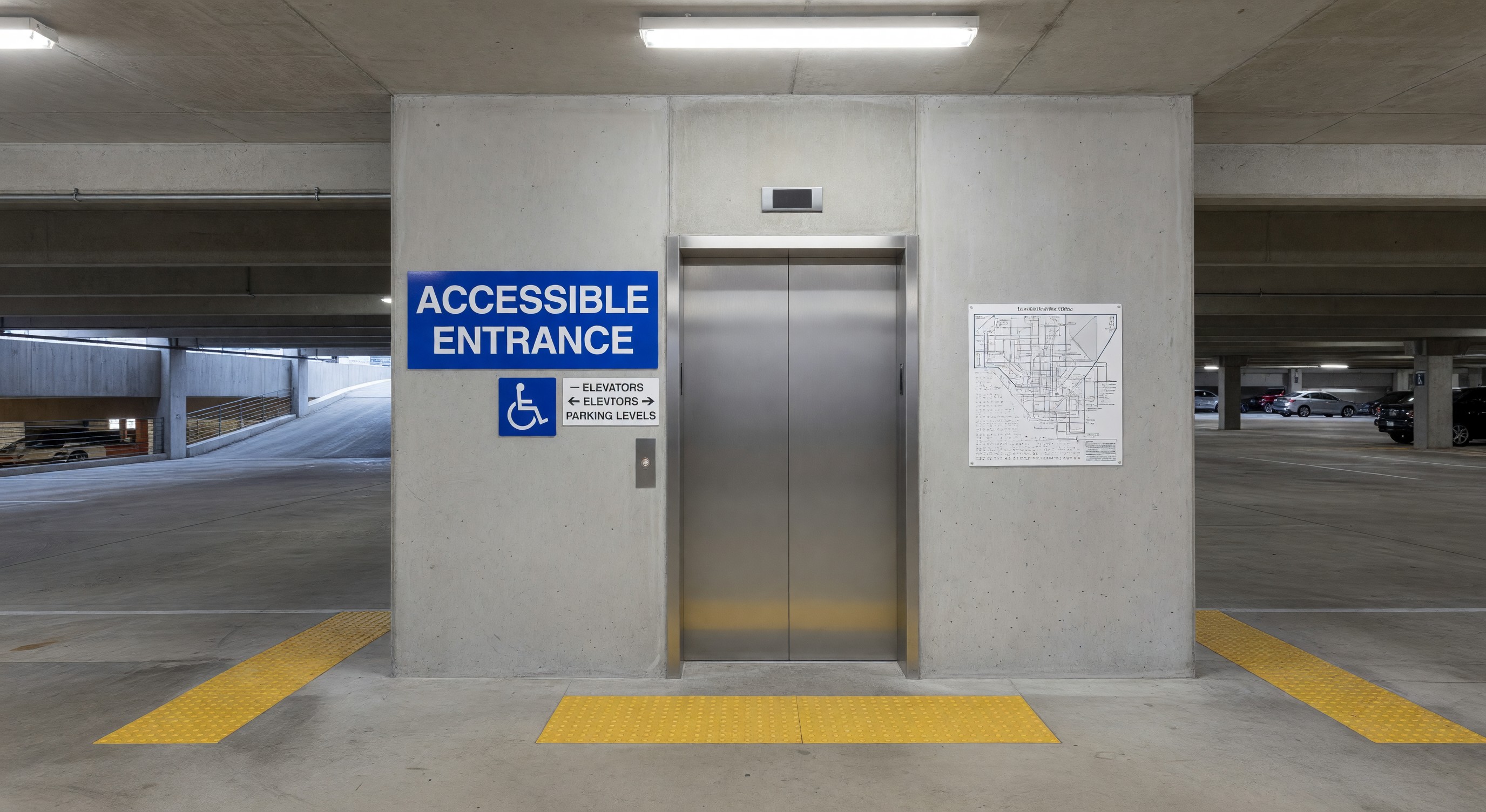
ADA also requires:
- Two-way emergency communication system in the cab
- Braille and raised-character designations at hall call buttons and cab controls
- Floor designations at each landing
- Leveling accuracy within 1/2 inch of the landing floor to avoid trip hazards
- Non-slip floor surfaces
Cab Sizing for Parking Applications
Parking structure elevators see users who rarely appear in office elevators: delivery drivers with hand trucks, parents with strollers, cyclists with folding bikes, and users pushing shopping carts in retail parking. Minimum ADA dimensions are inadequate for these loads.
A 6-foot × 8-foot cab interior (72 × 96 inches) provides generous space for two wheelchair users, a cyclist, and a stroller simultaneously. This size is appropriate for most commercial parking structures. In high-volume facilities such as sports arenas, convention centers, and urban garages with retail below, a 6 × 9-foot or 7 × 9-foot cab may be warranted to reduce lobby crowding during peak egress.
Cab capacity rating should reflect actual expected load. A standard 2,500-pound capacity elevator accommodates approximately 12 to 15 adult passengers. In parking applications with peak egress loads, 3,500 to 4,000-pound capacity elevators reduce wait times by serving more users per trip.
Speed and Performance
Elevator speed affects wait times and user satisfaction. For parking structures of 4 to 8 levels, speeds of 100 to 150 feet per minute (FPM) are standard. Taller structures (8+ levels) benefit from 200 to 350 FPM to maintain acceptable cycle times.
The relevant performance metric is round-trip time (RTT) — the time for an elevator to complete a full cycle. RTT depends on travel speed, door open/close time, leveling time, and the number of stops. In peak parking demand periods (event end, shift change), multiple elevators with adequate speed and capacity are necessary to prevent lobby crowding.
ASME A17.1 requires elevators to be designed for continuous duty — they must operate at rated load continuously without thermal overload. This is a different duty cycle than most residential elevators, which see intermittent use.
Environmental and Maintenance Considerations
Parking structures present challenging environments for elevator equipment. Key considerations:
Humidity and condensation: Temperature differentials between garage levels and the cab can cause condensation on electrical equipment and cab surfaces. Stainless steel cab interiors are preferred over painted steel or laminate for durability. Cab interiors with exposed joints that trap moisture should be avoided.
Vandalism resistance: Elevator cabs in public parking garages are subject to vandalism. Stainless steel walls with scratch-resistant finishes (brushed or embossed patterns that obscure scratches), polycarbonate not glass glazing in any windowed doors, and rounded rather than sharp profile components reduce vandalism damage.
Machine room location: Hydraulic elevator systems are used in most parking structures of 4 to 6 levels due to lower headroom requirements. Machine-room-less (MRL) traction elevators are increasingly common for taller structures. The machine room or MRL components must be located in a conditioned space — hydraulic fluid viscosity is temperature-sensitive and pump components require temperature control.
Inspection access: Elevator pit depth (minimum 4 feet per ASME A17.1) must be coordinated with the structural slab design at the lowest level.
Frequently Asked Questions
What are the minimum ADA cab dimensions for a parking structure elevator? ADA requires minimum cab dimensions of 68 inches wide × 51 inches deep (with a door on the narrow wall) or 80 inches wide × 54 inches deep with center-opening doors. In practice, parking structures should use 60 × 60 inch minimum or larger to accommodate power wheelchairs, strollers, and bicycles.
How fast should an elevator be in a parking structure? For 4 to 8 level structures, 100 to 150 FPM is standard. Taller structures or high-volume facilities may warrant 200 to 350 FPM to maintain acceptable round-trip times during peak demand.
Do all parking structures require elevators? Multi-level parking structures serving accessible spaces on upper levels require accessible vertical transportation. ADA requires that all accessible parking spaces be connected to the accessible entrance by an accessible route, which means elevators (or accessible ramps) must connect every level containing accessible parking to the accessible building entrance.
What materials are best for parking garage elevator cabs? Stainless steel with brushed or embossed finishes provides the best combination of durability, resistance to vandalism, and ease of cleaning in parking garage environments. Avoid laminate, painted steel, and large glass panels that are vulnerable to vandalism damage.
Takeaway
Elevator design in parking structures requires balancing ADA accessibility requirements, adequate cab size for the actual user population and loads encountered, speed and capacity for peak demand periods, and environmental durability. Designing to ADA minimums alone produces elevators that are technically compliant but operationally inadequate for parking users with bicycles, strollers, and mobility devices. A cab sized at 6 × 8 feet with 3,500-pound capacity, 150 FPM speed, and stainless steel finishes serves the realistic range of parking structure users and withstands the demanding environment of a public garage.