The question of how autonomous vehicles (AVs) will affect parking demand is not whether but when. Industry projections, policy discussions, and technology timelines have moderated from the peak optimism of 2015 to 2018, when some analysts forecast that AVs would eliminate most parking demand within a decade. Today, a more measured view holds that SAE Level 4 autonomous operation will achieve meaningful market penetration in controlled urban environments by the late 2020s to 2030s, and parking demand will shift — but not disappear — over a 20 to 30-year transition period.
How AVs Change Parking Demand
Fully autonomous vehicles (SAE Level 4 and 5) can self-park, self-retrieve, and circulate without a human driver. This fundamentally changes some parking design assumptions:
Stall width: AVs parking without human egress do not need access aisles for door opening. Vehicle-only AV stalls could be as narrow as 7 feet — compared to the standard 9-foot stall with door clearance. This could increase stall density by 15 to 25 percent in full AV sections.
Level heights: AV stalls without human access don’t need full ADA-accessible headroom. A level designed exclusively for AV self-parking could theoretically use 7-foot clear heights, allowing an additional level within a fixed structure height. However, mixed-use with conventional vehicles eliminates this advantage during the transition period.
Aisle widths: AVs can be programmed to park with narrower clearances than human drivers require. Aisle widths could potentially be reduced from 24 feet to 18 to 20 feet in fully automated AV sections. Again, this advantage disappears in mixed-use conditions.
Demand changes: TNCs (Uber, Lyft) and robotaxi services using autonomous vehicles reduce parking demand at the vehicle level — a robotaxi that serves 5 trips per hour instead of parking between trips displaces demand for individual parking. The degree to which this reduces overall parking demand depends on fleet size, trip patterns, and whether private AV ownership remains common.
Drop Zone Design
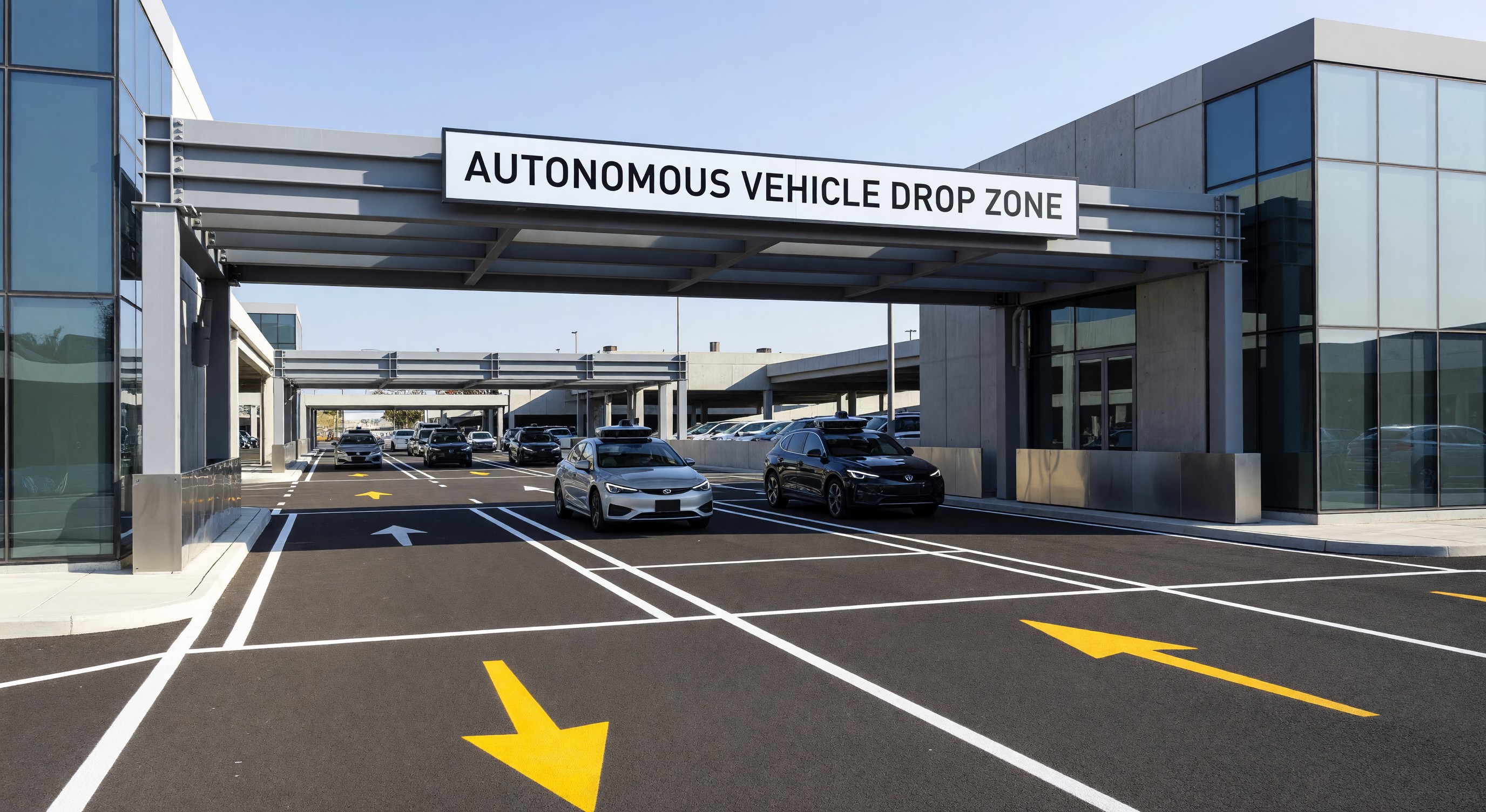
Drop zones (also called mobility hubs, pick-up and drop-off zones, or PUDO zones) are designated areas where AVs, TNCs, and autonomous vehicles stop briefly to embark and disembark passengers without parking. Drop zone design is increasingly standard in new construction and is a near-term need, regardless of full AV adoption timelines.
Dimensions: Standard drop zone stalls are 12 to 14 feet wide and 25 to 30 feet long — longer than standard parking stalls to accommodate door opening without conflicting with adjacent stalls. Back-in or pull-through configurations eliminate the need for vehicle maneuvering within the zone.
Location: Drop zones should be at the closest accessible point to the primary building entrance, with direct accessible pedestrian connection. In competition with accessible parking for prime location, drop zones should be sited to minimize pedestrian exposure to vehicle conflict — in a separate pull-through lane rather than in-aisle.
Throughput: A single drop zone stall handles approximately 30 to 60 vehicle stops per hour at 1 to 2 minute dwell times. Facilities with significant TNC demand (hotels, airports, transit centers) may require 4 to 10 drop zone stalls at primary entrances.
Curb management integration: In urban facilities, drop zones may be integrated with on-street curb management programs that designate specific curb areas for TNCs and AVs during specific hours. Some cities (San Francisco, Seattle, New York) have piloted digital curb reservation systems that allow advance booking of drop zone time.
Structural Adaptability for Future Use
The most significant AV-related design decision for new parking structures is not AV-specific features but structural adaptability for non-parking use conversion. As AV penetration reduces parking demand over 20 to 40 years, structures built today may need to be converted to residential, office, or retail use.
Adaptable parking structure design for future conversion (per ULI and CNU guidance):
Flat floor plates: Split-level and ramped-deck designs are nearly impossible to convert. Flat floor plates, connected by separate ramp structures, allow conversion of deck area to other uses.
Floor-to-floor height: Minimum 10 to 12 feet floor-to-floor allows future office or residential conversion. Standard parking floor-to-floor of 8.5 to 9.5 feet is too low for most non-parking uses.
Structural loading: 100 pounds per square foot live load (or 150 psf for residential) versus the typical 50 psf parking structure design load. Providing higher structural loading capacity at construction cost protects long-term conversion value.
Utility rough-ins: Rough-in locations for plumbing, electrical panels, and HVAC distribution in the structural slab, even if not installed initially, reduce future conversion costs.
Projections and Design Caution
AV adoption timelines have consistently been revised outward as technology, regulatory, and liability challenges prove more durable than early projections suggested. A parking structure built today at AV-driven reduced capacity that underestimates conventional vehicle demand over the next 15 to 20 years could create a chronic parking shortage. Conversely, over-building based on pre-AV demand assumptions produces stranded asset risk.
The most defensible design posture for new parking in regions with aggressive AV adoption trajectories:
- Build to current conventional vehicle demand minus a 10 to 15 percent reduction factor for near-term TNC and AV-displaced demand
- Design for structural adaptability rather than AV-specific stall configurations
- Include robust drop zone infrastructure to serve current TNC demand and future AV drop-off traffic
- Phase structure construction where site allows, deferring later phases until demand trends are clearer
Frequently Asked Questions
Should new parking structures use narrower stalls designed for autonomous vehicles? Not yet. Mixed-use conditions — conventional and AV vehicles sharing the same facility — mean that human-occupancy stall requirements still govern. Narrower stalls are appropriate only in sections designed exclusively for AV self-parking with no human egress, which is not yet a common operating model.
How many drop zone stalls are needed at a new building? For most commercial buildings, 2 to 4 drop zone stalls at the primary entrance accommodate current TNC demand and near-term AV traffic. Hotels, airports, and transit centers with high TNC volumes may need 6 to 12 stalls to prevent queuing into general circulation.
How do I design a parking structure for future non-parking conversion? The key decisions are flat floor plates (no ramped decks), 10 to 12-foot minimum floor-to-floor height, 100+ psf structural loading, and utility rough-ins in the structure. These design decisions add 5 to 15 percent to construction cost but preserve the option to convert to residential or commercial use as parking demand evolves.
Will autonomous vehicles eliminate the need for parking facilities? Full elimination is unlikely; significant demand reduction is plausible over a 30 to 50-year horizon. The more likely near-term scenario is demand redistribution — less parking at destinations, more short-term TNC staging and AV circulation, with aggregate demand reduction of 10 to 30 percent over 15 to 25 years depending on market and fleet composition.
Takeaway
Parking design for an autonomous vehicle future is not a single design feature but a portfolio of decisions: drop zone capacity for current TNC demand, structural adaptability for long-term conversion potential, and measured demand projections that neither over-estimate AV disruption nor ignore it. Facilities built today with flat floor plates, adequate floor-to-floor heights, and generous structural loading will retain long-term value regardless of whether AV penetration accelerates or stalls. Those built to conventional design standards with split-deck geometry and minimum floor heights will face difficult and expensive decisions when non-parking conversion becomes necessary.
Further Reading from Authoritative Sources
- Institute of Transportation Engineers autonomous vehicle technical resources — ITE is a primary technical authority on transportation engineering topics including AV integration, and is a standard reference for the parking and transportation engineering community evaluating AV design implications described in this article.
- NACTO urban street design guidance including curb management and drop zones — NACTO publishes widely adopted urban street and curb design guidelines that directly address pick-up/drop-off zones and curb management — the on-street counterpart to the drop zone infrastructure discussed in this article for parking facility design.