Water infiltration is the primary cause of structural deterioration in parking structures. Chloride-laden water from deicing salts penetrates concrete decks, reaches reinforcing steel, and initiates corrosive reactions that expand reinforcing, crack concrete, and cause spalling. The cost of repairing chloride-induced corrosion damage typically exceeds the original construction cost of the structure over a 40 to 50-year service life — making deck waterproofing one of the highest-return investments in parking structure design.
Why Parking Decks Need Waterproofing
Concrete is not inherently waterproof. Even well-designed, properly cured concrete has permeability that allows water to penetrate under sustained exposure. In parking structures, the problem is compounded by construction joints, expansion joints, cracks induced by shrinkage and thermal cycling, and the mechanical damage of vehicle traffic.
Chloride ions — primarily from road salt (sodium chloride) and de-icers like calcium chloride and magnesium chloride — are highly mobile through concrete. When chloride concentration at the reinforcing steel depth reaches a threshold (approximately 1.2 lbs per cubic yard of concrete for black bar), the passive protective oxide layer on reinforcing steel breaks down and corrosion begins. The corrosion products (rust) occupy 4 to 6 times the volume of the original steel, creating expansive pressure that causes concrete cracking and spalling.
Waterproofing systems prevent chloride-laden water from reaching reinforcing steel, dramatically extending the service life of the structure and reducing lifecycle repair costs.
Membrane Waterproofing Systems
Membrane systems are applied to the structural concrete deck surface beneath a wearing surface (typically asphalt overlay or concrete topping). They provide a continuous barrier that prevents water infiltration to the structural deck.
Sheet-applied membranes: Factory-fabricated sheets of bitumen-modified polymer (SBS or APP-modified), thermoplastic polyolefin (TPO), or PVC. Bonded to the concrete substrate with adhesive or heat fusion. Seams and terminations are critical failure points requiring careful installation. Service life of 20 to 30 years; requires a protective wearing surface (asphalt overlay, topping slab).
Liquid-applied membranes: Cold-applied or hot-applied fluid coatings that cure to form a seamless membrane. Polyurethane, epoxy, and rubber asphalt formulations are common. The seamless nature of liquid-applied systems is an advantage at penetrations and irregular surfaces; the quality of the cured membrane depends heavily on application conditions and contractor skill.
Crystalline waterproofing: Admixtures or surface treatments that react with water and cement to form crystalline structures that block pores. Used as a supplement to concrete mix design rather than a standalone surface membrane. Most effective for below-grade applications; less commonly specified for exposed deck applications.
The choice between sheet and liquid membrane depends on deck geometry, detail complexity, contractor availability, budget, and durability requirements. Both systems must be tested after installation and before topping placement — typically by electrical continuity testing or flood testing.
Traffic Coating Systems
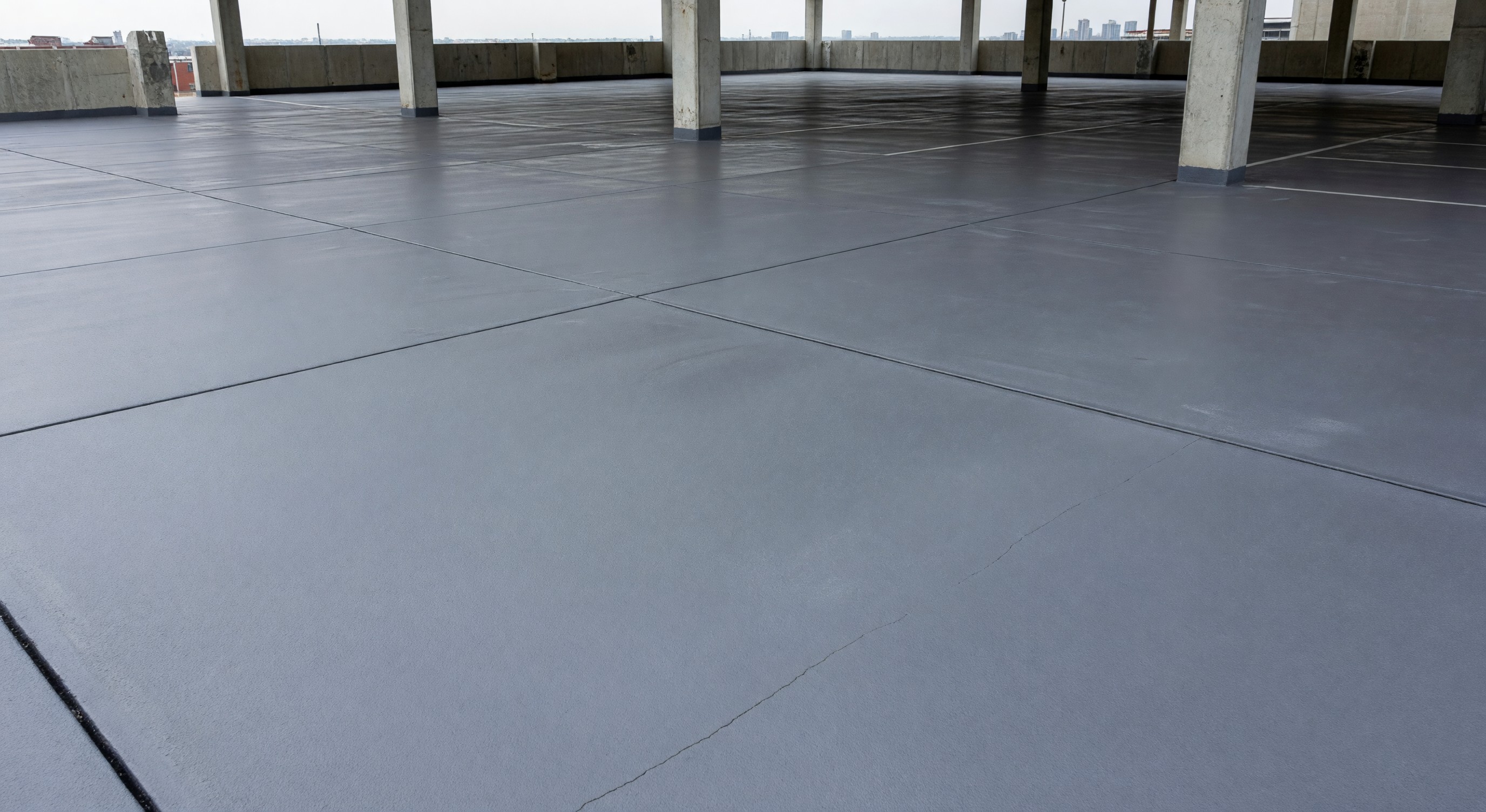
Traffic coatings (sometimes called wearing membranes or vehicular traffic systems) are polymer-based coatings applied directly to the concrete deck surface with no asphalt overlay. They serve simultaneously as waterproofing and wearing surface.
Traffic coating systems are specified in two- or three-component systems:
- Base coat: High-build elastomeric polyurethane or epoxy that bonds to concrete and provides the primary waterproofing layer. Applied at 10 to 30 mils dry film thickness.
- Broadcast aggregate: Silica sand or aluminum oxide broadcast into the wet base coat to provide skid resistance and protect the membrane from UV degradation.
- Topcoat: UV-stable aliphatic polyurethane or acrylic that protects the aggregate broadcast and provides color consistency. Refreshed every 3 to 7 years as the topcoat weathers.
Traffic coating systems are common on exposed upper decks and in mild-climate garages. They allow direct bonding to the structural deck, easier visual inspection of the surface, and simpler repair access than systems buried beneath asphalt overlays.
ASTM C836 (Standard Specification for High Solids Content, Cold Liquid-Applied Elastomeric Waterproofing Membrane) and manufacturer specifications govern material selection and application.
Expansion Joint Design
Expansion joints are the most common failure point in deck waterproofing systems. They must accommodate thermal movement (typically 0.5 to 1.5 inches in North American climates), seismic movement, and deflection under live loads — while remaining watertight throughout their service life.
Commercial expansion joint systems for parking structures use armored nosings (steel angles protecting joint edges from vehicle impact), elastomeric seals (neoprene, silicone, or proprietary compression seals), and backing rods. Premolded joint systems with factory-fabricated seals and metal faces provide better long-term performance than field-applied sealants, which typically fail within 5 to 10 years.
Joint design must coordinate with the structural engineer regarding expected movement magnitudes. Undersized joints fail when movement exceeds the seal’s compression/extension range; oversized joints create transition bumps that generate vehicle impact loads.
Maintenance Requirements
Waterproofing systems are not install-and-forget. Annual inspections should assess:
- Traffic coating condition (topcoat wear, aggregate loss, cracking)
- Expansion joint seal condition and drainage
- Drain sump cleanliness and flow
- Surface cracks in concrete that may indicate structural movement or reinforcing corrosion
- Areas of delamination or bubbling in membrane or coating
Traffic coatings should receive topcoat refreshing every 3 to 7 years depending on UV exposure and traffic volume. Base coats require repair of any tears or penetrations as they are discovered. Delaying maintenance allows water infiltration, which accelerates the deterioration that the waterproofing system was designed to prevent.
Frequently Asked Questions
How long does a parking deck waterproofing system last? Quality membrane systems under asphalt overlays last 20 to 30 years with proper installation. Traffic coating systems on exposed decks require topcoat refreshing every 3 to 7 years but can provide protection for 15 to 25 years before requiring full system replacement.
What is the difference between a membrane system and a traffic coating? Membrane systems are installed beneath an asphalt or concrete overlay and serve as the waterproofing barrier. Traffic coatings are applied directly to the structural deck and serve as both waterproofing and wearing surface. Membrane systems are generally more durable; traffic coatings allow easier inspection and repair access.
Why do expansion joints fail most often? Expansion joints must accommodate thermal movement and live load deflection while remaining watertight. Field-applied sealants have limited compression/extension cycles and typically fail within 5 to 10 years. Premolded systems with factory-fabricated seals perform better but require proper sizing for expected movement.
How can I tell if a parking deck has active water infiltration? Signs include visible efflorescence (white calcium deposits) on soffit surfaces, rust staining below joints or cracks, spalled concrete exposing reinforcing, and wet spots on deck surfaces after dry weather (indicating subsurface drainage).
Takeaway
Parking deck waterproofing is among the most important investments in parking structure preservation. Properly designed and maintained waterproofing systems prevent the chloride-induced corrosion that is the primary cause of structural deterioration and rehabilitation expense. Whether specifying a membrane system under an asphalt overlay or a direct-to-deck traffic coating, design details at joints and penetrations — and an ongoing maintenance program — determine whether the system achieves its full service life potential.
Further Reading from Authoritative Sources
- NIST concrete durability and chloride corrosion research — NIST conducts and publishes foundational research on concrete durability, chloride thresholds, and reinforcing corrosion mechanisms.
- Federal transportation infrastructure preservation and maintenance standards — The U.S.