Motorcycles and mopeds represent a growing share of the vehicle fleet in North American urban markets — driven by fuel economy, easier urban maneuvering, and parking convenience. Yet most parking facilities provide no dedicated motorcycle parking, leaving riders to park in standard stalls (wasting space), squeeze into gaps between parked cars (creating conflict), or park illegally. Facilities that design dedicated motorcycle parking improve space efficiency, reduce conflict, and attract riders who will choose a facility that accommodates them.
Why Motorcycle Parking Deserves Dedicated Design
A standard 9 × 18-foot parking stall can accommodate four to six motorcycles, yet most parking operators use these stalls for a single automobile when motorcycles are not designated their own area. This represents a significant inefficiency for facilities with active motorcycle demand — transit stations, urban garages, and destination facilities in warm-weather markets.
Motorcycle parking also carries specific safety risks that standard stall design does not address: motorcycles are top-heavy when stationary and vulnerable to being knocked over by car doors, adjacent car positioning, or wind. Surface conditions — oil, gravel, cross-slopes — that are minor inconveniences for automobiles create significant fall risks for motorcycle riders.
Stall Dimensions
Dedicated motorcycle stalls are substantially smaller than automobile stalls. Standard motorcycle stall dimensions:
- Minimum stall width: 4 to 5 feet. A typical cruiser or touring motorcycle is 2 to 2.5 feet wide; a 4-foot stall allows comfortable positioning and helmet removal without crowding.
- Minimum stall depth: 8 to 10 feet. Most motorcycles are 6 to 8 feet long; 8 to 10 feet accommodates handlebars, mirrors, and luggage.
- Recommended stall for sidecars or large touring bikes: 5 to 6 feet wide × 10 feet deep.
Mopeds and motor scooters (sub-50cc class) have similar dimensions to full motorcycles but may have wider front fairing widths. The same 4 to 5-foot stall width accommodates most scooter models.
Group motorcycle stalls — a set of individual stalls within a shared marked zone — should provide a minimum 6-foot aisle between stall rows or between the stall row and a wall/barrier. Motorcycles back into stalls in most configurations; the aisle must accommodate the motorcycle’s length protruding during entry.
Dedicated Zone Design
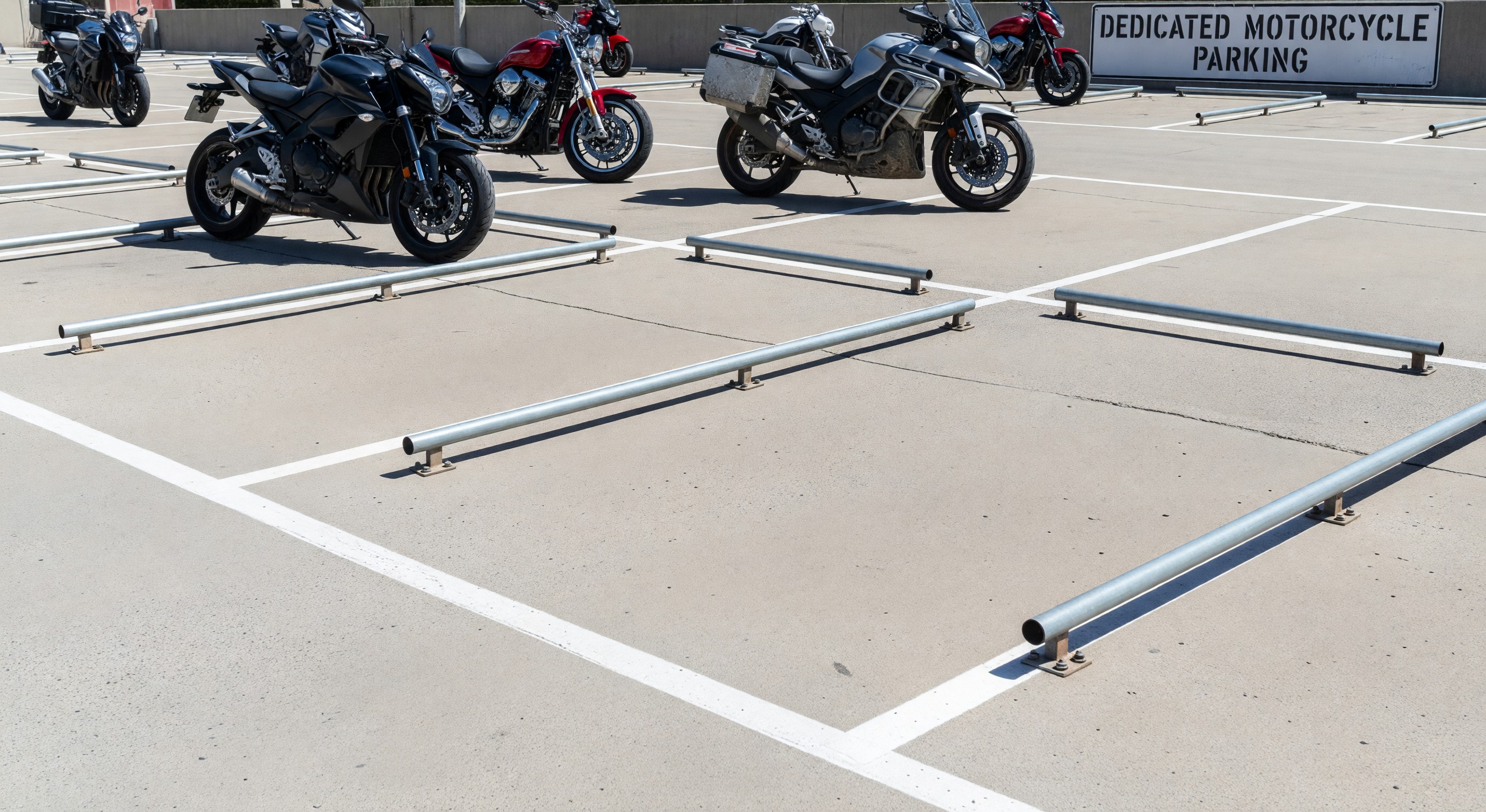
Motorcycle parking zones work best as a designated area separate from automobile parking, for several reasons:
- Security: Motorcycles are high-value theft targets. Visible motorcycle zones with CCTV coverage and, ideally, physical anchor points (embedded ground anchors for chain locks or fixed ring anchors) provide deterrence.
- Surface quality: Motorcycle zones should be level or very slightly sloped (1 percent maximum cross slope). Uneven surfaces or gaps in pavement cause kickstand instability. Zone surfaces should be swept regularly to remove gravel, sand, and debris that creates fall hazards.
- Signage: Dedicated motorcycle zones should be clearly marked with pavement text (“MOTORCYCLE PARKING ONLY”) and appropriate regulatory signs to prevent automobiles from occupying the zone.
Preferred locations for motorcycle zones: near building entrances (riders often choose motorcycles for convenience; they expect proximity parking), at covered areas in facilities with canopies, and in areas with good CCTV visibility.
Surface Design Requirements
Pavement surface quality in motorcycle areas deserves particular attention:
Level surface: Cross slopes should not exceed 1 to 2 percent. Steeper slopes cause kickstand instability on standard side-mounted kickstands. Bikes parked on slopes oriented toward the downhill side may roll off the kickstand.
Wheel guides and stops: Wheel chocks or low-profile wheel guides aligned with stall direction help riders position consistently and prevent rolling. Embedded rubber or polymer chocks 2 to 3 inches high are effective. Traditional car-sized wheel stops (6 inches high) are overly tall for motorcycles and create trip hazards.
Surface texture: Smooth concrete or fine-texture asphalt is preferred. Exposed aggregate surfaces create kickstand instability by allowing the stand to settle between aggregates. Painted or thermoplastic stall markings must not create slippery patches — motorcycle tires are narrow and more susceptible to marking surface slipperiness than car tires.
Grease and oil control: Motorcycle parking areas accumulate oil drips. More concentrated oil deposition per square foot than automobile areas (smaller surface area, more concentrated drip). Schedule regular degreasing and cleaning of motorcycle parking zones.
Regulatory and Code Considerations
ADA does not require accessible motorcycle parking spaces in the same way it requires accessible automobile parking. However, facilities should provide motorcycle parking at accessible locations when feasible — motorcycle use is disproportionately common among veterans and individuals with certain mobility limitations who can ride but have difficulty walking distances.
Some cities (San Francisco, New York, Los Angeles) have adopted ordinances that require or incentivize motorcycle parking provisions in new commercial developments. California Vehicle Code Section 22511 and similar statutes in other states govern where motorcycles may legally park. Parking operators should post applicable regulations in motorcycle zones.
Frequently Asked Questions
How many motorcycles fit in a standard car parking stall? A standard 9 × 18-foot car stall can accommodate 4 to 6 motorcycles, depending on the configuration and motorcycle size. Designated motorcycle stalls of 4 × 8 to 5 × 10 feet allow efficient use of the available space.
What surface requirements apply to motorcycle parking? Motorcycle areas should have level surfaces with maximum 1 to 2 percent cross slope, clean of gravel and oil, with smooth or fine-textured pavement. Exposed aggregate and painted surfaces can create kickstand instability or slip hazards for narrow motorcycle tires.
Should motorcycle parking be secured or enclosed? CCTV coverage and physical anchor points (ground-embedded rings or chocks) are best practice for motorcycle zones. Motorcycles are high-value theft targets; visible security infrastructure and physical locking points both deter theft and reassure riders.
Does ADA require accessible motorcycle parking? ADA does not currently specify accessible motorcycle parking requirements equivalent to those for automobiles. Best practice is to locate motorcycle parking near accessible building entrances and to provide at least one space on a level surface accessible without traversing steps or steep slopes.
Takeaway
Dedicated motorcycle parking is an efficiency opportunity for parking operators, a safety improvement for riders, and an amenity that attracts a growing market segment that specifically values parking convenience. Stall dimensions of 4 to 5 feet wide by 8 to 10 feet deep, organized in dedicated zones with level surfaces, wheel guides, CCTV coverage, and anchor points, serve motorcycle users effectively while allowing facility operators to convert underutilized standard stalls into productive multi-motorcycle inventory.
Further Reading from Authoritative Sources
- U.S. Access Board accessible parking standards and technical guidance — The U.S.
- Institute of Transportation Engineers parking design technical resources — The Institute of Transportation Engineers (ITE) publishes parking design resources including stall dimension guidance and facility layout standards that are authoritative references for the dimensional standards discussed in the article.