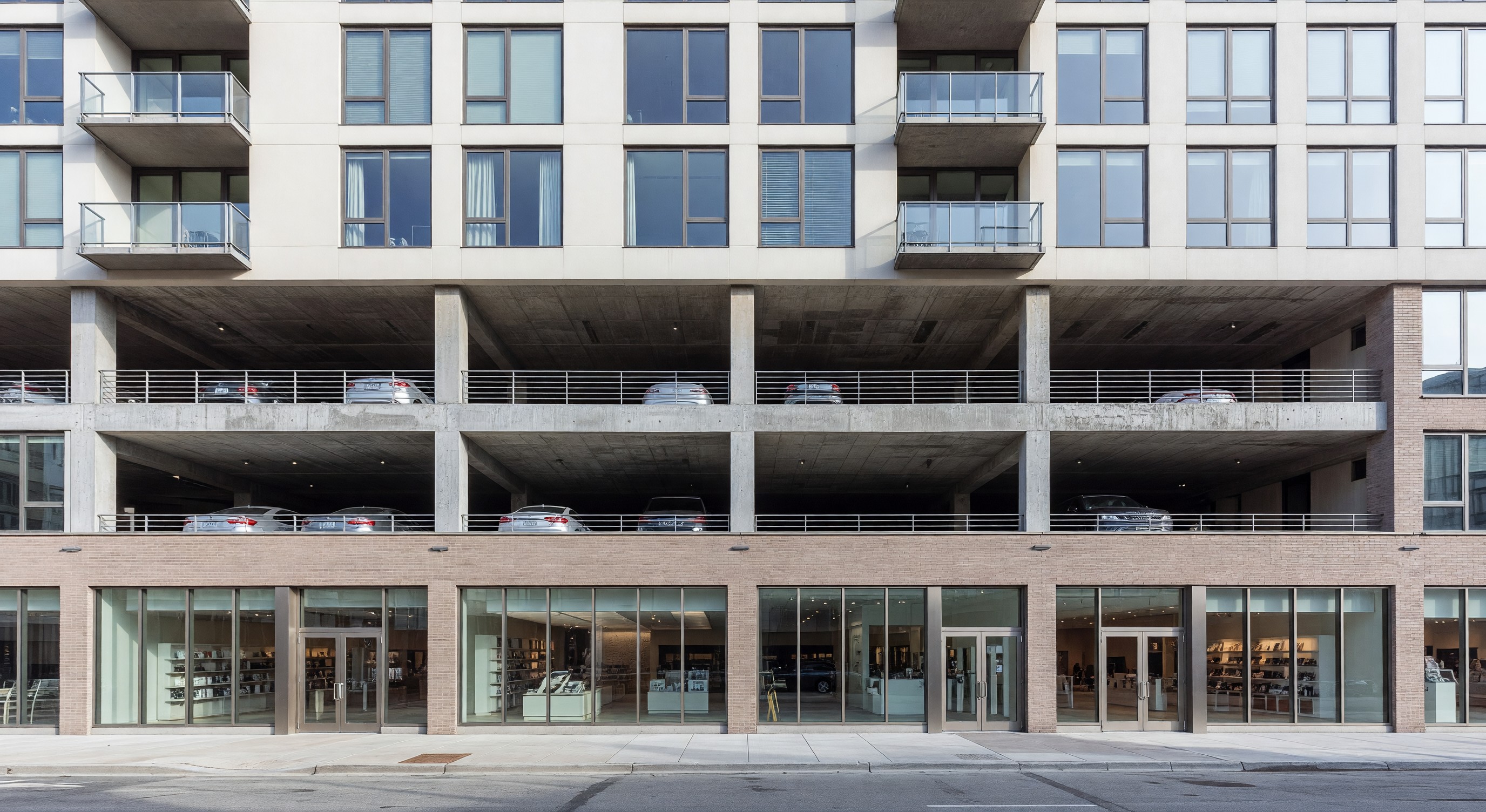
Mixed-use parking structures — typically retail at grade, parking on intermediate levels, and residential or office at top — are an increasingly common urban development form. They are not simply a parking garage with uses added around it; they are multi-use buildings with fundamentally different structural, mechanical, acoustic, and operational requirements on each level. The degree to which these requirements are resolved in design determines whether the building functions well across all its uses — or generates chronic operational conflicts between incompatible neighbors.
Structural Coordination
The structural systems for parking, retail, and residential uses have different column spacing, loading, and floor-to-floor height requirements that must be resolved in a single structural design.
Column grid: Retail at grade prefers wide, column-free spans — 30 to 40-foot column spacing to create flexible, unobstructed floor plates for merchandising. Parking above prefers the 60-foot bay module (two stall rows plus aisle). Residential above prefers column spacing aligned with unit plans (typically 20 to 30-foot bays). These are fundamentally incompatible grids that must be resolved with transfer beams or a structural compromise that serves all uses acceptably.
Transfer beams at the parking-to-retail level are a common solution: wide-span beams spanning across retail columns carry the load of the more closely spaced parking structure columns above. These beams add significant structural depth (3 to 4 feet) and cost at the transfer level.
Loading: Residential use is designed for 40 to 50 pounds per square foot live load; parking is designed for 50 psf (ASCE 7 Chapter 4) with allowance for concentrated vehicle wheel loads; retail for 75 to 100 psf. When parking loads must be carried through residential structure to foundation, the structural design must accommodate parking loads throughout the load path.
Floor-to-floor height: Retail at grade typically requires 15 to 20-foot floor-to-floor height for signage, tenant identity, and mechanical accommodation. Parking levels require 8.5 to 10 feet floor-to-floor. Residential requires 9 to 12 feet. These heights must be organized in section so that the building’s total height meets zoning requirements while satisfying each use’s needs.
Access and Circulation Separation
Operational conflicts in mixed-use structures arise most acutely at circulation. Parking users, retail customers, residential tenants, and delivery vehicles all need access to the building, but their paths should be separated to avoid conflict and security breaches.
Vehicle access: Parking ramps should be accessible from secondary streets or side drives, away from the primary retail frontage. Delivery access should be a dedicated off-street loading area, not shared with parking entry. Residential tenant vehicle access — particularly if parking is allocated separately from the public parking — should have separate entry lane and access control.
Pedestrian access: Retail entrances at grade should face the primary retail street with clear, wide sidewalk frontage. Residential lobbies should be on a quieter secondary elevation with a separate entry, ideally with security control. Parking egress elevators and stairwells should not discharge through the retail floor — they should connect to either a shared lobby or directly to the exterior at a secondary location.
Security zoning: Residential floors must be accessible only to residents and authorized visitors; public parking areas must not have direct uncontrolled access to residential floors. Elevators from parking levels should require a key card or code for residential floor access. Stairwells from parking levels should either not serve residential floors at all, or be controlled at the residential level entry.
Acoustic and Vibration Management
Vehicle movement in parking creates noise and vibration that, without design mitigation, transmits through the structure to residential units above:
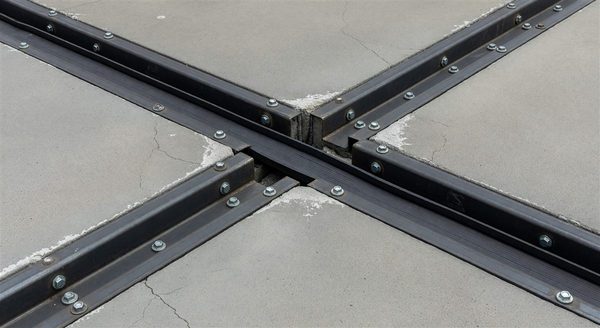
Structural separation: Isolating the parking structure from the residential structure above using isolation joints, flexible bearing pads, or floating slab systems at the parking-to-residential transition is the most effective mitigation. This prevents structure-borne sound from propagating through the concrete.
Waterproofing as sound control: Traffic coatings on parking decks reduce tire squeal and impact noise transmission. Textured traffic surfaces (broadcast aggregate) are quieter than smooth-finish coatings.
Mechanical systems: Ventilation fans in the parking levels generate low-frequency noise. Fan mounting should use vibration isolators; exhaust ducts should not penetrate directly through residential floor slabs without appropriate silencing.
Financial Dynamics
Mixed-use parking development is more complex financially than single-use parking. The parking component may be cross-subsidized by the residential or retail development to make the project economics work — a common arrangement in urban infill TOD where parking alone would not pencil at urban land costs.
Residential developers may contribute to parking construction cost as a quid pro quo for allocated stalls below market rate. Retail tenants may negotiate free or validated parking as part of lease agreements. Public/private parking structures often use tax increment financing (TIF), special assessment districts, or public bonding to fund parking that enables adjacent private development.
Parking in mixed-use buildings is often separately owned or operated from the residential and retail components — with a condominium parking structure owned by a separate entity, or a long-term operating agreement between the parking operator and the building owner. These arrangements require careful legal drafting to address maintenance responsibilities, access rights, and operational conflicts between uses.
Frequently Asked Questions
Why is column grid coordination so important in mixed-use parking structures? Retail, parking, and residential use have incompatible preferred column spacing. Retail wants wide clear spans (30 to 40 feet); parking uses 60-foot bays; residential is based on 20 to 30-foot unit modules. Resolving these grids requires structural compromises or transfer beams, all of which have cost implications that must be addressed in early design.
How is vehicle access separated in mixed-use parking buildings? Best practice separates parking entry lanes on secondary streets from retail frontage; uses separate entry points for public parking, residential parking, and delivery; and restricts elevator and stairwell access between parking levels and residential floors using key card access control.
What acoustic measures prevent parking noise from affecting residential units above? Isolation joints or floating slab systems at the parking-to-residential transition level prevent structure-borne sound transmission. Traffic coatings on parking deck surfaces reduce tire squeal. Ventilation fans should use vibration isolators. The most effective measure is structural isolation rather than after-the-fact sound treatment.
Who typically owns or operates the parking component in a mixed-use development? Arrangements vary. The parking may be a condominium portion of the building owned separately, operated by a third-party parking operator under a management agreement, or integrated with residential and retail management under a single owner. The key is clear legal agreements addressing maintenance cost allocation, access rights, and operational decision authority.
Takeaway
Mixed-use parking structures create real estate value by stacking uses efficiently on constrained urban sites, but they require rigorous design integration across structural, mechanical, operational, and acoustic systems to function well for each use. The parking-retail-residential combination is the most common arrangement, and resolving the conflicting column grids, loading requirements, access patterns, and acoustic conditions is genuinely complex. Early engagement of a structural engineer, parking consultant, and acoustic engineer in the design team — before schematic design is complete — is the most reliable path to a building that serves all its uses effectively throughout its life.
Further Reading from Authoritative Sources
- Institute of Transportation Engineers parking design technical resources — ITE publishes widely referenced guidance on parking structure design geometry, including column spacing and circulation standards that directly inform mixed-use parking structure design decisions described in this article.
- FHWA livability planning resources for mixed-use development — FHWA’s livability and urban design resources address transit-oriented development and mixed-use structure integration in urban contexts, providing federal-level planning guidance relevant to the urban infill mixed-use developments discussed in this article.