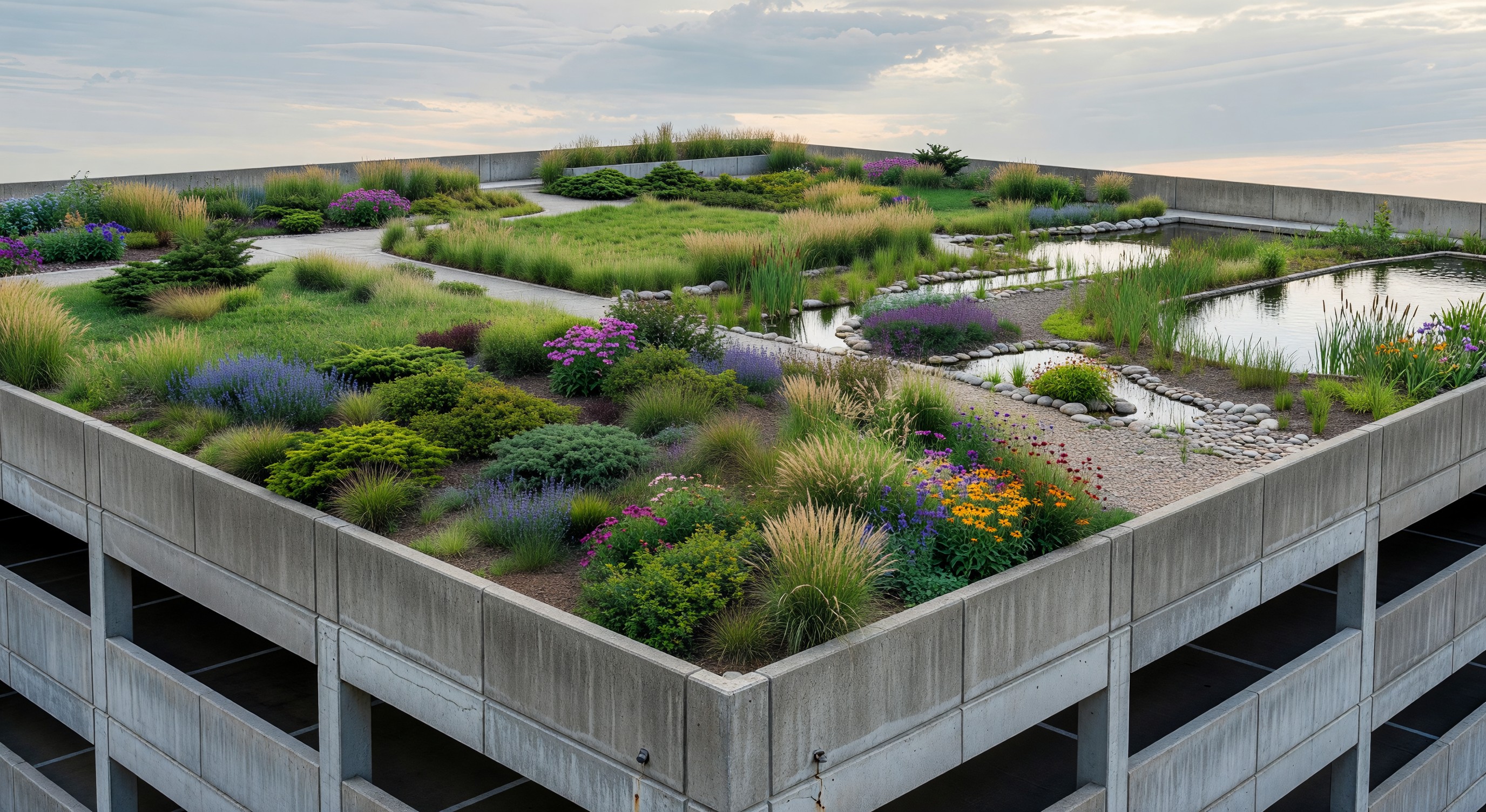
Green roofs on parking structures occupy a unique design niche — they sit atop a structure optimized for vehicle movement and durability, yet must support vegetation systems with radically different requirements. When executed well, they transform the top level of a parking structure from a utilitarian asphalt deck into a functional green space that manages stormwater, reduces heat island effect, provides habitat, and can serve as accessible park space in dense urban environments. When executed poorly, they create waterproofing failures, structural overloads, and maintenance burdens that outweigh their benefits.
Green Roof System Types
Extensive green roofs: The lightest-weight, lowest-maintenance option. Growing medium depth of 2 to 4 inches; planted with sedums, native groundcovers, and drought-tolerant species that survive without supplemental irrigation once established. Saturated weight of 15 to 30 psf. Appropriate for structures where structural loading limits rule out heavier systems. Provides stormwater retention, insulation, and heat island reduction; not accessible for recreational use.
Semi-intensive green roofs: Growing medium of 4 to 8 inches; planted with grasses, herbs, and shrubs. Saturated weight of 30 to 60 psf. Allows a wider range of plants including some ornamental species. Requires occasional irrigation in dry periods; moderate maintenance. Can incorporate circulation paths for access.
Intensive green roofs: Growing medium of 8 inches to several feet; supports shrubs, small trees, and full landscape designs. Saturated weights of 80 to 200+ psf — comparable to a conventional soil landscape. Typically used for accessible rooftop parks, terraces, and amenity spaces. Highest construction cost, maintenance cost, and structural impact.
The choice among these types is primarily determined by the existing structural capacity of the parking deck, the program objectives (recreational access, stormwater management, aesthetics), and the maintenance budget.
Structural Loading Requirements
The top deck of a parking structure is typically designed for 50 psf live load and the self-weight of the traffic-bearing surface (typically 10 to 15 psf for concrete topping or 8 to 12 psf for asphalt overlay). Adding a green roof imposes:
- Saturated growing medium weight: 10 to 30 psf for extensive; 30 to 80 psf for semi-intensive; 80 to 200+ psf for intensive
- Plant and growing medium retained water load: Already included in the saturated weight
- Drainage layer: 2 to 5 psf for drainage mat, protection board, and filter fabric
Most parking structures cannot support even a semi-intensive green roof without structural augmentation, unless the deck was designed with green roof loading in mind. Structural assessment by a structural engineer is essential before any green roof is specified for an existing structure. For new structures, designing the top deck for 80 to 100 psf live load (versus 50 psf standard) at modest additional structural cost preserves the option for semi-intensive green roof installation.
Waterproofing Integration
The waterproofing membrane under a green roof must be:
- Highly durable: Green roof waterproofing cannot be inspected or accessed once planted. It must last the life of the green roof system without failure.
- Root-resistant: Plant roots can penetrate standard roofing membranes. Modified bitumen, EPDM, TPO, and PVC membranes used in parking decks are not all root-resistant. Membranes specified for green roof use must be either inherently root-resistant or protected by a geotextile root barrier layer.
- Properly tested: Flood testing (ponding water for 72 hours) or electric field vector mapping (EFVM) testing of the membrane before planting is essential. Once planted, membrane leak location is extremely difficult and expensive.
The waterproofing system under a green roof must be designed and installed with the same rigor as any traffic-bearing deck waterproofing system — ideally more, given that leak detection after planting is difficult.
Stormwater Management Benefits
Green roofs retain stormwater in the growing medium and release it slowly through evapotranspiration, reducing peak runoff rates and total runoff volume. Performance depends on growing medium depth and antecedent moisture conditions:
- Extensive green roofs (2 to 4 inch media): Retain 40 to 70 percent of annual rainfall volume; reduce 1-inch storm peak runoff by 30 to 70 percent depending on media saturation at storm onset
- Semi-intensive green roofs (4 to 8 inch media): Retain 50 to 80 percent of annual rainfall volume; more effective for peak attenuation
- Intensive green roofs: Can retain 80 to 90 percent of annual rainfall in smaller storms
Many state and local stormwater programs provide green infrastructure credit for green roofs, allowing reduction or elimination of detention basin requirements. LEED Rainwater Management credits and SITES certification both recognize green roof contributions to stormwater management objectives.
Maintenance Requirements
Green roof maintenance is often underestimated:
Extensive systems: Annual inspections; weed removal (particularly in establishment years); debris clearance from drains; occasional irrigation during establishment (typically first 2 to 3 growing seasons). Mature sedum roofs require minimal ongoing maintenance if the plant community is well-established and the irrigation is functional.
Semi-intensive and intensive systems: Seasonal irrigation management; regular plant care (pruning, fertilizing, plant replacement); drain inspection and cleaning; snow and ice management in northern climates; path and hardscape maintenance if recreational access is provided.
Budget for green roof maintenance separately from standard parking deck maintenance. Many facility managers who add green roofs underestimate the ongoing cost and then allow the vegetation to die, leaving bare growing medium that erodes and clogs drains.
Frequently Asked Questions
How much additional structural load does a green roof impose on a parking structure top deck? Extensive systems add 15 to 30 psf saturated; semi-intensive add 30 to 80 psf; intensive systems add 80 to 200+ psf. Most standard parking structures are designed for 50 psf live load and cannot support even a semi-intensive green roof without structural assessment and potential augmentation.
What type of waterproofing membrane is required under a green roof? Root-resistant membranes or standard membranes protected by a geotextile root barrier are required. The membrane must be fully tested before planting — flood testing or EFVM testing — because leak detection after planting is extremely difficult. Green roof waterproofing must be treated as a life-of-building system, not a replaceable component.
Do green roofs on parking structures qualify for stormwater management credit? Yes. Most state and municipal stormwater programs credit green roofs as green infrastructure, and LEED Rainwater Management credits recognize green roof stormwater retention. Credit calculations depend on media depth, roof area, and the specific calculation methodology required by the local stormwater authority.
What maintenance does an extensive sedum green roof require? Annual inspection, weed management (particularly in the first 3 years of establishment), drain inspection and cleaning, and periodic irrigation during dry spells in the establishment period. Once established, a sedum green roof requires significantly less maintenance than a semi-intensive or intensive system — typically 4 to 8 hours of labor per 10,000 square feet annually.
Takeaway
Green roofs on parking structures are both technically feasible and environmentally compelling, but they impose structural loading, waterproofing, and maintenance requirements that must be addressed with as much rigor as any parking system element. The most successful green roof parking projects design for them from the start — specifying structural loading for the intended green roof system type, using root-resistant waterproofing specified and tested before planting, and budgeting for ongoing maintenance. Extensive sedum systems are the most practical option for most existing parking structures where structural capacity is limited; semi-intensive and intensive systems require purpose-designed or significantly upgraded structural systems.
Further Reading from Authoritative Sources
- EPA green infrastructure program — stormwater management and green roofs — The EPA’s Office of Water publishes authoritative guidance on green infrastructure approaches — including green roofs — as stormwater management tools.
- Federal transportation sustainability and infrastructure resources — The U.S.