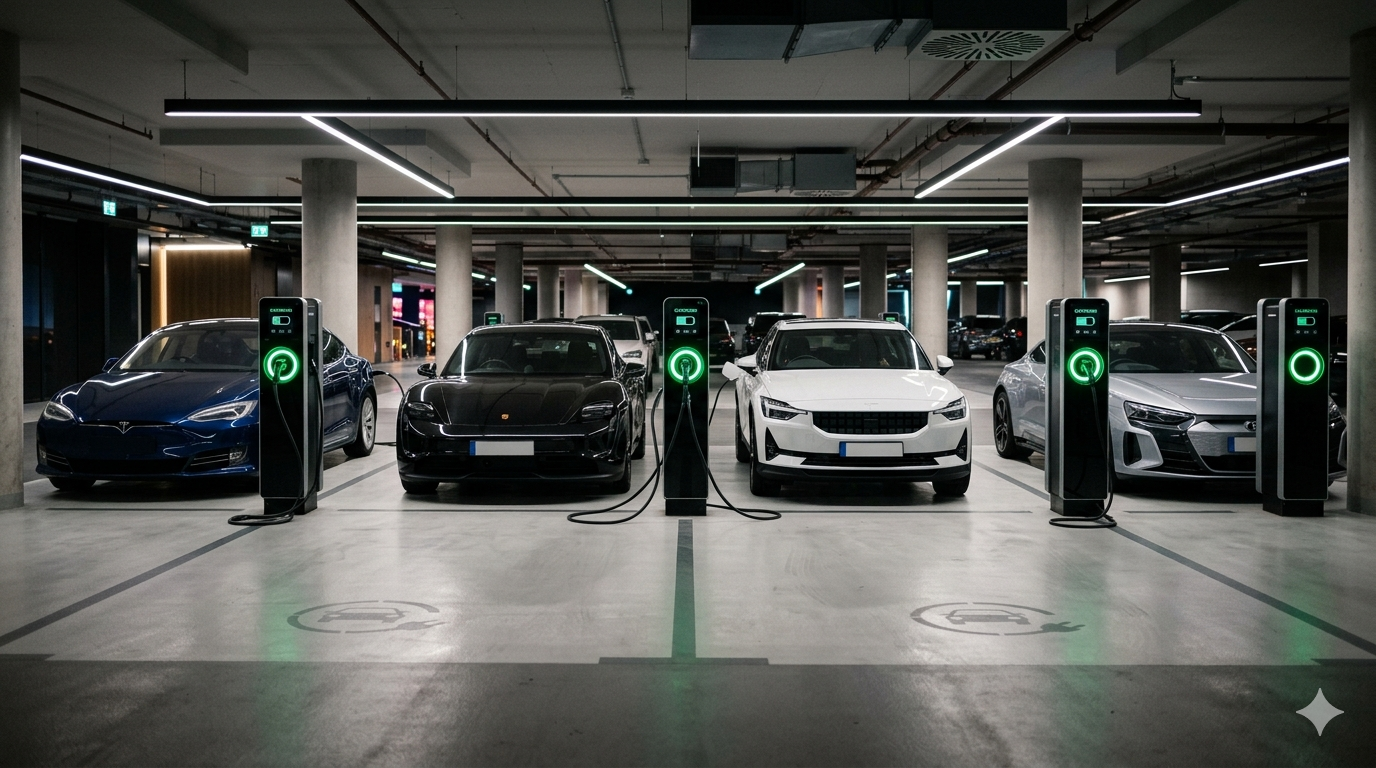
Electric vehicle adoption crossed a meaningful threshold in 2023. Global EV sales exceeded 14 million units, representing roughly 18 percent of all new car sales. In North America, the trajectory is steeper than many parking operators anticipated — the United States saw over 1.4 million EV sales, a 50 percent increase over 2022, and Canada tracked proportionally higher. The U.S. Department of Energy has been tracking this acceleration through its Alternative Fuels Data Center, which provides detailed adoption data by state and metro area.
For parking facility operators and designers, this is no longer a future planning exercise. EV drivers need charging. They are making parking decisions based on charger availability. And the facilities that accommodate them are capturing both direct charging revenue and the loyalty of a growing, affluent customer segment.
But installing EV charging in a parking facility is more complex than bolting a charging station to a wall. Electrical capacity constraints, station placement decisions, revenue model choices, code compliance, and long-term infrastructure planning all require careful consideration. This guide addresses each of these areas with practical recommendations for operators navigating their first or next phase of EV charging deployment.
Understanding Electrical Capacity
Electrical capacity is the single most significant constraint on EV charging deployment in existing parking facilities. A Level 2 charging station draws 7 to 19 kilowatts. A DC fast charger draws 50 to 350 kilowatts. To put that in perspective, a typical 500-space parking garage might have a 200 to 400 kW electrical service — enough for lighting, ventilation, elevators, payment equipment, and gate systems, but not enough to add 50 Level 2 chargers without upgrading the service.
Assessing Available Capacity
The first step in any EV charging project is an electrical capacity assessment. This involves:
Reviewing the existing electrical service. What is the total capacity of the main switchgear? What is the current peak demand? The difference between capacity and peak demand represents the headroom available for EV charging without an electrical upgrade.
Understanding demand patterns. Electrical demand in most parking facilities peaks during occupied hours — when lighting, ventilation, and elevator use are highest. This happens to coincide with when EV charging demand is also highest. There is limited opportunity to offset charging load to off-peak electrical periods unless you implement managed charging.
Estimating future needs. Current EV penetration in your market may be five to ten percent, but planning for a facility that will operate for 20 to 30 more years requires thinking about 30 to 50 percent or higher EV penetration. Building electrical infrastructure in phases is more cost-effective than retrofitting capacity later.
Managing Demand
Electrical capacity constraints have driven innovation in managed charging — systems that distribute available power across multiple charging stations based on priority, demand, and grid conditions.
Load management allows operators to install more stations than their electrical capacity could support if all were running at maximum power simultaneously. A system with 40 Level 2 stations on a circuit that can support 20 at full power uses intelligent distribution to share that capacity, charging vehicles that need it most while throttling others. Most EV drivers do not need a full charge in a single parking session, making this approach practical.
Demand response programs offered by utilities can provide financial incentives for operators who allow their charging load to be curtailed during grid peak events. These programs can offset electricity costs by 10 to 20 percent in some markets.
On-site energy storage using battery systems can buffer charging demand, drawing power from the grid during off-peak periods and dispensing it during peak demand. The economics of battery storage for EV charging are improving but remain marginal in most markets as of early 2024. Facilities with solar installations may find the combination more compelling.
Station Placement and Design
Where you put charging stations within a facility matters more than most operators initially appreciate. Poor placement decisions increase installation costs, create operational conflicts, and undermine utilization.
Level 2 vs. DC Fast Charging
The appropriate charger type depends on the parking use case:
Level 2 (7-19 kW) is appropriate for facilities where vehicles park for two or more hours. Workplace parking, hotel parking, airport long-term lots, residential garages, and hospital visitor parking all fit this profile. Level 2 stations are less expensive to install ($2,000 to $6,000 per station including installation), have lower electrical demand, and require less robust electrical infrastructure.
DC fast charging (50-350 kW) is appropriate for short-duration parking where drivers need a meaningful charge in 20 to 45 minutes. Retail parking, highway-adjacent facilities, and fleet operations benefit from fast charging. Installation costs are significantly higher ($30,000 to $100,000+ per station), and electrical infrastructure requirements are substantial.
Most parking facilities will deploy predominantly Level 2 charging, with DC fast charging reserved for specific high-turnover applications.
Placement Principles
Minimize conduit runs. Every foot of conduit between the electrical panel and the charging station adds cost. Locate stations as close to electrical infrastructure as practical. In structured garages, this often means concentrating charging on the level closest to the electrical room.
Avoid premium spaces. Placing chargers in the most convenient spaces near entrances and elevators creates conflict with non-EV drivers and can generate resentment. Mid-level or slightly less convenient locations are usually better choices — EV drivers are willing to walk an extra minute for a charge, and the arrangement avoids perceptions of preferential treatment.
Plan for cable management. Charging cables are trip hazards and obstacles. Stations should be positioned so that cables reach vehicle charge ports without crossing pedestrian paths. Wall-mounted stations with retractable cables work well in structured environments. Pedestal-mounted stations in surface lots need clear cable routing.
Consider accessible spaces. ADA requirements apply to EV charging spaces. At least one accessible charging space must be provided, with appropriate access aisles and reach ranges. The 2024 updates to accessibility standards provide specific guidance on EV charging station accessibility that operators should review.
Future-proof with conduit. Even if you are installing 10 stations today, run conduit for 30. The incremental cost of empty conduit during initial construction is a fraction of the cost of trenching or cutting concrete to add conduit later. This is the single most impactful decision for long-term EV charging economics.
Revenue Models
EV charging revenue models continue to evolve, and operators face a fundamental strategic choice: own and operate charging infrastructure directly, or partner with a charging network.
Owner-Operated
In the owner-operated model, the parking operator purchases, installs, and maintains charging equipment. Revenue from charging sessions flows directly to the operator after electricity costs.
Advantages: Higher per-session revenue, full control over pricing and customer experience, no revenue sharing.
Disadvantages: Capital investment, maintenance responsibility, need for billing and payment infrastructure, technology obsolescence risk.
Owner-operated models work best for operators with technical capability, access to capital, and facilities where utilization will be high enough to justify the investment. A Level 2 station that costs $4,000 to install and generates $3 per session needs roughly 1,300 sessions to break even — about four sessions per day over a year, assuming electricity costs are covered by the per-session fee.
Network Partnership
Charging networks like ChargePoint, Blink, EVgo, and others offer partnership models where the network provides equipment at reduced cost (or free), handles billing and maintenance, and shares revenue with the facility operator.
Advantages: Lower or no capital investment, no maintenance burden, established billing systems and driver apps, network visibility that drives utilization.
Disadvantages: Revenue sharing reduces per-session income, less control over pricing and customer experience, contract terms that may lock in unfavorable arrangements.
Partnership models are appropriate for operators who want to offer charging as an amenity without building operational expertise. The revenue share should be evaluated carefully — the difference between a 70/30 and 50/50 split on a high-utilization station is substantial over a five-year contract term.
Charging as Amenity
Some operators, particularly in hospitality, healthcare, and premium office environments, offer EV charging as a free amenity. The cost is treated as an operating expense offset by competitive differentiation, tenant satisfaction, or customer loyalty.
This approach makes economic sense when the per-space electricity cost ($1 to $4 per session for Level 2) is small relative to the parking revenue the space generates and the customer value at stake. A hotel where EV-driving guests spend $200 per night can absorb $3 in charging costs without blinking.
Code Requirements and Standards
EV charging in parking facilities is subject to a growing body of codes and standards that operators must navigate. As of early 2024, the landscape includes:
Building Codes
The 2021 International Building Code (IBC) and International Energy Conservation Code (IECC) include EV readiness requirements for new construction. Many jurisdictions have adopted or exceeded these requirements:
EV-ready spaces require full electrical infrastructure including a dedicated circuit and outlet or hardwired connection. EV-capable spaces require conduit and panel capacity but not a full circuit. EV-installed spaces have operational charging equipment.
Percentages vary by jurisdiction. California’s CALGreen code requires the most aggressive deployment — 20 percent of spaces must be EV-capable in new nonresidential construction, with 5 percent EV-installed. Several other states and municipalities have adopted similar or more aggressive requirements.
Electrical Codes
NEC (National Electrical Code) Article 625 governs electric vehicle supply equipment. Key requirements include dedicated branch circuits, appropriate wire sizing for continuous loads (charging is classified as continuous because it exceeds three hours), and ground-fault protection.
NEC 2023 introduced Article 625.42, which specifically addresses managed charging and power sharing — an important development that legitimizes load management approaches and provides clear code compliance pathways for installations where multiple stations share electrical capacity.
Accessibility
ADA and state accessibility codes require accessible EV charging spaces with appropriate access aisles, reach ranges, and operable controls. The precise requirements are evolving, but operators should plan for at least one accessible charging space per installation and consult current ADA accessibility standards.
Integration with Parking Operations
EV charging should be integrated with broader parking operations rather than treated as a standalone system. The most effective integrations leverage existing parking technology and management platforms.
Access control integration ensures that charging spaces are used by vehicles that are actually charging. Without enforcement, EV spaces become convenient parking for any vehicle. Smart parking systems that incorporate LPR, occupancy sensing, or space-level detection can identify and enforce EV-only spaces, sending alerts when non-charging vehicles occupy them.
Payment integration simplifies the customer experience by bundling charging fees with parking fees in a single transaction. Operators using modern parking management platforms can often integrate charging billing through APIs provided by charging equipment manufacturers.
Reporting integration gives operators a unified view of parking and charging revenue, utilization, and operational metrics. This holistic perspective enables better decision-making about future charging deployment, pricing adjustments, and infrastructure investment.
Planning for the Future
EV charging infrastructure decisions made today will operate for 10 to 20 years. The most important planning principle is to build electrical infrastructure ahead of charging station deployment.
Phase your deployment. Install charging stations based on current demand plus a reasonable buffer, but build electrical capacity for two to three times the initial deployment. Conduit, wire, and panel capacity installed during initial construction cost a fraction of what they will cost as retrofits.
Expect technology evolution. Charging standards, connector types, and communication protocols will continue to change. Choose equipment from manufacturers with strong track records and commitments to backward compatibility. Avoid proprietary ecosystems that lock you into a single vendor.
Monitor utilization. Track charging station utilization rigorously. Stations running above 50 percent utilization during occupied hours indicate that you should expand. Stations below 15 percent may be poorly located or poorly marketed. Data drives better decisions about where and when to add capacity.
Engage your utility. The Alternative Fuels Data Center maintains a comprehensive database of state and utility incentive programs. Utility companies in most markets offer EV charging programs that include rate discounts, demand charge mitigation, infrastructure cost sharing, and technical assistance. These programs can significantly improve the economics of charging deployment, and utilities are generally eager to support EV infrastructure in parking facilities.
The parking industry has a unique opportunity with EV charging. Parking facilities are where vehicles spend most of their time — the average car is parked 95 percent of the day. As that parked time increasingly overlaps with charging time, parking operators who invest wisely in charging infrastructure will find themselves at the center of the electric transportation ecosystem.