Preferential parking for carpoolers and high-occupancy vehicles (HOV) is a transportation demand management (TDM) tool that incentivizes ride-sharing by offering better parking locations, reduced rates, or both. Deployed correctly, these programs can meaningfully reduce single-occupancy vehicle (SOV) commutes, reduce parking demand at congested facilities, and support employer sustainability commitments. Deployed poorly — with poor stall locations, inadequate signage, or weak enforcement — they generate cynicism from participants and free-riders from non-participants.
The Business Case for Preferential Parking
Employers, universities, and campuses with constrained parking capacity use preferential parking as a demand management tool. If 10 percent of a 1,000-person workforce can be shifted from SOV to carpool — typically a realistic target for well-managed TDM programs — the parking capacity released (50 to 80 stalls, depending on average carpool size) can defer or eliminate parking expansion costs.
The leverage is greatest at facilities where parking is genuinely constrained: where some employees already use transit or carpool due to difficulty finding stalls, and where a marginal improvement in parking quality could tip borderline carpoolers to commit to the program.
Market research on employer TDM programs (Victoria Transport Policy Institute, EPA COMMUTER model data, and FHWA commute options program reports) indicates that preferential parking, combined with a subsidy or rate discount, increases carpool participation by 5 to 15 percentage points above baseline, depending on the availability and quality of carpool matches and transit alternatives.
Stall Location: The Critical Design Variable
Preferential parking only incentivizes carpooling if the reserved stalls are genuinely preferable to general parking. The location criteria:
Proximity: Carpool stalls should be closer to the primary building entrance than general parking — not to the accessible stall locations, which are protected for ADA compliance, but as close as possible to the main entrance queue. If general employee parking averages a 3-minute walk, carpool stalls should provide a 1 to 2-minute walk.
Covered or protected: Where the facility has a mix of covered and uncovered parking, covered stalls are significantly more desirable in climates with rain, snow, or extreme heat. Allocating covered stalls to carpoolers maximizes the incentive value.
Weather-protected route: The route from carpool stalls to the building entrance should be covered or at minimum clearly marked and well-lit.
Quantity: Over-allocation of carpool stalls creates empty reserved zones while general parking is full — which generates resentment from SOV parkers and signals poor program management. Start with 5 to 8 percent of total inventory; adjust based on enrollment and observed utilization.
Signage and Marking
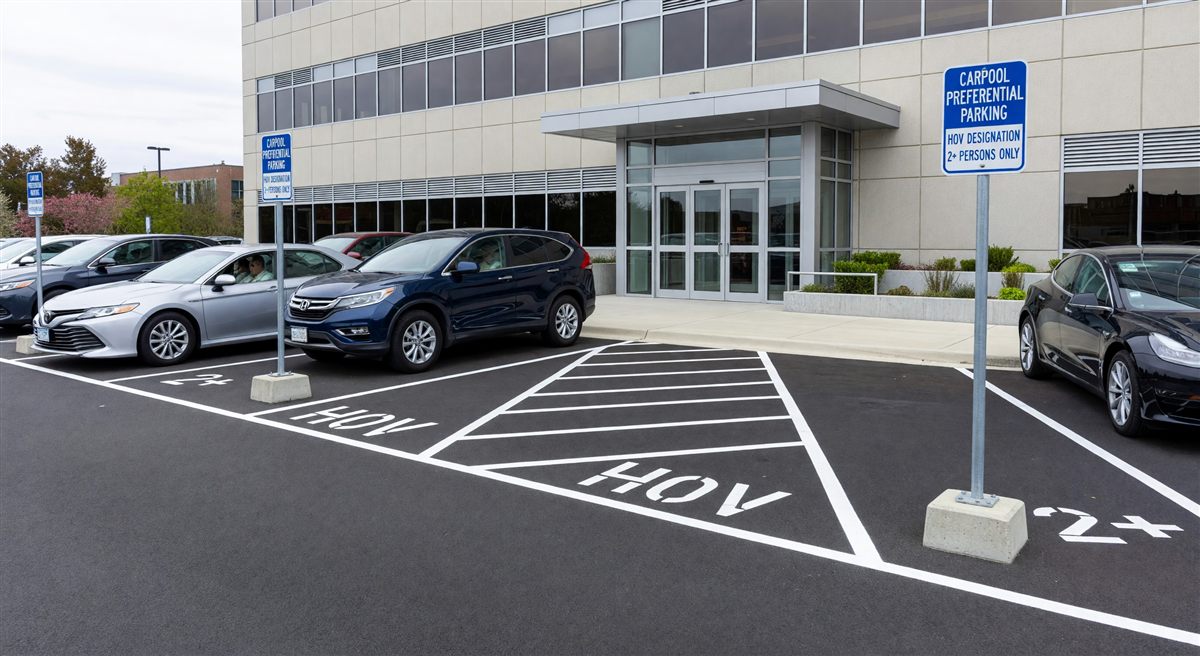
Carpool stalls must be clearly identified with both regulatory signs and pavement markings.
Regulatory sign: A post-mounted or wall-mounted sign reading “CARPOOL PARKING” or “HOV ONLY” with appropriate permit or verification language. Signs should include the penalty for non-compliance if enforcement is active. Standard sign dimensions of 12 × 18 inches are appropriate for most applications.
Pavement marking: “CARPOOL” or “HOV” stenciled in the stall, ideally in a contrasting color (green is commonly used for sustainability-related designations) to make the zone visually distinct from general parking.
Zone identification: Where carpool stalls form a dedicated zone rather than scattered individual stalls, a zone entrance sign or overhead banner identifies the zone approach. Color-coded columns or wall markings reinforce zone identity.
Eligibility Verification and Permit Management
Carpool programs require some form of eligibility verification and permit distribution to prevent non-carpoolers from using preferential stalls:
Permit-based programs: Participants register their carpool (typically minimum 2 occupants) and receive a hang tag or virtual permit. Employers or universities often require a carpool agreement form. Permits are time-limited (monthly, quarterly, or annually) and require renewal.
Honor-based systems: Some programs rely on self-certification (participants agree to carpool criteria when registering) without physical spot checks. Appropriate for low-stakes programs; less effective in tight parking markets where cheating is more tempting.
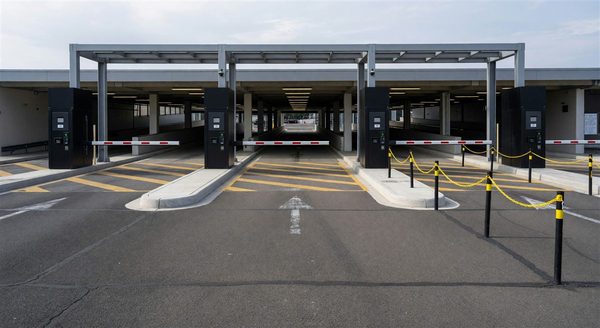
Verification by parking staff: Staffed entry lane facilities can verify HOV status visually during morning ingress. This is feasible only in facilities with consistently staffed entry lanes.
Technology-based verification: LPR systems linked to carpool permit databases can verify registered vehicle plates at entry. This provides consistent enforcement without manual staff involvement but requires integration between the carpool program database and the PARCS system.
Enforcement
Unenforceable preferential parking programs quickly become non-preferential parking programs as non-enrolled users park in carpool stalls and enrolled carpoolers see no benefit. Enforcement options:
- Patrol enforcement: Regular patrols during peak morning ingress confirm occupancy. Difficult to scale to every carpool vehicle every day.
- Citation issuance: Non-carpool vehicles in carpool stalls receive standard parking citations.
- Permit hang tag requirement: Non-permitted vehicles are easily identified for citation.
Most effective enforcement is concentrated during the first 30 to 60 days of program launch, establishing the norm that carpool stalls are genuinely enforced. After initial compliance is established, enforcement frequency can be reduced.
Integration with Broader TDM Programs
Preferential parking is most effective as part of a broader TDM program that also includes:
- Carpool matching services (regional 511 programs, Liftango, Rideshare2)
- Transit subsidies or vanpool programs
- Commuter tax benefits (pre-tax commuter accounts)
- Guaranteed ride home programs for carpoolers who face unexpected schedule changes
The combination of multiple TDM tools produces greater SOV reduction than any single tool alone.
Frequently Asked Questions
How many carpool stalls should a facility provide? Start at 5 to 8 percent of total inventory, monitored against enrollment and observed utilization. If carpool stalls are consistently full (greater than 90 percent utilization), add more. If routinely under 70 percent, carpool enrollment may be lower than expected and stall count should be reduced.
Where should carpool stalls be located? As close to the primary building entrance as possible, in the best weather-protected locations available, while maintaining required ADA accessible stall provisions at the closest accessible locations. The incentive value of preferential parking depends entirely on the stalls actually being preferable.
How is carpool eligibility typically verified? Most employer and campus programs use permit systems with registration of participating vehicles. Some integrate LPR verification for enrolled vehicle plates at entry lanes. Honor-based systems work in low-stakes environments; tight parking markets require more active verification and enforcement.
What rideshare matching services integrate with carpool programs? Regional 511 rideshare programs, Liftango, and Rideshare2 are among the carpool matching platforms used by North American employers. Some integrate with employer HR systems to automate carpool group formation and permit issuance.
Takeaway
Preferential parking programs incentivize carpooling by converting parking quality into a TDM tool — one with measurable cost savings for facility owners through reduced parking demand. Program success depends on genuinely preferable stall locations, clear signage and marking, a functional permit and verification system, and consistent early enforcement. Facilities that combine preferential parking with broader TDM programs — transit subsidies, carpool matching, guaranteed ride home — achieve the greatest SOV reduction and parking demand management outcomes.
Further Reading from Authoritative Sources
- FHWA commute options and TDM program guidance — FHWA is explicitly cited in the article as a source for TDM and commute options program research.
- EPA COMMUTER model for carpool program impact estimation — The EPA is explicitly cited in the article as a source for COMMUTER model data used to quantify TDM program effectiveness.