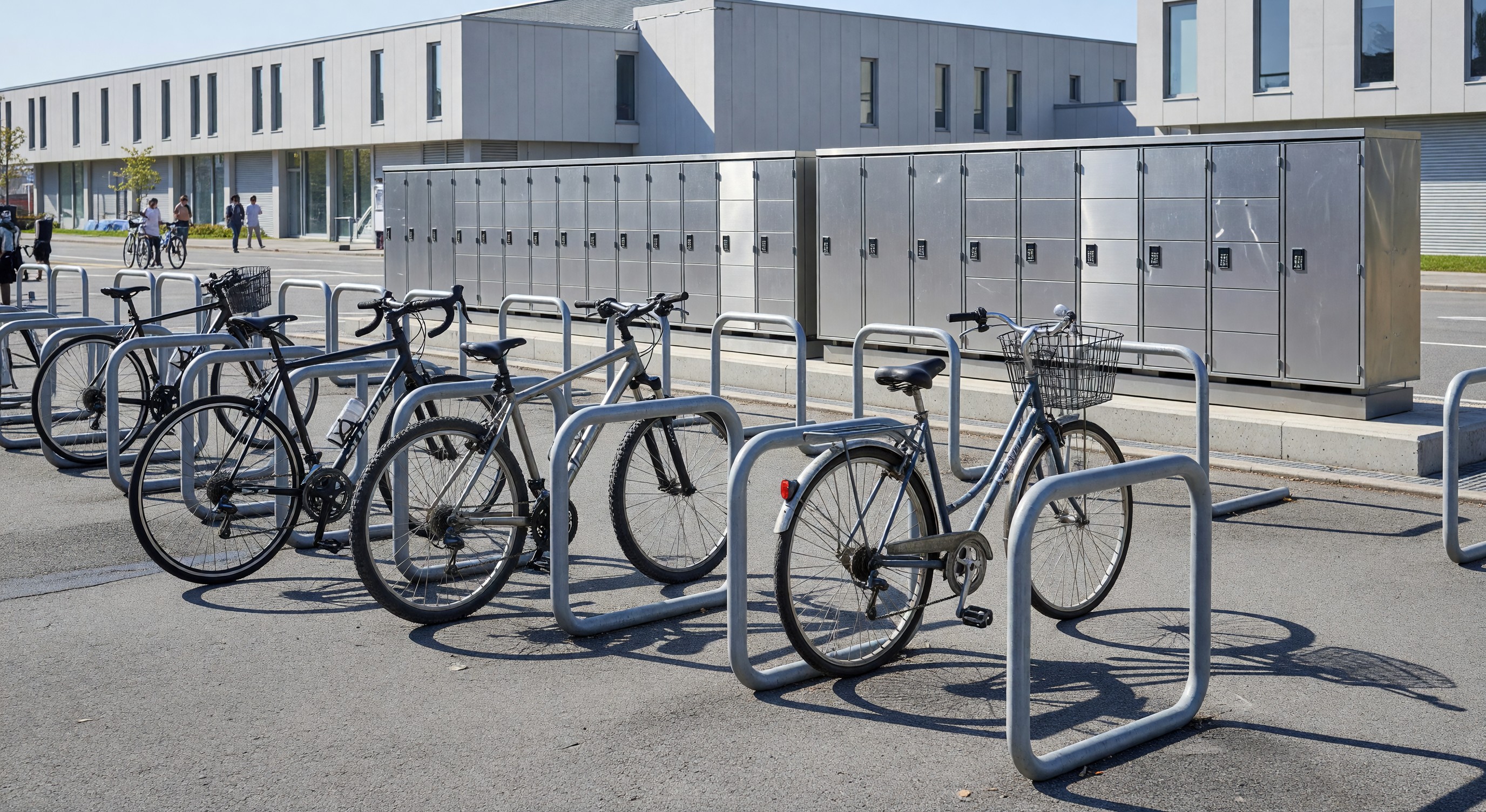
Bicycle parking is an underspecified element of most parking facility designs — an afterthought relegated to a few racks near the entrance, often poorly positioned, inadequately lit, and exposed to weather. Yet bicycle parking quality directly affects mode choice: people who might otherwise ride to work, school, or retail destinations will drive if bicycle parking is difficult to access, insecure, or uncomfortable. As cycling mode share grows in North American cities and TOD development emphasizes multimodal access, bicycle parking design deserves the same rigor applied to vehicle parking.
The Association for Bicycle and Pedestrian Professionals (APBP) Standards
The Association for Bicycle and Pedestrian Professionals (APBP) publishes the Essentials of Bike Parking guide, which is the primary design reference for bicycle parking in North America. Key APBP principles:
- Two-point support: Preferred racks support the bicycle at two points — the frame at two locations, or frame and wheel — to prevent tipping. Single-point wheel support (“wheel bender” or toast racks) deforms wheels and is explicitly not recommended by APBP.
- Lockable: The rack must allow a U-lock or chain to secure both the frame and rear wheel to the rack structure.
- Independent: Each bicycle space should be usable independently of adjacent spaces — a bicycle should be lockable and retrievable without moving neighboring bikes.
- Space efficiency: Racks should accommodate a bicycle with fenders, panniers, and child seats without interference.
Rack Types
Inverted-U rack (staple rack): The most recommended rack type for general use. A single U-shaped tube anchored at both ends to the ground. Provides two lockable contact points on the frame; supports are independent for each bicycle. Cost-effective, durable, and widely recognized by cyclists. Minimum spacing of 30 inches on center between racks (APBP recommends 48 inches for comfortable simultaneous use by adjacent users).
Hoop rack: Similar to the inverted-U but with a circular profile. Functionally equivalent. Used in architecturally sensitive contexts where the hoop profile is aesthetically preferred.
Post-and-ring rack: A vertical post with a locking ring at the top. Supports one bicycle per rack. Less space-efficient than inverted-U but compact footprint; used in constrained urban locations.
Comb/grid racks (wave racks): A series of uniform wave-profile tubes at ground level. These hold multiple bicycles and are space-efficient, but bicycles of different frame sizes do not always fit well, and they typically support only the front wheel — violating APBP two-point contact guidance. Not recommended for primary bicycle parking.
Vertical post systems: Racks that support the bicycle in a vertical orientation (rear wheel up). Space-efficient in constrained locations but difficult to use for heavy bicycles, cargo bikes, or riders with limited upper body strength. APBP recommends supplementing vertical systems with some horizontal-access spaces.
Quantity Standards
Bicycle parking quantity requirements are established by local zoning codes and vary widely. NACTO’s Urban Street Design Guide, the APBP Essentials guide, and the National Association of City Transportation Officials recommend:
- Retail: 1 to 4 spaces per 1,000 square feet of floor area
- Office: 1 space per 5 to 10 employees or per 4,000 to 5,000 square feet
- Residential: 1 to 1.5 spaces per unit
- Transit stations: 1 space per 10 to 20 daily boardings
Short-term bicycle parking (racks for visits of a few hours or less) should be at the most visible, accessible, weather-protected location nearest the primary building entrance. Long-term parking (racks or secure storage for commuters leaving bicycles all day) can be located further from entrances but should be in a secure, sheltered area.
Lockers and Secure Rooms
For commuters and others leaving bicycles for extended periods, the security and weather protection of open racks is inadequate. Lockers and secure rooms provide the higher protection standard appropriate for long-term parking.
Bicycle lockers: Prefabricated enclosures that accommodate one bicycle each (standard dimensions: approximately 6 feet long × 2.5 feet wide × 4 feet tall). Available in single-access or pass-through (two-sided access) configurations. Key, combination, or smart-card controlled. Durable steel construction with ventilation for humidity control. Lockers are appropriate for locations without space or demand for a full secure room.
Secure bicycle rooms: Enclosed rooms accessible by key card or combination, containing rack storage. Best for transit stations, large office buildings, and universities where many commuters need long-term daily bicycle storage. Rooms should include:
- CCTV coverage
- Motion-activated lighting at minimum 10 fc
- Repair stand and basic tool station (air pump, wrenches)
- Clothing hooks and a bench for gear management
- Ventilation for humidity and odor control
- Accessible entry (35-inch clear minimum doorway)
Bicycle room rack density can use double-decker vertical racks to maximize storage in constrained rooms. Allow minimum 24-inch aisles between rack rows; 48 inches is preferred.
Weather Protection
Covered bicycle parking dramatically increases use compared to uncovered racks. Even a simple roof structure over rack areas increases utilization in rainy climates. Covered bicycle parking is required for long-term spaces under many green building certification programs (LEED, SITES).
Preferred location for covered bicycle parking is in an area sheltered by the building overhang, under a dedicated canopy, or in a covered garage entry area — not in an exposed corner of the site.
LEED and Green Building Credits
LEED BD+C v4 offers Sustainable Transportation credits for bicycle parking. Credit requirements:
- Provide short-term bicycle storage for 2.5 percent of all building peak users
- Provide long-term bicycle storage for 5 percent of all regular building occupants
- Provide shower and changing facilities at a ratio of 1 per 100 regular occupants using long-term bicycle storage
These thresholds are achievable in most commercial buildings and represent meaningful minimum standards for bicycle parking program design.
Frequently Asked Questions
What is the APBP recommended rack type for bicycle parking? The inverted-U (staple) rack is the most recommended general-purpose bicycle rack per APBP Essentials guidelines. It supports the bicycle at two contact points, allows frame locking with a U-lock, and permits independent use by adjacent cyclists.
How much space does each bicycle parking stall require? An inverted-U rack at 48-inch center-to-center spacing provides 2 bicycle spaces (one per side) in approximately 24 square feet. APBP minimum spacing is 30 inches on center; 48 inches allows comfortable simultaneous use by cyclists at adjacent positions.
When should a secure bicycle room be provided instead of racks? Secure bicycle rooms are appropriate for commuter destinations — office buildings, transit stations, universities — where cyclists leave bicycles unattended for extended periods. Rooms with card access, CCTV coverage, and enclosed storage address security concerns that open racks cannot meet.
Do bicycle parking spaces count toward vehicle parking requirements? In most jurisdictions, they do not directly substitute for vehicle parking. However, many cities allow reduction in vehicle parking minimums when high-quality bicycle parking and amenities are provided. Check local zoning for applicable provisions.
Takeaway
Bicycle parking designed to APBP standards — with two-point-contact racks, weatherprotection, independent access, and appropriate security levels for short- and long-term uses — meaningfully increases cycling mode share for destinations that get it right. Facilities that invest in secure bicycle rooms, covered racks at convenient locations, and shower amenities for commuters consistently outperform those that treat bicycle parking as a minimum-compliance exercise. As cities continue to invest in cycling infrastructure and as LEED and green transportation goals become more central to development programs, bicycle parking quality is an increasingly important factor in facility design.
Further Reading from Authoritative Sources
- NACTO urban street design guidance for bicycle facilities — NACTO (National Association of City Transportation Officials) publishes the Urban Street Design Guide and Urban Bikeway Design Guide, which are the primary design references for bicycle infrastructure in North American cities and directly relate to the bicycle parking context described in the article.
- FHWA bicycle and pedestrian program design resources — The Federal Highway Administration’s Bicycle and Pedestrian Program publishes design guidance and standards that inform bicycle parking requirements at federally funded facilities and provide authoritative benchmarks for the design standards referenced throughout the article.