Accessible parking is not a discretionary amenity — it is a legal requirement governed by the Americans with Disabilities Act of 1990 and its subsequent revisions, including the 2010 ADA Standards for Accessible Design. For parking facility owners, designers, and operators, understanding exact dimensional requirements, signage standards, and route obligations is essential to avoid enforcement actions and, more importantly, to serve the 26 percent of American adults who live with some form of disability.
Required Number of Accessible Spaces
The 2010 ADA Standards (Section 208) establish a ratio-based minimum count for accessible spaces. For parking lots and structures:
- 1 to 25 total spaces: 1 accessible space required
- 26 to 50 total: 2 required
- 51 to 75 total: 3 required
- 76 to 100 total: 4 required
- 101 to 150 total: 5 required
- 151 to 200 total: 6 required
- 201 to 300 total: 7 required
- 301 to 400 total: 8 required
- 401 to 500 total: 9 required
- 501 to 1,000 total: 2 percent of total
- 1,001 and over: 20 plus 1 for each 100 over 1,000
Of the required accessible spaces, at least 1 in every 6 must be van-accessible. Facilities with fewer than 6 required accessible spaces must provide at least 1 van-accessible space. Medical facilities must provide a higher ratio: 10 percent of patient and visitor parking must be accessible.
Stall Dimensions: Standard and Van-Accessible
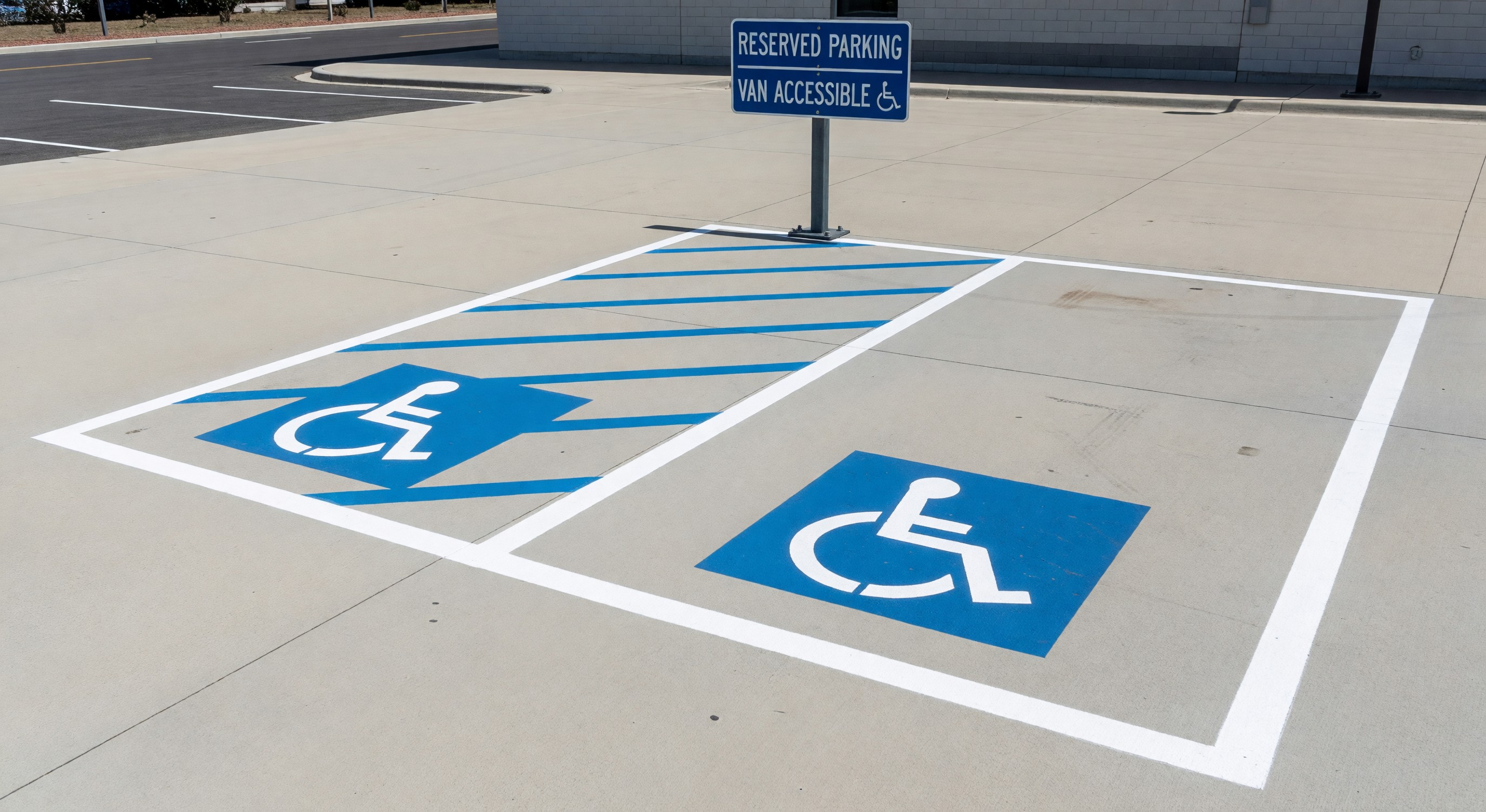
Standard accessible stalls must be at least 8 feet wide with an adjacent access aisle of at least 5 feet. The access aisle must be at the same grade as the stall and must connect to an accessible route leading to the building entrance. Two accessible stalls may share a single access aisle, which is a common space-saving layout.
Van-accessible stalls must be at least 11 feet wide (or 8 feet wide with a 8-foot access aisle on the passenger side). The additional width accommodates wheelchair lift deployment. Vertical clearance through the accessible route and within the van-accessible space itself must be at least 8 feet 2 inches — the ADA requirement — though many designers use 9 feet to accommodate newer, taller accessible vehicles and to future-proof the facility.
All accessible parking spaces must be on the shortest accessible route from parking to the accessible building entrance. When a parking facility serves multiple building entrances, accessible spaces must be dispersed to provide the shortest routes to each entrance. This dispersal requirement means large surface lots often need accessible spaces in multiple locations rather than clustered in one ADA section.
Surface and Grade Requirements
The surface within accessible stalls, access aisles, and accessible routes must be stable, firm, and slip resistant. Cross slopes within accessible stalls and access aisles may not exceed 1:48 (approximately 2 percent) in any direction. Longitudinal slopes on accessible routes may not exceed 1:20 (5 percent) without being classified as a ramp, which triggers additional standards.
Drainage inlets, utility covers, and expansion joints within accessible stalls or on accessible routes must be flush with the surrounding surface and oriented to prevent wheelchair wheels from dropping into grooves. Gratings with elongated openings oriented perpendicular to the direction of travel are prohibited.
Signage Requirements
Each accessible parking space must be marked with the International Symbol of Accessibility (ISA), the universal blue wheelchair symbol on a white background. Signs must be mounted on a post or wall so the bottom of the sign is between 60 and 66 inches above the finish floor — a height that keeps the sign visible above parked vehicles.
Van-accessible spaces require an additional “Van Accessible” designation below the ISA on the same sign. Both the ISA and Van Accessible designations must meet color contrast requirements. The sign mounting location should be at the head of the stall, not the side, to ensure visibility from the access aisle.
Where local or state law imposes fines for illegal parking in accessible spaces, a fine notification sign must be posted at the facility entrance or at each accessible space, per applicable state law. California, for example, requires the fine amount to appear on accessible space signs.
Accessible Routes from Parking to Building
An accessible route must connect every accessible parking space to the accessible entrance it serves. The route must have a minimum clear width of 44 inches (36 inches in some configurations), a cross slope not exceeding 2 percent, and surface meeting the stability and slip-resistance criteria above.
Where the accessible route crosses a vehicular drive aisle, a marked crosswalk must be provided. Curb ramps are required wherever the accessible route transitions between grades; they must have a slope not exceeding 1:12 (8.3 percent) and detectable warning surfaces (truncated domes) at the transition to the vehicular way.
Covered parking structures must provide access to vertical transportation (elevators or ramps) on the accessible route. Stairways alone are not acceptable as accessible vertical circulation.
Common Compliance Failures
Enforcement actions under the ADA and Title II/III compliance programs most commonly cite: insufficient number of van-accessible spaces; cross slopes exceeding 2 percent in accessible stalls or aisles; inaccessible routes from parking to building (steps, excessive slope, poor surface); and missing or incorrectly mounted signage.
Periodic self-audits — at least annually and after any resurfacing or restriping — are the practical standard for maintaining compliance. The Access Board provides free technical assistance and design guidance documents at access-board.gov.
Frequently Asked Questions
What is the difference between an accessible space and a van-accessible space? A van-accessible space provides an 8-foot access aisle (versus 5 feet for standard accessible spaces) and at least 8 feet 2 inches of vertical clearance throughout the accessible route. Van-accessible spaces accommodate wheelchair lift deployment from the side of a van.
Can two accessible stalls share one access aisle? Yes. Two adjacent accessible stalls may share a single 5-foot access aisle between them. Van-accessible spaces must have an 8-foot access aisle on the passenger side.
How often should accessible parking compliance be checked? At minimum, audit after any resurfacing, restriping, or lot reconfiguration. Annual audits are best practice. Focus on stall counts, aisle widths, cross slopes, and signage mounting heights.
Do medical facilities have higher accessible parking requirements? Yes. The ADA requires that 10 percent of patient and visitor spaces in medical facilities be accessible, which is significantly higher than the standard ratio that applies to most facilities.
Takeaway
Accessible parking design requires precision across multiple dimensions: stall count, stall size, access aisle width, surface grades, signage placement, and the quality of the accessible route connecting parking to building entrances. The 2010 ADA Standards for Accessible Design and the Access Board’s technical guidance documents are the authoritative references. Compliance is not a one-time certification — changes to lot layout, resurfacing, and restriping all create opportunities for non-compliance that only systematic auditing will catch.
Further Reading from Authoritative Sources
- US Access Board ADA guides on accessible parking requirements — The US Access Board is the federal agency that develops and maintains the ADA Accessibility Guidelines.
- ADA requirements for accessible parking spaces — ADA.gov is the official US government site for ADA information and is directly relevant to the article’s focus on the Americans with Disabilities Act requirements governing accessible parking dimensions, counts, and routes.